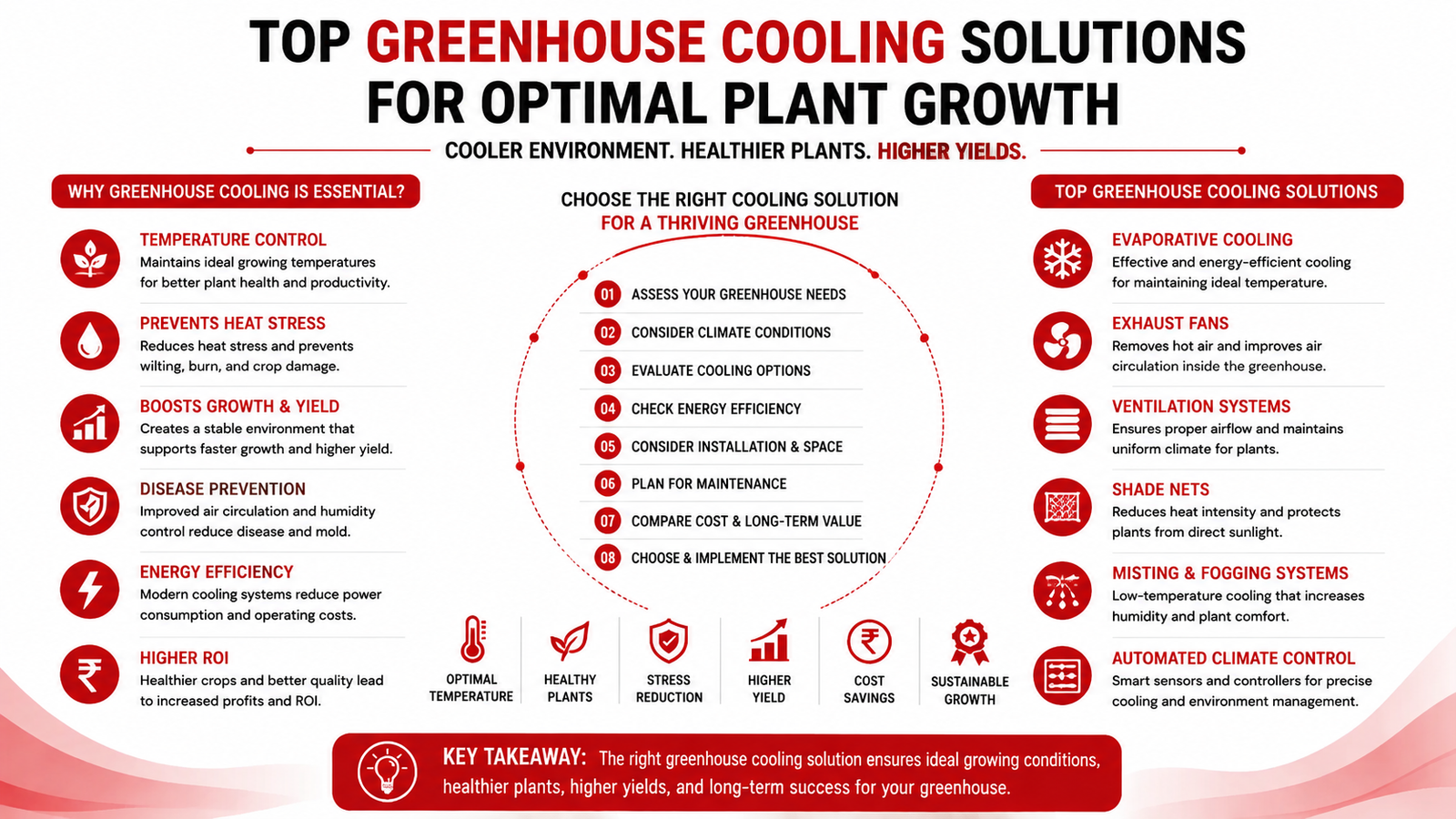
Top Greenhouse Cooling Solutions for Optimal Plant Growth
Shop the Best Greenhouse Cooling Solutions for India's Hot Climates
Indian greenhouses often trap heat far beyond outside temperatures, turning a controlled growing environment into a stress zone for plants during summer. The right greenhouse cooling solutions keep internal temperature within the 20-28°C range that most crops need for healthy photosynthesis, flowering, and fruiting. Megastar Coolers Pvt. Ltd., a Delhi-based manufacturer, builds and supplies these systems directly from its own factory to greenhouse growers across India — cutting out dealer margins and delivering engineering support backed by 1,000+ successful installations nationwide.
Understanding the Importance of Temperature Control in Greenhouses
Polyhouses and greenhouses trap solar radiation under their covering material, which can push internal temperature 8-15°C higher than outside air on a sunny day. Once temperature crosses 32-35°C, most vegetable and flower crops experience reduced photosynthetic efficiency, poor pollen viability, and slower growth.
Uncontrolled heat inside a greenhouse leads to:
- Flower and fruit drop in tomato, capsicum, and cucumber crops
- Reduced yield and smaller produce size
- Increased pest and disease pressure due to stagnant, humid air pockets
- Wilting and water stress even with adequate irrigation
This is why greenhouse cooling is treated as core infrastructure by commercial growers, not an optional add-on.
Top Greenhouse Cooling Systems for Hot Climate Regions in India
For regions like Rajasthan, Gujarat, Haryana, and Maharashtra where summer temperatures regularly cross 40°C, growers rely on a combination of:
- Cooling pad and exhaust fan systems — the most widely used active cooling method for commercial polyhouses
- Centralized duct cooling systems — ideal for large, multi-span greenhouses needing uniform temperature distribution
- HVLS fans — improve air circulation and reduce hot pockets near the greenhouse roof
- Shade net integration — reduces direct solar load before it enters the structure
Megastar Coolers designs each system around your greenhouse span, crop type, and regional climate rather than offering a fixed, generic size.
How Greenhouse Cooling Helps Increase Crop Yield & Plant Health
A well-cooled greenhouse directly protects the biological processes plants depend on for growth:
- Stable photosynthesis rates, since most crops perform best between 20-28°C
- Better pollination and fruit set, as excess heat reduces pollen viability in crops like tomato and capsicum
- Reduced transpiration stress, allowing plants to use irrigation water more efficiently
- Improved produce quality and shelf life, since heat-stressed crops often show smaller size and uneven ripening
Growers using properly sized greenhouse cooling systems typically report more consistent yield across summer cycles compared to naturally ventilated structures.
Key Benefits of Installing a Greenhouse Cooling System
- Extends the growing season by making summer cultivation viable for heat-sensitive crops
- Reduces crop loss during heat waves
- Lowers dependency on excess irrigation used to compensate for heat stress
- Improves working conditions for farm labor inside the structure
- Protects long-term ROI on high-value crops like exotic vegetables, cut flowers, and nursery saplings
Common Challenges in Greenhouse Cooling
- Uneven temperature distribution in long or multi-span structures
- High humidity buildup when ventilation is inadequate
- Water quality issues affecting cooling pad lifespan
- Energy cost concerns when using inefficient or oversized equipment
- Poor structure orientation increasing solar heat gain
Addressing these challenges requires choosing the correct combination of passive design and active cooling equipment, not relying on a single method alone.
Passive Cooling Techniques for Greenhouses
Passive methods reduce heat load before active cooling systems even switch on:
- Proper greenhouse orientation to minimize direct afternoon sun exposure
- Reflective or diffused covering materials
- Natural ventilation through roof vents and side curtains
- Strategic plant spacing to improve internal airflow
Passive techniques work best when combined with active systems rather than used as a standalone solution in extreme heat regions.
Active Cooling Systems: Fans and Ventilation
Active systems mechanically move air to remove heat and humidity faster than natural airflow allows. Exhaust fans paired with greenhouse cooling pad systems create negative pressure that pulls cooled air across the entire structure, while HVLS fans keep air moving to prevent stagnant hot zones near the roof. This combination is the standard for commercial-scale Indian greenhouses.
Evaporative Cooling: How It Works and Its Benefits
Evaporative cooling remains the most energy-efficient active cooling method for large greenhouse structures. Hot outside air passes through a water-saturated greenhouse cooling pad, drops in temperature by 8-12°C through evaporation, and is then drawn across the growing area by exhaust fans.
Key benefits include:
- Up to 80% lower energy consumption compared to refrigerant-based cooling for the same air volume
- No harmful refrigerants, making it safer for food-crop environments
- Simultaneous humidity control, which benefits many horticultural crops
- Lower operating cost per square meter compared to mechanical AC systems
Shade Cloths and Their Role in Temperature Regulation
Shade nets reduce direct solar radiation before it heats the greenhouse interior, cutting the cooling load that fans and pads need to manage. Combining shade cloths with a greenhouse cooling system reduces overall energy consumption and extends equipment lifespan by lowering peak-load stress during the hottest hours of the day.
The Use of Misting Systems for Humidity Control
Misting systems add fine water droplets directly into the greenhouse air, offering supplementary cooling for crops that need higher humidity alongside temperature control, such as certain ornamentals and nursery plants. Misting works well as a secondary system alongside pad-and-fan cooling but is generally less effective as a standalone solution in very hot, dry regions.
How to Maintain Ideal Temperature in a Commercial Greenhouse
- Set cooling systems to activate before peak afternoon heat, not after crop stress signs appear
- Monitor temperature at multiple points across the structure, not just near the entrance
- Adjust water flow to cooling pads based on outside humidity and temperature
- Combine shade netting with active cooling during extreme heat months
- Ensure exhaust fans and pad systems are correctly sized for the greenhouse floor area
Insulation Strategies for Energy Efficiency
Proper covering material selection, sealed joints, and reduced air leakage all help maintain consistent internal temperature with less strain on cooling equipment. Reducing unwanted heat gain through the structure directly lowers the load on your greenhouse cooling solutions, improving both performance and electricity costs.
Signs Your Greenhouse Needs a Better Cooling System
- Wilting or leaf curling during peak afternoon hours despite adequate watering
- Uneven crop growth between different sections of the greenhouse
- Reduced flowering or fruit set during summer months
- Existing cooling pads showing reduced efficiency after 2-3 seasons of use
- Persistent high humidity leading to fungal or disease pressure
How to Choose the Right Greenhouse Cooling System for Your Farm
Factors to Consider Before Buying or Installing a Greenhouse Cooling System
- Greenhouse size and span — determines required airflow capacity and pad area
- Crop type — different crops have different optimal temperature and humidity ranges
- Regional climate — dry heat regions benefit most from evaporative cooling; humid regions need additional ventilation planning
-
Water availability and quality
, since cooling pad performance depends on consistent water supply - Build quality, particularly FRP cabinets and pad frames that resist corrosion in humid growing environments
- Manufacturer support, including installation guidance and pad replacement service
When comparing greenhouse cooling solutions manufacturers, prioritize companies that offer site-specific system sizing over fixed, one-size-fits-all packages — undersized systems fail to cool larger spans effectively, while oversized systems waste energy and capital.
Smart Technology in Greenhouse Cooling Solutions
Modern systems increasingly use automated sensors to monitor temperature and humidity in real time, switching fans and water pumps on or off based on actual greenhouse conditions rather than fixed timers. This reduces both energy consumption and manual monitoring effort, while maintaining more stable growing conditions across the full crop cycle. Megastar Coolers incorporates these advancements into its industrial cooling range, engineered specifically for Indian voltage conditions and water quality.
Greenhouse Cooling Maintenance Tips for Long-Term Performance
- Clean the greenhouse cooling pad every 15-20 days during peak season to prevent algae and dust blockage
- Flush water tanks and pipelines regularly to reduce mineral scaling
- Inspect fan motors and belts monthly for wear
- Replace cooling pads every 2-3 years depending on water hardness and usage
- Check for air leaks around doors and vents that reduce cooling efficiency
Why Choose Megastar Coolers for Your Greenhouse Cooling Requirements
- Direct-from-factory manufacturing in Delhi — no dealer markup added to your price
- Trusted by 1,000+ clients across warehouses, factories, greenhouses, and poultry farms in India
- Custom-engineered systems based on greenhouse span, crop type, and regional climate
- Durable greenhouse cooling pad media and heavy-duty industrial-grade cabinets built for long service life
- Complete product range — cooling pad systems, HVLS fans, and centralized duct cooling — under one roof
- Recognized among leading greenhouse cooling solutions suppliers for on-ground installation and maintenance support
Contact Megastar for Greenhouse Cooling Solutions at the Best Price
Get a custom quote based on your greenhouse size, crop type, and location. As a Delhi-based manufacturer serving 1,000+ clients pan-India, Megastar Coolers delivers factory-direct pricing with no middleman markup.
Get Your Free Quote Today — talk to our engineering team and protect your crop this summer.