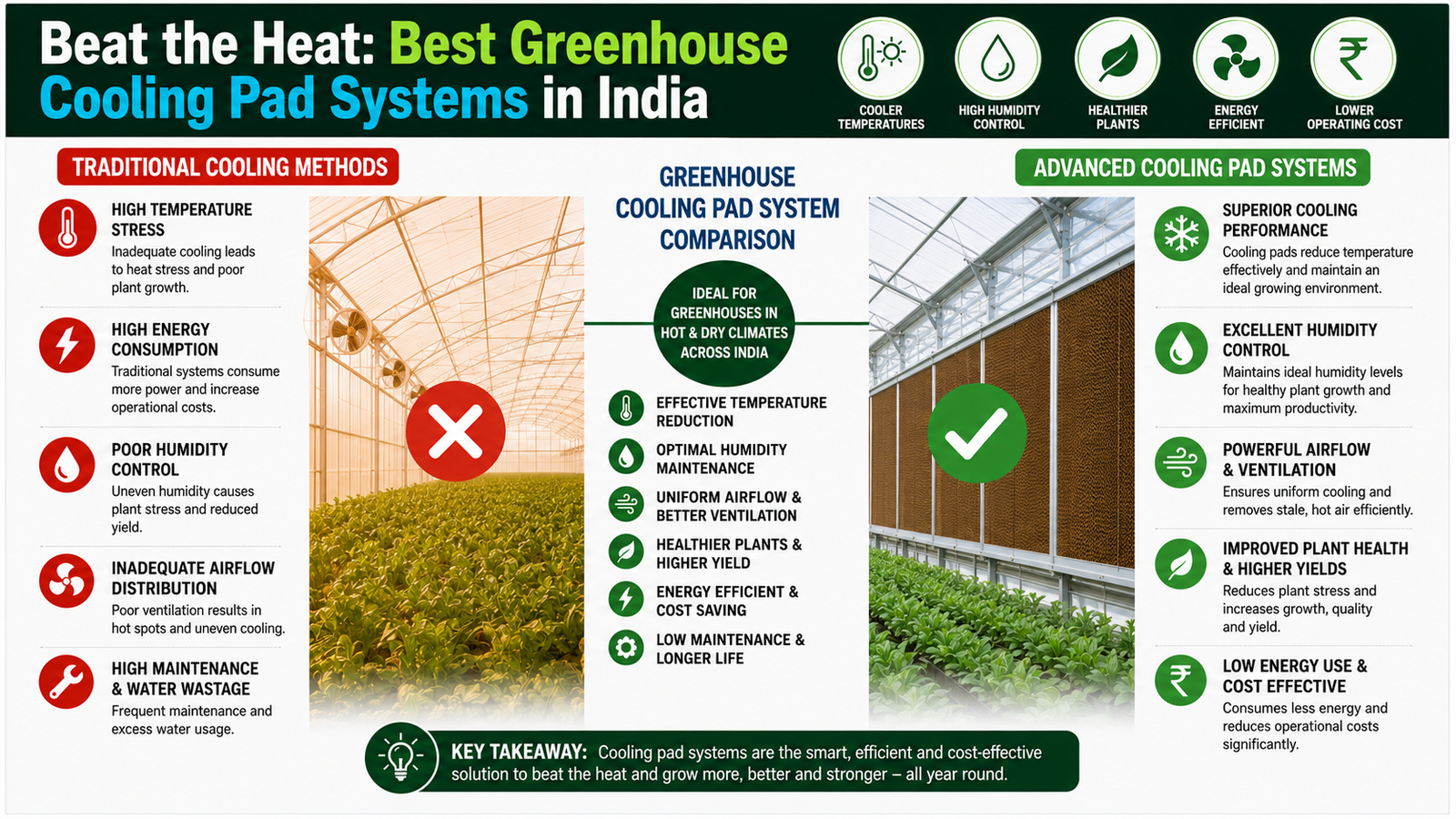
Beat the Heat: Best Greenhouse Cooling Pad Systems in India
Shop the Best Greenhouse Cooling Pad System at the Best Price in India — Megastar Coolers Pvt. Ltd.
Looking for a reliable, energy-efficient Greenhouse Cooling Pad System to protect your crops from intense summer heat? Megastar Coolers Pvt. Ltd. manufactures and supplies high-performance greenhouse cooling solutions trusted by 1000+ agricultural and industrial facilities across India. Get the right system for your polyhouse, greenhouse, or commercial farm — at a competitive factory price, with full installation support.
What Is a Greenhouse Cooling Pad System & How Does It Work?
A Greenhouse Cooling Pad System is an evaporative cooling solution specifically engineered for enclosed growing environments like polyhouses, greenhouses, and commercial nurseries. It uses the natural principle of evaporative cooling — the same process that makes you feel cooler near a waterfall — to bring down indoor temperatures efficiently and affordably.
Here is how it works in three simple steps:
- Water flows over cellulose or cross-fluted cooling pads installed on one wall of the greenhouse.
- Exhaust fans on the opposite wall pull hot outside air through the wet pads. As hot, dry air passes through the saturated pad media, water evaporates and the air temperature drops by 10°C to 15°C.
- Cool, humid air circulates through the entire growing area, maintaining optimal conditions for plant growth.
This pad-and-fan system creates a continuous cross-ventilation effect. It replaces stale, hot air with fresh, cooled air — without the high operating costs of refrigerant-based air conditioning.
Why Air Circulation Is Important in Greenhouse Farming
Inside a closed greenhouse, temperatures can rise 20°C to 30°C above outside ambient levels within hours of sunrise. Without active cooling and ventilation, the consequences are severe:
- Heat stress in plants causes wilting, flower drop, and fruit deformation.
- High humidity stagnation promotes fungal diseases like powdery mildew and botrytis.
- Carbon dioxide depletion near the plant canopy slows photosynthesis.
- Pollinator activity drops sharply above 35°C, reducing fruit set.
- Labour productivity falls when workers operate in extreme heat.
Proper air circulation through a greenhouse cooling pad system addresses all five problems simultaneously. It maintains the temperature-humidity balance that most vegetable, flower, and fruit crops require — particularly during the hottest months from March to July across Indian growing regions.
Top Benefits of Installing a Greenhouse Cooling Pad System
Megastar's Greenhouse Cooling Pad Systems deliver measurable advantages from day one of installation:
Temperature Reduction of 10°C–15°C Evaporative cooling pads consistently bring indoor temperatures down into the 22°C–30°C range even when outdoor temperatures exceed 42°C — keeping crops in the ideal growth zone.
Up to 80% Lower Energy Costs vs. Air Conditioning Evaporative pad systems consume a fraction of the electricity that mechanical refrigeration requires. For large greenhouse areas of 500 sq. m. or more, the savings are substantial across a full cropping season.
Uniform Airflow Across the Entire Growing Area The pad-and-fan configuration creates a single direction of airflow from pad wall to exhaust wall. Every plant row receives consistent cooling — no hot spots, no dead zones.
Improved Crop Quality and Shelf Life Crops grown in temperature-controlled environments produce firmer fruits, brighter colours, and longer shelf life — directly improving your market price and reducing post-harvest losses.
Low Maintenance, Long Service Life High-quality cellulose pads used in Megastar systems are treated to resist algae, mould, and mineral scaling. With basic seasonal maintenance, pads last 5–7 years. The overall system has a service life of 10–15 years.
Easy Scalability Whether you run a 200 sq. m. hobby greenhouse or a 10,000 sq. m. commercial polyhouse cluster, Megastar engineers design a system scaled precisely to your structure and crop requirements.
Cooling Pad vs. Fogging System: Which Is Better for Greenhouses?
Both systems aim to lower greenhouse temperatures, but they work differently and suit different situations. Here is a direct comparison:
| Feature | Cooling Pad System | Fogging System |
|---|---|---|
| Cooling Method | Evaporation through pad media | Fine water mist directly into air |
| Temperature Drop | 10°C–15°C | 5°C–10°C |
| Humidity Control | Consistent, uniform | Can create uneven wet zones |
| Water Consumption | Moderate — recirculated | Higher — mist is lost to air |
| Risk of Leaf Wetness | None — air is cooled before it reaches plants | Moderate — mist can settle on foliage |
| Installation Complexity | Moderate | Low to moderate |
| Maintenance | Seasonal pad cleaning | Frequent nozzle cleaning required |
| Best For | Vegetable crops, floriculture, large polyhouses | Propagation houses, orchid cultivation |
| Energy Efficiency | Very high | High |
| Capital Cost | Moderate | Low to moderate |
Verdict: For most commercial greenhouse operations in India, a Greenhouse Cooling Pad System delivers superior, consistent temperature reduction with lower risk of fungal disease from leaf wetness. Fogging is better suited for propagation or mist-loving specialty crops.
How Greenhouse Cooling Pads Improve Crop Yield & Plant Health
The link between temperature management and crop performance is well-established in horticultural science. Here is what growers across India experience after installing Megastar Greenhouse Cooling Solutions:
Tomatoes & Capsicum: These crops require a day temperature of 22°C–28°C for optimal fruit set. Above 35°C, pollen viability drops sharply, causing flower abortion. Cooling pad systems reliably hold temperatures within the target range, maintaining consistent yields through summer months.
Cucumbers & Bitter Gourd: Cucurbits are highly heat-sensitive at the flowering stage. Temperature control during this phase directly translates to higher fruit counts per plant.
Roses & Gerbera: Premium floriculture requires precise temperature management to achieve export-grade stem length and bloom quality. Cooling pad systems protect floral investments that would otherwise be lost to heat.
Leafy Vegetables: Lettuce, spinach, and herbs bolt (go to seed prematurely) under high heat. Consistent cooling extends the harvestable window and improves leaf texture.
Seedling Nurseries: Young transplants are the most heat-sensitive stage of any crop. Cooling pad systems in nursery greenhouses dramatically reduce seedling mortality rates.
In practical terms, growers consistently report 20%–35% improvements in marketable yield after installing an evaporative greenhouse cooling system — alongside a significant reduction in crop losses during peak summer.
Best Greenhouse Cooling Solutions for Hot Indian Summers
India's agricultural belt spans diverse climatic zones — from the dry heat of Rajasthan and Gujarat to the humid summers of Maharashtra and Andhra Pradesh. A single cooling solution does not fit all environments.
Megastar Coolers designs greenhouse cooling solutions specific to your location:
High-Dry Heat Zones (Rajasthan, Gujarat, MP): Evaporative cooling is most effective in low-humidity conditions. A 100mm or 150mm thick cooling pad paired with high-CFM exhaust fans achieves maximum temperature drop in these regions. This is where evaporative technology performs at its best.
Humid Coastal & Semi-Arid Zones (Maharashtra, AP, Telangana): In areas with higher ambient humidity, pad selection and fan speed control become critical. Megastar engineers size systems to achieve the best possible cooling even where the psychrometric conditions are less ideal.
High-Altitude Growing Areas (Himachal, Uttarakhand, Northeast): Greenhouses in cooler zones primarily need ventilation rather than aggressive cooling. A lighter pad system with controllable fan speeds provides flexibility across seasons.
Regardless of your location, Megastar's engineering team conducts a site-specific thermal load calculation before recommending any system. You never receive a generic, off-the-shelf design.
Signs Your Greenhouse Needs a Cooling Pad System
If you observe any of the following in your greenhouse operations, it is time to invest in a professional cooling pad system:
- Indoor temperatures exceed 35°C during daytime hours between March and October.
- Flower or fruit drop is unexplained by pest or disease activity — heat stress is likely the cause.
- Workers can only operate for short periods before heat exhaustion forces breaks.
- You rely on manual water spraying or primitive shade netting as your only cooling method.
- Crop diseases like powdery mildew recur frequently — stagnant, hot air accelerates fungal spread.
- Yield during summer months is significantly lower than during cooler seasons.
- You already use a fogging system but find it insufficient for large-scale temperature reduction.
Any one of these signals justifies a cooling pad investment. All six together represent a critical, urgent need.
How to Choose the Right Cooling Pad Thickness for Your Greenhouse
Cooling pad thickness is the single most important specification decision. It directly determines how much temperature drop your system achieves.
100mm (4-inch) Cooling Pads Suitable for greenhouses in relatively mild climates or where partial cooling is sufficient. Delivers a temperature drop of approximately 8°C–10°C. Lower capital cost, lower resistance to airflow, and slightly higher fan efficiency.
150mm (6-inch) Cooling Pads The standard choice for most Indian commercial greenhouses in hot, dry regions. Delivers a temperature drop of 12°C–15°C. Greater water contact area means more evaporation and more cooling. Slightly more airflow resistance requires appropriate fan sizing.
When to Choose 100mm: Greenhouses in coastal high-humidity zones, where maximum evaporation is limited by ambient moisture, or where budget is a primary constraint.
When to Choose 150mm: Greenhouses in hot, dry inland regions (Rajasthan, Gujarat, Maharashtra interior, Karnataka Deccan) where maximum cooling is the priority. Any greenhouse larger than 1,000 sq. m. where temperature uniformity is critical.
Megastar's technical team calculates the correct pad area, thickness, and fan capacity based on your greenhouse dimensions, crop type, local climate data, and operating hours. Never guess on this specification — under-sized systems fail to cool adequately, while over-sized systems create excessive humidity.
Greenhouse Temperature Control: Why Cooling Pads Matter
Precision temperature control is the foundation of productive greenhouse farming. Here is the temperature range that major greenhouse crops require:
| Crop | Optimal Day Temp | Heat Stress Threshold |
|---|---|---|
| Tomato | 22°C–28°C | Above 35°C |
| Capsicum / Bell Pepper | 20°C–28°C | Above 32°C |
| Cucumber | 22°C–30°C | Above 35°C |
| Rose | 18°C–25°C | Above 30°C |
| Gerbera | 18°C–26°C | Above 32°C |
| Lettuce / Leafy Greens | 15°C–22°C | Above 28°C |
| Strawberry | 15°C–22°C | Above 30°C |
Without active cooling, Indian summer temperatures push well beyond every threshold in this table. A greenhouse cooling pad system is not an optional upgrade — it is the fundamental infrastructure that makes commercial greenhouse farming viable in India from March through October.
How Evaporative Cooling Pads Reduce Heat Stress in Plants
Plants manage heat through transpiration — releasing water vapour through leaf stomata to cool themselves. When air temperature is too high and relative humidity is too low, plants experience heat stress even when water is available. Here is why:
- Stomata close under extreme heat to prevent water loss, which simultaneously stops CO₂ uptake and halts photosynthesis.
- Enzyme activity is disrupted above 35°C, slowing metabolic processes critical to cell growth.
- Pollen viability drops sharply above 32°C–35°C for most fruiting vegetables, directly reducing fruit set.
- Cell membrane damage occurs during sustained exposure to temperatures above 40°C.
Evaporative cooling pads address heat stress at its source. By reducing air temperature to the 22°C–30°C range before it reaches the plant canopy, the system allows stomata to remain open, photosynthesis to proceed normally, and the plant to focus energy on growth and reproduction rather than thermal defence.
Greenhouse Cooling Pad Maintenance Tips for Long Life
A properly maintained Megastar greenhouse cooling pad system will deliver reliable performance for 10–15 years. Follow this maintenance schedule to protect your investment:
Daily (During Operation Season):
- Check water flow distribution across the pad surface — look for dry patches that indicate blocked distributors.
- Inspect the sump pump for debris accumulation.
- Verify fan operation — listen for bearing noise or vibration.
Weekly:
- Clean the water distribution header and nozzles.
- Check water pH and add biocide treatment if algae growth is visible.
- Inspect fan belts (belt-driven models) for wear and proper tension.
Monthly:
- Flush the sump tank completely and refill with fresh water.
- Inspect pad frames for corrosion or warping.
- Check electrical connections for the pump and fans.
Seasonal (End of Season Before Shutdown):
- Run a dry cycle for 24–48 hours to fully dry the pad media before storage.
- Apply an approved pad treatment to inhibit scale and biological growth during the off-season.
- Clean and oil fan bearings per the manufacturer specification.
- Inspect pad media for damage — replace any sections that show structural breakdown.
Water Quality Note: Hard water with high mineral content accelerates scaling on pad media. If your water TDS exceeds 500 ppm, Megastar recommends a water softener or bleed-off system to extend pad life.
Common Problems in Greenhouse Cooling Pad Systems & Solutions
Problem: Uneven Cooling — Some Areas Are Still Hot Cause: Insufficient pad coverage area, air leaks in the greenhouse structure, or inadequate fan capacity. Solution: Seal gaps and joints in the greenhouse cladding. Recalculate pad area-to-fan capacity ratio. Megastar's team can audit your existing system and recommend corrective measures.
Problem: Pads Are Not Getting Evenly Wet Cause: Blocked water distribution nozzles or incorrect water flow rate. Solution: Clean distribution headers weekly. Ensure water pump delivers the specified flow rate for your pad area (typically 1.5–2 litres per minute per square metre of pad).
Problem: Strong Musty Odour from the System Cause: Algae or bacterial growth in standing water or on pad media. Solution: Drain and flush the sump. Apply a diluted biocide solution approved for agricultural use. Increase sump flush frequency to twice weekly.
Problem: Cooling Performance Has Declined Over Two or More Seasons Cause: Mineral scale build-up reducing pad porosity and effective evaporative surface. Solution: Descale pads with a mild citric acid solution, or replace pad media if scaling is severe. Consider installing a bleed-off valve to reduce mineral concentration in the circulating water.
Problem: Fan Noise Has Increased Cause: Worn bearings, loose mounting hardware, or belt slippage. Solution: Replace bearings on schedule. Tighten all mounting bolts. Adjust belt tension to manufacturer specification.
Why Farmers Prefer Cooling Pad Systems for Polyhouses
Polyhouse farming has grown rapidly across India as growers seek to achieve year-round production of high-value crops. Cooling pad systems have become the standard ventilation and cooling solution for polyhouses for these specific reasons:
Compatible with Polyhouse Structure: Cooling pads install directly into the polyhouse wall frame with minimal structural modification. The system integrates cleanly with UV-stabilised polyfilm cladding.
Scalable from Small to Large: A 500 sq. m. polyhouse and a 5,000 sq. m. commercial cluster both benefit from the same technology — just scaled appropriately.
Minimal Power Infrastructure: Unlike centralised air conditioning, a pad-and-fan system requires only standard single-phase or three-phase power connections that most agricultural sites already have.
Farmer-Operated: The system is simple enough that trained farm workers can operate and maintain it without specialised HVAC expertise.
Government Subsidy Eligibility: Greenhouse and polyhouse equipment including cooling systems is eligible for subsidy under several national and state horticulture mission schemes. Megastar provides the technical documentation required for subsidy applications.
Proven ROI: With improved yield, reduced crop loss, and lower energy costs compared to mechanical cooling, the payback period for a greenhouse cooling pad system is typically 1–2 growing seasons.
Best Greenhouse Cooling Pad Manufacturers & Suppliers in India
When evaluating greenhouse cooling pad system manufacturers and suppliers in India, assess these five factors:
1. Manufacturing Capability: Does the company manufacture in-house, or resell imported components? In-house manufacturing allows custom sizing, faster delivery, and better quality control.
2. Engineering Support: Can the supplier perform a proper thermal load calculation for your greenhouse, or do they simply supply standard-sized units? Proper sizing is critical to system performance.
3. Pad Media Quality: Are the cooling pads manufactured from high-density cellulose with anti-microbial and anti-algae treatment? Low-cost uncertified pads degrade rapidly.
4. After-Sales Service: Does the company have service technicians available in your region? A cooling system that fails during peak summer requires rapid support.
5. Industry Track Record: How many agricultural and industrial installations has the company completed? Look for documented case studies and verifiable customer references.
Megastar Coolers Pvt. Ltd. satisfies all five criteria — with in-house manufacturing, a dedicated engineering team, certified pad media, a nationwide service network, and 1000+ installations across industrial and agricultural applications.
Why Choose Megastar Coolers for Your Greenhouse Cooling Pad System?
Megastar Coolers Pvt. Ltd. is India's leading manufacturer of industrial evaporative cooling solutions, with a proven track record across warehouses, poultry farms, textile mills, hospitals, schools, and greenhouse operations.
Here is what sets Megastar apart:
In-House Manufacturing Every Megastar Greenhouse Cooling Pad System is designed and built in our own production facility. We control every element of quality — from pad media density and frame fabrication to pump specifications and fan blade geometry. No dependency on third-party components for critical parts.
Site-Specific Engineering Design Our technical team studies your greenhouse dimensions, orientation, crop type, local climate data, and operating schedule before designing your system. You receive a solution engineered for your exact conditions — not a catalogue product adapted to your site.
High-Performance Cellulose Pad Media Megastar uses cross-fluted, high-density cellulose pads treated for anti-algae, anti-mould, and anti-scale performance. Our pads deliver consistent evaporative efficiency across their full service life.
Complete Turnkey Installation From site survey and thermal calculation to fabrication, supply, installation, and commissioning — Megastar manages the entire project. You deal with one accountable partner, not multiple vendors.
Nationwide Service Network With service capability across major Indian states, Megastar provides rapid support for any operational issue — critical protection during the summer peak when your crops depend on uninterrupted cooling.
Trusted by 1000+ Industries Across India Our cooling solutions operate in some of India's most demanding environments — industrial plants where temperatures soar above 50°C, poultry farms that need precise temperature control year-round, and commercial greenhouses where a single day of overheating can destroy an entire crop cycle.
Competitive Factory-Direct Pricing Because we manufacture in-house, Megastar eliminates distributor margins and passes those savings to you. You receive a premium-engineered system at a price point that delivers a fast return on investment.
Documentation Support for Government Subsidies Megastar provides all technical specifications and certifications needed for subsidy applications under national and state horticulture schemes.
Frequently Asked Questions
What area does one standard cooling pad unit cover?
Coverage depends on greenhouse height, crop type, and local climate. As a general guide, 1 sq. m. of pad area serves approximately 50–75 sq. m. of greenhouse floor area. Megastar's engineers calculate the exact requirement for your structure.
How much water does the system consume daily?
Water consumption depends on ambient temperature, humidity, and operating hours. As an indicative figure, a 1,000 sq. m. greenhouse system typically consumes 500–1,000 litres per day during peak summer operation.
Does the system work in humid coastal regions?
Yes, though the temperature drop is lower in high-humidity conditions. Megastar sizes systems specifically for local psychrometric conditions to maximise performance in every climate zone.
How long does installation take?
For a standard commercial greenhouse, installation typically takes 3–7 days depending on size and existing infrastructure.
Is the system eligible for any subsidy?
Yes. Greenhouse cooling equipment qualifies under the National Horticulture Mission (NHM) and Rashtriya Krishi Vikas Yojana (RKVY) schemes in most states. Megastar provides the documentation required for your application.
What warranty does Megastar offer?
Megastar offers a standard manufacturer's warranty on all components. Contact our sales team for specific warranty terms applicable to your system configuration.
Contact Megastar Coolers for the Best Price in India
Ready to protect your greenhouse crops from heat stress and maximise your yield this season? Our team is available to assess your requirements, design the right system, and deliver a competitive quote — fast.
Get in touch today:
- Request a Free Site Assessment — our engineers will evaluate your greenhouse and recommend the ideal system.
- Ask for a Custom Price Quote — factory-direct pricing with no hidden costs.
- Speak to a Cooling Expert — our technical team answers every question before you commit.
Megastar Coolers Pvt. Ltd. India's Leading Greenhouse Cooling Pad System Manufacturer & Supplier
Serving greenhouse farmers, polyhouse operators, and agribusinesses across India — including Rajasthan, Gujarat, Maharashtra, Andhra Pradesh, Telangana, Karnataka, Tamil Nadu, Punjab, Haryana, Uttar Pradesh, Madhya Pradesh, and beyond.
Megastar Coolers Pvt. Ltd. — Trusted by 1000+ Industries. Built for Indian Conditions. Engineered for Performance.