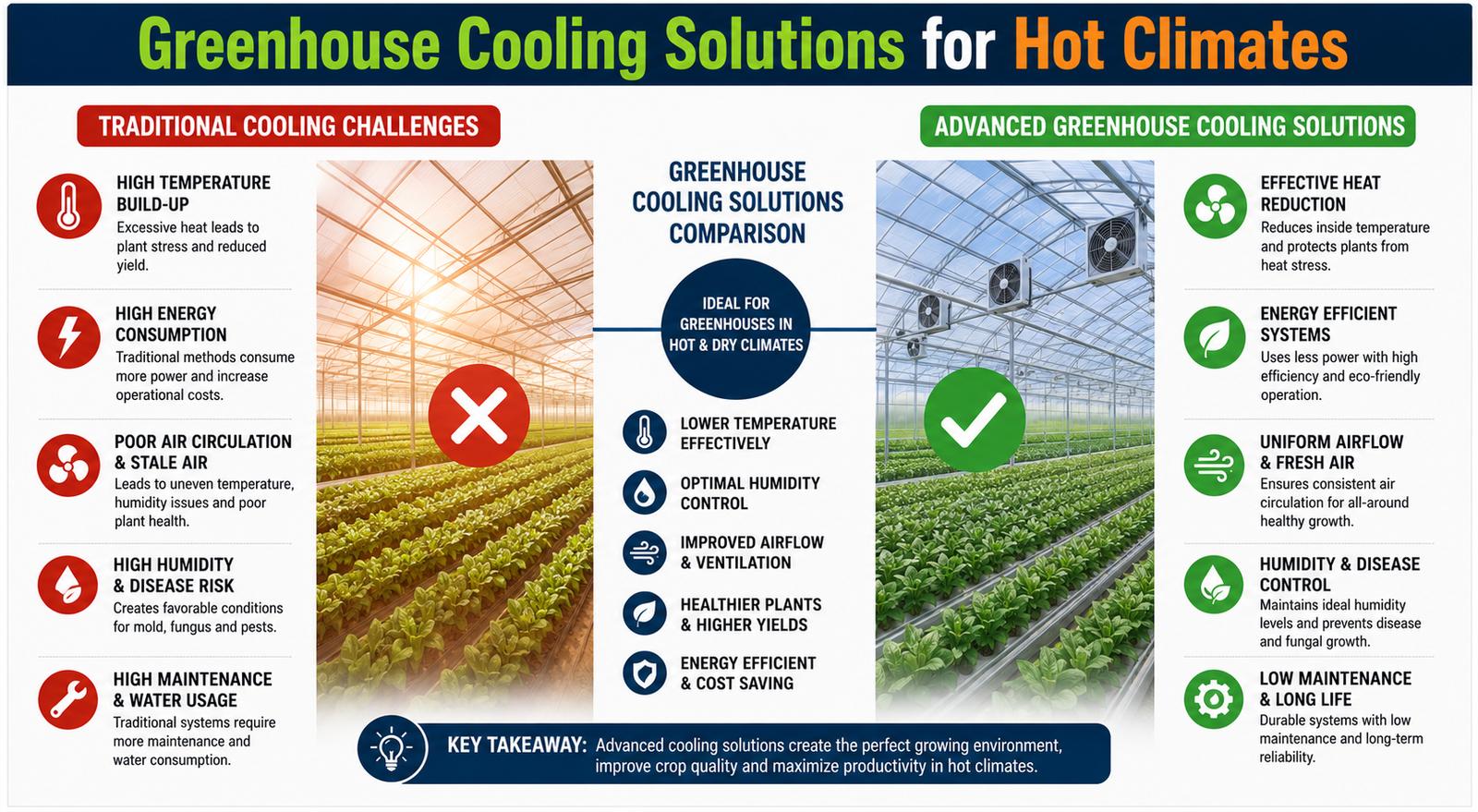
Greenhouse Cooling Solutions for Hot Climates
Advanced Greenhouse Cooling Solutions for Hot Climates
India's greenhouse growers face one of the most punishing challenges in modern agriculture — extreme heat. When outdoor temperatures cross 40°C in states like Rajasthan, Gujarat, Maharashtra, and Punjab, greenhouse interiors can easily reach 50°C or more. At those temperatures, crops wilt, yields drop, and months of investment vanish within days.
The answer is not guesswork. It is a professionally engineered greenhouse cooling solution built for India's climate.
Megastar Coolers Pvt. Ltd. designs and manufactures advanced evaporative cooling and ventilation systems trusted by 1,000+ industries across India — including commercial greenhouses, polyhouses, and nurseries. If your greenhouse suffers from heat stress, poor air circulation, or inconsistent humidity, this guide will help you identify the right system — and make a confident buying decision.
What Are Greenhouse Cooling Solutions & Why Are They Important?
Greenhouse cooling solutions are mechanical and evaporative systems that regulate the internal temperature, humidity, and airflow of an enclosed growing environment. They prevent heat accumulation, remove stale air, and create the stable microclimate that plants need to grow at their best.
Why greenhouse cooling is non-negotiable in India
- Most vegetable crops grow optimally between 18°C and 30°C
- Temperatures above 35°C trigger heat stress, causing flower drop, fruit deformation, and reduced photosynthesis
- Excessive humidity without airflow accelerates fungal disease and pest infestation
- A well-cooled greenhouse can extend the growing season by 2–3 months, particularly through Indian summers
Without active cooling, a greenhouse becomes a heat trap. With the right greenhouse cooling system, it becomes a year-round, high-yield production unit.
Top Greenhouse Cooling Systems for Hot Climate Regions in India
Not all cooling systems perform equally in India's diverse agro-climatic zones. Megastar Coolers offers the following proven solutions, each suited to specific greenhouse sizes, budgets, and temperature conditions.
1. Evaporative Air Coolers (Pad & Fan Cooling System)
The pad and fan system is the most widely used greenhouse cooling method in hot and dry climates. Cooling pads — typically made of cellulose or aspen — are installed on one side of the greenhouse. Industrial exhaust fans are fixed on the opposite side. When fans pull air through the wet pads, evaporation reduces the air temperature by 10°C to 15°C before it enters the crop zone.
Best for: Polyhouses, shade net houses, commercial vegetable and flower farms in arid and semi-arid regions.
Megastar's evaporative coolers are built with corrosion-resistant frames, high-efficiency cellulose pads, and variable-speed motors that consume up to 80% less energy than traditional air conditioning.
2. Industrial Exhaust Fans for Greenhouses
Exhaust fans create negative pressure inside the greenhouse, forcing hot air out and drawing fresh, cooler air in. When used alongside cooling pads or side vents, they form a complete cross-ventilation system.
Best for: Large greenhouses, nurseries, and polyhouses where natural ventilation alone is insufficient.
Megastar's exhaust fans are designed for continuous 24/7 operation, feature weather-resistant blades, and are available in diameters from 18 inches to 60 inches to suit any structure size.
3. HVLS Fans (High Volume Low Speed Fans)
HVLS fans move massive volumes of air at slow speeds, creating a gentle, uniform breeze across the entire greenhouse floor. They work exceptionally well in tall greenhouse structures where air stratification is a problem — hot air accumulates near the roof while plants at ground level receive insufficient circulation.
Best for: Large polyhouses, gutter-connected greenhouses, and farms cultivating tall crops like tomatoes, cucumbers, and capsicum.
4. Duct Air Cooling Systems
Ducted cooling systems distribute cooled air through a network of ducts and vents, ensuring uniform temperature in every zone of the greenhouse. They are ideal for greenhouses that require precise zone-level climate control.
Best for: High-value crops — roses, orchids, strawberries — where temperature variation between zones must not exceed 1°C–2°C.
5. Complete Greenhouse Ventilation Solutions
For large commercial operations, Megastar designs and installs complete greenhouse ventilation and cooling systems — combining evaporative coolers, exhaust fans, HVLS fans, and automated controls into a single integrated solution. This approach delivers the most consistent results and the lowest long-term operating cost.
How Greenhouse Cooling Helps Increase Crop Yield & Plant Health
A controlled greenhouse environment is a direct driver of agricultural productivity. Here is how active cooling delivers measurable results:
| Benefit | Impact on Crops |
|---|---|
| Maintains ideal temperature | Reduces heat stress, supports steady photosynthesis |
| Controls relative humidity | Prevents fungal disease, powdery mildew, and botrytis |
| Improves air circulation | Strengthens plant stems, reduces CO₂ depletion near leaf surfaces |
| Extends growing seasons | Enables summer cultivation of cool-season crops |
| Reduces pesticide use | Stable microclimate minimises pest pressure |
| Increases flowering & fruiting | Consistent temps support successful pollination |
Growers using Megastar's evaporative cooling systems have reported crop yield improvements of 25% to 40% compared to uncooled or passively ventilated greenhouses — particularly for high-value vegetables and cut flowers.
How to Maintain Ideal Temperature in a Commercial Greenhouse
Maintaining the ideal growing temperature in a commercial greenhouse is a multi-system process. Follow this structured approach:
Step 1 — Define your target temperature range. Different crops need different conditions. Tomatoes and capsicum thrive at 22°C–28°C. Roses perform best at 18°C–24°C. Lettuce and leafy greens prefer 15°C–22°C.
Step 2 — Calculate your greenhouse's heat load. Heat load depends on greenhouse volume, roof material, glazing type, sunlight exposure, and the number of plants. Megastar's technical team performs free heat load calculations to recommend the right system capacity.
Step 3 — Install the right cooling and ventilation system. A combination of evaporative coolers and exhaust fans typically handles 90% of greenhouse cooling requirements in India's climate.
Step 4 — Use shade nets or UV-blocking films. Reducing solar radiation through 30–50% shade nets reduces the cooling load and cuts operating costs.
Step 5 — Automate your controls. Thermostat-controlled or timer-based automation ensures your cooling system activates at the right time without manual monitoring.
Step 6 — Monitor and adjust seasonally. Cooling requirements in May are very different from those in October. Review your system performance at the start of each season.
Greenhouse Cooling Solutions: Working, Types, Benefits & Applications
How Evaporative Greenhouse Cooling Works
Evaporative cooling works on a simple thermodynamic principle — when water evaporates, it absorbs heat from the surrounding air. In a pad-and-fan system:
- Water is pumped over cellulose cooling pads
- Industrial fans draw outside air through the wet pads
- Evaporation reduces the air temperature by 10°C–15°C
- Cooled, humidified air flows across the crop zone
- Warm, stale air exits through exhaust fans on the opposite wall
This process is continuous, energy-efficient, and does not use refrigerants — making it the most cost-effective greenhouse cooling method available.
Types of Greenhouse Cooling Systems
| System Type | Cooling Capacity | Energy Use | Best For |
|---|---|---|---|
| Pad & Fan Evaporative Cooling | High | Low | Hot, dry climates |
| HVLS Fans | Moderate | Very Low | Large tall structures |
| Exhaust Fan Ventilation | Moderate | Low | All greenhouse types |
| Duct Air Cooling | Very High | Moderate | High-value crops |
| Combined Systems | Maximum | Low–Moderate | Large commercial operations |
Key Benefits of Installing a Greenhouse Cooling System
Energy efficiency:
- Evaporative coolers use up to 80% less electricity than air conditioning for equivalent cooling effect
- Low operating cost: Once installed, daily operating costs are minimal — primarily water and electricity for fans
- Zero refrigerant use: Environmentally safe cooling that complies with India's sustainability norms
- Extended crop life: Uniform temperature and humidity reduce post-harvest losses
- Higher market value: Better-looking, healthier produce commands premium prices
Applications Across Crop Types
- Vegetable cultivation: Tomatoes, capsicum, cucumber, brinjal, beans
- Floriculture: Roses, gerbera, carnations, orchids, lilies
- Nurseries and propagation units: Seedling trays, grafted saplings, tissue culture plants
- Fruit production: Strawberries, melons, bell peppers
- Herb and medicinal plant cultivation: Basil, aloe vera, lavender
Signs Your Greenhouse Needs a Better Cooling System
Do not wait for crop failure to act. Watch for these early warning signs:
- Wilting during peak hours (11 AM–4 PM) even with irrigation in place
- Leaf curl, tip burn, or bleaching on sensitive crops
- Flower drop or poor fruit set despite healthy plant nutrition
- Visible condensation on roof panels combined with poor air movement
- Recurring fungal outbreaks like downy mildew or botrytis in spite of proper treatment
- Uneven growth patterns — plants near vents growing better than those in the centre
- Worker discomfort — if your farm staff cannot work inside without distress, your crops are suffering too
If you notice two or more of these signs, your current cooling arrangement is inadequate. Contact Megastar's team for a free site assessment.
How to Choose the Right Greenhouse Cooling System for Your Farm
Choosing the right greenhouse cooling solution depends on several factors specific to your farm. Here is a practical decision guide:
Greenhouse Size and Structure
- Small polyhouses (under 500 sq. m.) — wall-mounted evaporative coolers + exhaust fans
- Medium greenhouses (500–2,000 sq. m.) — pad and fan cooling system with HVLS fans
- Large commercial greenhouses (above 2,000 sq. m.) — fully integrated systems with automation
Local Climate Conditions
- Hot & dry (Rajasthan, Gujarat, Maharashtra inland): Evaporative cooling is highly effective — dry air maximises the evaporation rate and temperature drop
- Hot & humid (coastal Maharashtra, Andhra Pradesh, Tamil Nadu): Exhaust fan ventilation + HVLS fans work better; evaporative cooling is less effective in high-humidity zones
- Moderate with seasonal extremes (Punjab, Haryana, UP, MP): Pad-and-fan systems with seasonal adjustments
Crop Sensitivity
High-value or sensitive crops (roses, strawberries, orchids) require more precise temperature control and benefit from duct cooling or automated multi-zone systems. Vegetable crops tolerate a wider range and perform well with standard pad-and-fan systems.
Budget and ROI Expectation
| System Type | Installation Cost | Monthly Operating Cost | Expected Payback Period |
|---|---|---|---|
| Exhaust Fan Ventilation | Low | Very Low | 6–12 months |
| Evaporative Cooler (standalone) | Moderate | Low | 12–18 months |
| Pad & Fan System | Moderate | Low | 12–24 months |
| Complete Integrated System | Higher | Low–Moderate | 18–36 months |
Factors to Consider Before Buying or Installing a Greenhouse Cooling System
Before you place an order or sign an installation contract, verify the following:
1. Manufacturer's experience with agricultural applications General-purpose industrial coolers are not optimised for greenhouse environments. Ensure the manufacturer has direct experience supplying to greenhouses and polyhouses.
2. CFM (Cubic Feet per Minute) rating The cooling system must be sized to achieve at least one full air change per minute in your greenhouse. An undersized system will underperform regardless of its quality.
3. Pad material and quality Cellulose (Celdek) pads outperform aspen pads in longevity and cooling efficiency. Confirm the pad specification before buying.
4. Motor quality and IP rating Greenhouse environments are humid. Motors must carry an IP54 or higher rating to resist moisture ingress and ensure long service life.
5. After-sales support and spare parts availability A cooling system is only as reliable as its service support. Megastar operates a dedicated service network across India with guaranteed spare part availability.
6. Energy consumption vs. cooling output Always evaluate the cooling system on COP (Coefficient of Performance) — how much cooling it delivers per unit of electricity consumed.
7. Installation warranty Insist on a minimum 12-month installation warranty covering all parts and labour.
Greenhouse Cooling Maintenance Tips for Long-Term Performance
A properly maintained greenhouse cooling system delivers 10–15 years of reliable performance. Follow these maintenance practices:
Daily checks:
- Confirm water supply to cooling pads is uninterrupted
- Check fan operation and listen for unusual noise or vibration
Weekly maintenance:
- Inspect and clean water distribution pipes and nozzles
- Check belt tension on belt-driven fans
- Remove dust accumulation from fan blades and guards
Monthly maintenance:
- Clean cooling pads with clean water to remove mineral deposits
- Lubricate motor bearings as per manufacturer recommendation
- Test thermostat and control panel operation
Seasonal maintenance (before summer):
- Replace cooling pads if efficiency has dropped below acceptable levels (typically every 3–5 years)
- Test the full system at maximum load before peak summer demand
- Check all electrical connections and tighten terminals
Annual service:
- Commission a professional inspection by Megastar's service team
- Replace worn belts, bearings, and water pump seals
- Clean and treat water distribution tanks to prevent algae growth
Why Choose Megastar Coolers for Your Greenhouse Cooling Requirements
Megastar Coolers Pvt. Ltd. is not just a product supplier. We are India's trusted cooling infrastructure partner for agricultural, industrial, and commercial applications. Here is what sets us apart:
Manufacturing Excellence
We design and manufacture every product in-house at our ISO-certified facility. This gives us complete control over quality at every stage — from raw material selection to final dispatch.
Proven Track Record
Over 1,000 industries across India — warehouses, poultry farms, greenhouses, textile mills, hospitals, and schools — rely on Megastar systems every day. Our greenhouses customers report consistent performance across seasons, year after year.
Agricultural Specialisation
We understand that greenhouse cooling is not the same as industrial cooling. Our engineering team has designed systems specifically for the agronomic requirements of India's major crops and growing regions.
Full Product Range
From standalone wall-mounted coolers to complete integrated greenhouse climate systems — we supply everything your greenhouse needs under one roof:
- Industrial evaporative air coolers
- Pad and fan cooling systems
- HVLS fans
- Industrial exhaust fans
- Duct air cooling systems
- Complete ventilation solutions
Technical Support & After-Sales Service
Our technical team is available for site assessments, heat load calculations, system design, installation supervision, and after-sales service. We do not disappear after delivery.
Energy-Efficient Design
Every Megastar cooling system is engineered for maximum cooling output at minimum electricity consumption — reducing your operating costs and your carbon footprint simultaneously.
Competitive & Transparent Pricing
We offer factory-direct pricing with no hidden charges. Our team provides detailed quotes with complete product specifications so you know exactly what you are buying.
Contact Megastar for Greenhouse Cooling Solutions at the Best Price
Your greenhouse deserves a cooling system that works as hard as you do.
Whether you manage a 500 sq. m. polyhouse or a 10,000 sq. m. commercial greenhouse, Megastar Coolers Pvt. Ltd. has a solution engineered for your specific needs, climate, and crop.
Get in touch today for:
- Free heat load calculation for your greenhouse
- Expert product recommendation based on your crops and climate zone
- Factory-direct pricing with no middleman markup
- Fast delivery and professional installation support across India
📞 Call us now to speak directly with our greenhouse cooling specialists. 📧 Send us your greenhouse dimensions and location — we will send you a complete system recommendation within 24 hours. 🌐 Visit our website to explore our full range of greenhouse cooling products.
Megastar Coolers Pvt. Ltd. India's Leading Manufacturer & Supplier of Industrial Evaporative Coolers, HVLS Fans & Ventilation Solutions
Trusted by 1,000+ industries across India. Built for performance. Designed for durability.
Frequently Asked Questions — Greenhouse Cooling Solutions
Q: What is the best greenhouse cooling system for India's hot summer climate?
A: The pad and fan evaporative cooling system is the most effective and energy-efficient choice for hot, dry climates in India. It delivers 10°C–15°C temperature reduction at a fraction of the energy cost of air conditioning.
Q: How many air changes per minute does a greenhouse need?
A: A minimum of one complete air change per minute is recommended for most greenhouse crops. High-density cultivation or very sensitive crops may require 1.5–2 air changes per minute.
Q: Can evaporative coolers work in humid climates?
A: Evaporative coolers are most effective in dry climates where relative humidity is below 60%. In humid coastal regions, exhaust fan ventilation combined with HVLS fans is a more practical solution.
Q: How long do cellulose cooling pads last?
A: High-quality cellulose (Celdek) pads typically last 3–5 years with proper maintenance and regular cleaning to prevent mineral deposit buildup.
Q: Does Megastar provide installation services across India?
A: Yes. Megastar Coolers provides installation support and after-sales service across all major states in India. Contact our team to confirm service availability in your district.
Q: What is the power consumption of an evaporative cooler for a greenhouse? A: Power consumption depends on the unit size and motor rating. A standard Megastar greenhouse evaporative cooler consumes between 0.75 kW and 3 kW — significantly less than equivalent air conditioning systems.
Content published by Megastar Coolers Pvt. Ltd. — India's leading manufacturer and supplier of industrial evaporative air coolers, HVLS fans, and greenhouse ventilation solutions.