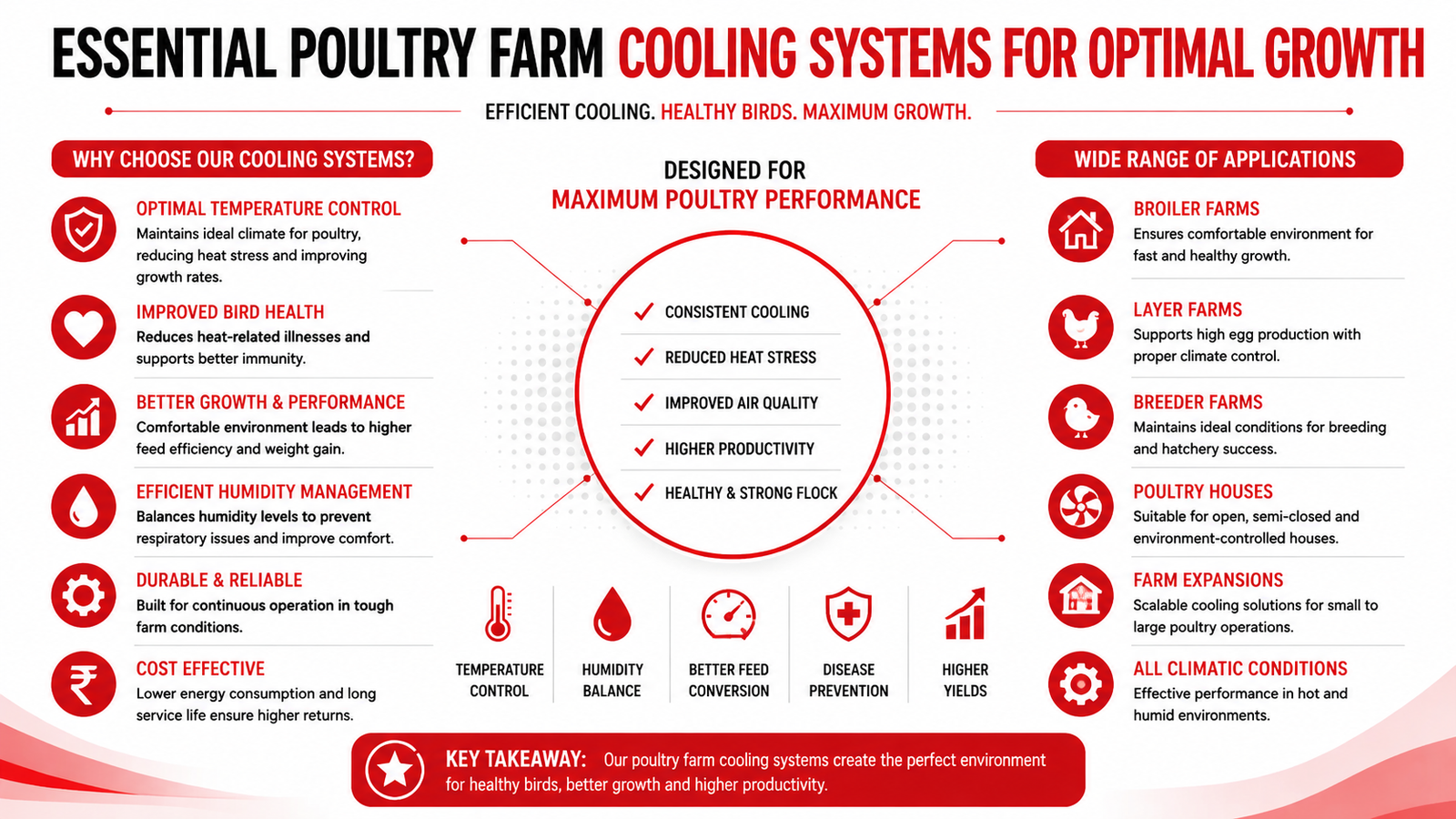
Essential Poultry Farm Cooling Systems for Optimal Growth
Shop the Best Poultry Farm Cooling Systems for Temperature Control in Poultry FarmFrom India's Leading Manufacturer - Megastar Coolers Pvt. Ltd.
Heat stress is the single biggest reason Indian poultry farmers lose weight gain, egg production, and live birds every summer. A properly installed poultry farm cooling system keeps shed temperature between 21°C and 26°C even when outside temperatures cross 45°C, protecting your flock and your profit margin. Megastar Coolers Pvt. Ltd. manufactures and supplies these systems directly from its Delhi factory to poultry farms across India — no dealer markup, no middlemen, just factory-direct pricing and engineering support from a company that has already equipped 1,000+ farms, warehouses, and industrial units.
Importance of Temperature Control in Poultry Farming
Broilers and layers are extremely sensitive to heat because they cannot sweat. Once shed temperature crosses 30°C, birds start panting, feed intake drops, and mortality risk rises sharply. Studies from poultry research institutes show that heat stress can reduce broiler weight gain by 10-15% and egg-laying rate by up to 20% during peak summer months.
Poultry farm coolingis not a comfort feature — it is a production necessity. Consistent temperature control ensures:
- Stable feed conversion ratio (FCR)
- Reduced mortality during heat waves
- Uniform bird growth across the shed
- Protection of egg quality and shell strength in layer farms
A farm without proper cooling infrastructure is directly exposed to seasonal profit loss, especially during April to July in North, Central, and West India.
Overview of Poultry Farm Cooling Systems
A poultry farm cooling system works on the principle of evaporative cooling — hot, dry outside air is pulled through water-soaked cooling pads, drops in temperature by 8-12°C, and is then pushed through the shed using high-capacity fans or centralized ducting. This is far more energy-efficient than air conditioning for large open sheds, since evaporative cooling consumes up to 80% less electricity than refrigerant-based AC systems for the same air volume. Megastar Coolers designs these systems specifically for poultry shed dimensions, bird density, and regional climate, rather than offering one generic size for every farm.
How Poultry Farm Cooling Systems Improve Bird Health and Productivity
When shed temperature is controlled within the thermoneutral zone, birds spend their energy on growth instead of managing heat stress. This directly improves:
- Weight gain consistency — birds reach target weight in fewer days
- Reduced heat-related mortality, especially in the last two weeks before broiler dispatch
- Better immunity, since heat-stressed birds are more prone to respiratory and gut infections
- Higher hatchability in breeder farms, where embryo development is temperature-sensitive
A well-maintained poultry farm cooling setup also reduces ammonia buildup by supporting consistent airflow, which further protects respiratory health.
How to Maintain Proper Air Quality in Poultry Farms
Cooling and air quality go hand in hand. Stagnant air inside a poultry shed leads to ammonia accumulation, high humidity, and dust — all of which increase respiratory stress in birds. To maintain healthy air quality:
- Ensure negative-pressure ventilation so fresh air is continuously drawn in
- Position cooling pads and exhaust fans on opposite walls for proper cross-ventilation
- Clean and replace poultry farm cooling pad media every season to prevent algae and dust clogging
- Monitor humidity — ideal range is 50-70% for most poultry breeds
- Avoid overcrowding, which restricts airflow between birds
Megastar's centralized duct cooling systems are engineered to maintain uniform air distribution across the entire shed length, avoiding hot spots near the exhaust end that are common in poorly designed setups.
Types of Cooling Systems for Poultry Farms
| System Type | Best Suited For | Key Advantage |
|---|---|---|
| Cooling Pad + Exhaust Fan System | Standard broiler/layer sheds | Most cost-effective, proven evaporative technology |
| Centralized Duct Cooling System | Large, multi-row sheds | Uniform temperature across long sheds, no hot zones |
| HVLS (High Volume Low Speed) Fans | Open-sided or naturally ventilated sheds | Improves air circulation without high power draw |
| Portable/Heavy-Duty Industrial Air Coolers | Smaller farms or supplementary cooling | Flexible placement, quick installation |
Each system uses a poultry farm cooling pad as the core cooling medium — typically a 100mm or 150mm thick cellulose pad that maximizes water-to-air contact for efficient temperature drop.
Benefits of Proper Cooling for Poultry Health and Growth
- Lower feed wastage, since stressed birds eat less efficiently
- Fewer veterinary interventions and medication costs
- Higher survival rate during May-June heat peaks
- Better return on investment per production cycle
- Reduced labor stress, since automated systems require minimal manual monitoring
How to Choose the Best Poultry Farm Cooling System
Factors to Consider When Choosing a Cooling System
- Shed size and bird capacity — determines required airflow (CFM) and pad area
- Regional climate — dry heat regions benefit most from evaporative cooling; humid regions need combined ventilation strategy
- Water quality and availability, since cooling pads depend on continuous water supply
- Build quality of the pad and cabinet — FRP (fiber-reinforced plastic) bodies last longer than mild steel in humid, corrosive shed environments
- After-sales support, especially pad replacement and motor servicing
Energy Efficiency and Cost-Effectiveness in Cooling Solutions
Evaporative poultry farm cooling systems typically consume 0.5-1.5 kW per unit compared to several kW for equivalent refrigerant AC, making them the most cost-effective large-scale cooling method for open and semi-open sheds. Megastar's factory-direct pricing model removes distributor margins, which typically add 15-25% to the final cost when buying through dealers.
Cooling Management Tips for Poultry Farms For India's Summer
- Start cooling systems before peak afternoon heat, not after birds show stress signs
- Increase water flow to cooling pads during extreme heat (above 40°C outside)
- Combine misting with pad cooling in very high-temperature zones like Rajasthan and Vidarbha
- Insulate shed roofing to reduce direct heat gain before it reaches the cooling system
- Schedule feeding during cooler morning and evening hours to reduce metabolic heat load
Signs Your Poultry Farm Needs a Better Cooling System
- Birds are consistently panting or spreading wings away from the body
- Feed intake drops noticeably during afternoon hours
- Mortality spikes during heat waves despite normal health status
- Uneven temperature across different sections of the shed
- Existing cooling pads are more than 2-3 seasons old and show reduced cooling efficiency
Maintenance Tips for Poultry Cooling Systems
- Clean the poultry farm cooling pad every 15-20 days during peak season to prevent dust and algae blockage
- Check water pump and distribution pipes weekly for leaks or uneven flow
- Inspect fan belts and motors monthly for wear
- Flush the water tank regularly to prevent mineral scaling on pads
- Replace cooling pads every 2-3 years depending on water quality and usage intensity
Innovations in Poultry Farm Cooling Technology
Modern poultry farm cooling systems now integrate automated temperature sensors that switch fans and pumps on or off based on real-time shed conditions, reducing both power consumption and manual monitoring. Centralized duct systems have also improved airflow uniformity, addressing the older problem of temperature difference between the pad-end and exhaust-end of long sheds. Megastar Coolers incorporates these advancements into its industrial cooling range, built specifically for Indian farm conditions and voltage fluctuations.
Case Studies: Successful Cooling System Implementations
Poultry integrators and independent farm owners across Punjab, Haryana, Maharashtra, and Rajasthan have installed Megastar's centralized duct cooling and pad-fan systems to manage 40°C+ summer temperatures. Farms report more stable daily weight gain and noticeably lower summer mortality after switching from basic fan-only ventilation to a properly sized evaporative cooling setup — proof that correctly engineered poultry farm cooling infrastructure pays for itself within a few production cycles.
Why Choose Megastar Coolers for Your Poultry Farm Cooling System
- Direct-from-factory manufacturing in Delhi — no dealer margins added to your price
- 1,000+ clients served across warehouses, factories, greenhouses, and poultry farms in India
- Custom-engineered systems based on your shed size, bird count, and regional climate
- Durable poultry farm cooling pad media and heavy-duty industrial-grade cabinets built for long service life
- Complete range: cooling pad systems, HVLS fans, and centralized duct cooling under one roof
- On-ground technical support for installation and maintenance
Conclusion and Future Trends in Poultry Farm Cooling Systems
Reliable poultry farm cooling is no longer optional for Indian poultry operations facing longer, harsher summers each year. Farms that invest in properly sized, well-maintained systems consistently protect bird health, feed efficiency, and overall profitability. As automation and sensor-based controls become more accessible, cooling systems will continue shifting toward smarter, lower-maintenance operation — and Megastar Coolers is already building this technology into its current product range.
Contact Megastar Coolers for Your Poultry Farm Cooling System at the Best Price
Get a custom quote based on your shed size and location. As a Delhi-based manufacturer serving 1,000+ clients pan-India, Megastar Coolers delivers factory-direct pricing with no middleman markup.
Get Your Free Quote Today — speak to our engineering team and protect your flock this summer.