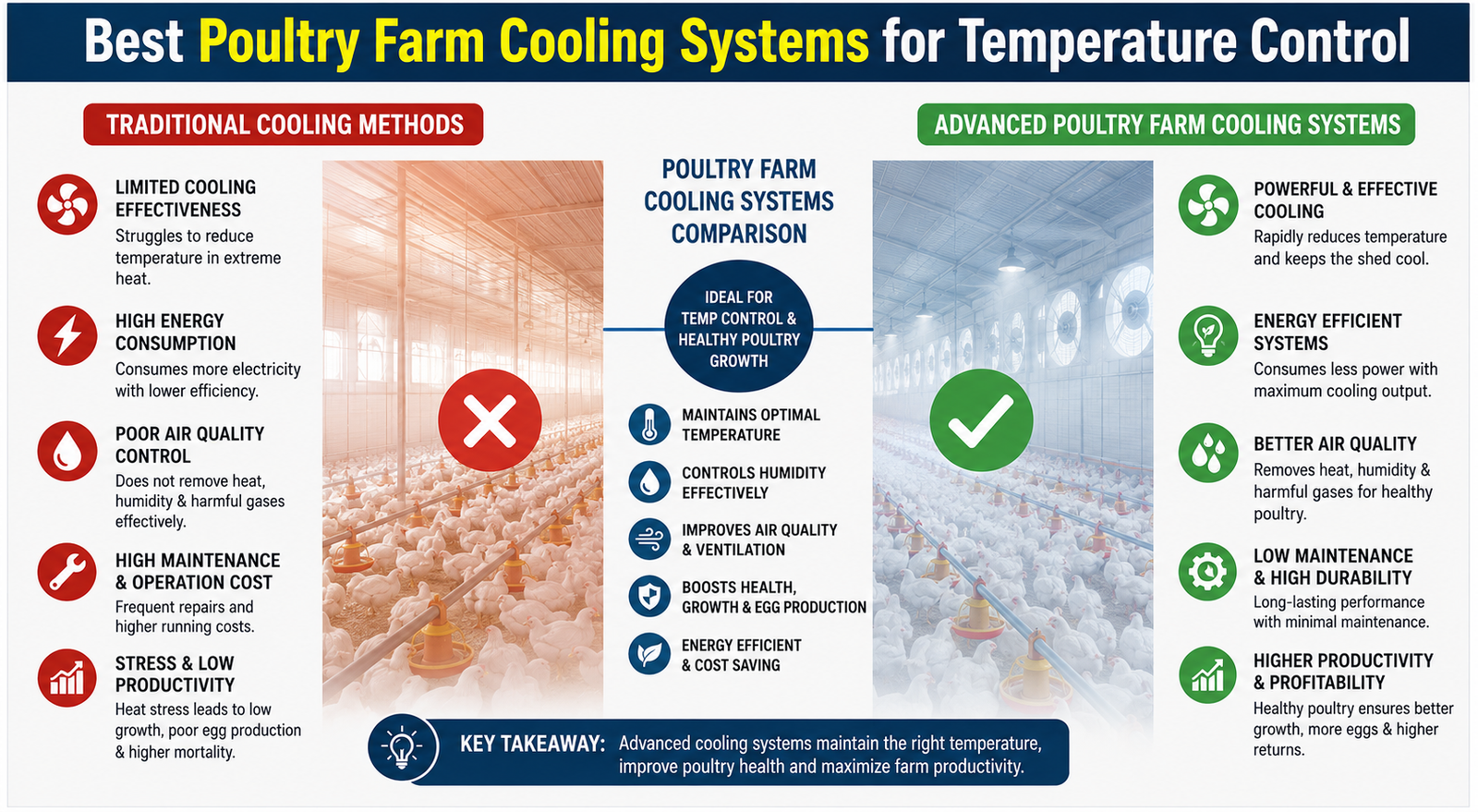
Best Poultry Farm Cooling Systems for Temperature Control
India's summer heat is ruthless — and your birds feel every degree of it. When temperatures inside a poultry shed cross 35°C, heat stress sets in fast. Feed conversion drops. Egg production falls. Mortality rates climb. And every hour without proper cooling costs you money you cannot recover. Megastar Coolers Pvt. Ltd. designs and manufactures industrial-grade poultry farm cooling systems built specifically for Indian climatic conditions. Our solutions are trusted by 1,000+ farms, warehouses, and agricultural setups across the nation — and they work where ordinary fans simply fail. If you are looking for the best cooling system for your poultry shed, you are in the right place.
What Is a Poultry Farm Cooling System and Why Is It Important?
A poultry farm cooling system is a combination of mechanical and evaporative technologies — including air coolers, exhaust fans, HVLS fans, and duct ventilation units — that work together to maintain a safe, stable internal temperature inside poultry sheds throughout the year.
In Indian poultry farming, the ideal temperature inside a broiler or layer shed must stay between 18°C and 28°C for optimal bird health. During summer months in regions like Rajasthan, Maharashtra, Telangana, and Punjab, outside temperatures easily touch 44–47°C. Without active cooling, indoor temperatures spike dangerously.
Here is why a reliable poultry cooling system is not optional — it is a production necessity:
- Heat stress kills feed efficiency. Birds eat less and lose weight when they are hot, directly reducing your output per bird.
- Egg production drops sharply. Studies in Indian poultry science confirm that layer productivity drops 10–25% when shed temperature exceeds 32°C.
- Mortality risk rises with every degree. Broilers above 40°C face severe respiratory distress and mass mortality within hours.
- Ammonia and humidity build up faster in poorly ventilated sheds, creating respiratory disease and bacterial growth.
- Litter quality deteriorates when airflow is inadequate, increasing pododermatitis and leg health issues.
A well-engineered poultry farm ventilation system solves all of these problems simultaneously — controlling temperature, humidity, air quality, and bird comfort in a single integrated setup.
How Poultry Farm Cooling Systems Improve Bird Health and Productivity
The connection between shed temperature and bird performance is direct and measurable.
When you install an efficient poultry cooling system, here is what changes on your farm:
Better Feed Conversion Ratio (FCR): Birds in a thermally comfortable environment eat consistently and convert feed into body weight more efficiently. A drop of just 3°C in average shed temperature can improve FCR by 0.10–0.15 points — which at commercial scale translates into significant cost savings.
Higher Egg Production in Layers: Layer hens in well-ventilated, cool sheds maintain their laying cycle without seasonal disruption. Farms using evaporative cooling systems report 12–18% higher egg production during summer compared to sheds with only basic fan arrangements.
Reduced Mortality in Broilers: Adequate poultry shed cooling cuts summer mortality rates by 60–80% in commercial broiler operations, based on field data from Indian poultry integrators.
Faster Weight Gain: Birds that do not spend energy on panting and heat regulation gain weight faster. You reach target slaughter weight in fewer days — reducing your cost per kilogram.
Lower Disease Incidence: Proper air circulation removes ammonia, dust, and pathogens from the shed air. This reduces the incidence of respiratory infections like Newcastle disease, CRD (Chronic Respiratory Disease), and Aspergillosis.
The ROI on a good poultry farm air cooling system pays back within a single summer cycle for most commercial farms.
The Science Behind Poultry Farm Air Circulation
Effective poultry farm ventilation is not simply about pushing air — it is about creating the right airspeed, air exchange rate, and directional airflow pattern inside the shed.
Tunnel Ventilation vs. Cross Ventilation
Two primary ventilation models dominate modern poultry farm design in India:
- Tunnel Ventilation draws air from one end of the shed and exhausts it from the other using high-speed exhaust fans. This creates a wind-chill effect that significantly lowers the felt temperature for birds, even if the actual air temperature remains moderately high. Tunnel ventilation works best for closed, climate-controlled sheds.
- Cross Ventilation uses exhaust fans placed along sidewalls to pull fresh air through inlet panels on the opposite wall. This system suits open-sided sheds and provides effective air exchange across the width of the shed.
The Role of Evaporative Cooling
Evaporative air coolers use the natural physics of water evaporation to reduce air temperature. When warm, dry outside air passes over water-saturated cooling pads, it cools down by 10–15°C before entering the shed. This principle — called direct evaporative cooling — is highly effective in India's hot and semi-arid regions.
Megastar Coolers' evaporative cooling pads are engineered to deliver maximum cooling efficiency with minimum water consumption, making them ideal for water-scarce regions in Rajasthan, Gujarat, and Karnataka.
Air Changes Per Hour (ACH)
The number of times the total air volume in a shed is replaced per hour is called ACH. A properly designed poultry ventilation system achieves 40–60 air changes per hour during peak summer — ensuring continuous removal of heat, ammonia, carbon dioxide, and moisture from the bird zone.
How to Maintain Proper Air Quality in Poultry Farms
Temperature is only one dimension of shed climate management. Air quality — including humidity, ammonia levels, CO₂ concentration, and dust particle load — directly affects bird respiratory health and farm biosecurity.
Follow these practices to maintain optimal air quality alongside your poultry cooling system:
1. Monitor Ammonia Levels Regularly Ammonia above 25 ppm causes visible respiratory distress in birds. Above 50 ppm, production losses become severe. Your ventilation system must provide enough air exchanges to keep ammonia below 20 ppm at bird level.
2. Control Relative Humidity Ideal relative humidity inside a poultry shed is 50–70%. High humidity combined with high temperature creates the most dangerous heat stress conditions. Evaporative coolers work best when outside humidity is below 70%, which covers most of India's dry summer months.
3. Use Negative Pressure Ventilation Negative pressure ventilation — where exhaust fans create a slight suction inside the shed — prevents hot outside air from entering through gaps and cracks. It ensures all incoming air passes through controlled inlet points, giving you predictable temperature and air quality outcomes.
4. Clean Cooling Pads and Fan Blades Regularly Dirty cooling pads reduce evaporation efficiency. Dust-clogged fan blades reduce airflow volume by 20–30%. Schedule monthly cleaning of all cooling and ventilation equipment.
5. Maintain Proper Litter Management Wet, compacted litter generates ammonia far faster than dry, well-managed litter. Good ventilation and cooling reduce moisture accumulation in litter, creating a cleaner, healthier shed environment.
Different Types of Poultry Cooling Systems Explained
Megastar Coolers manufactures and supplies a comprehensive range of poultry farm cooling and ventilation products. Here is a clear breakdown of each system type and where it works best:
1. Evaporative Air Coolers for Poultry Farms
Evaporative coolers — also called desert coolers or swamp coolers in industrial format — use cellulose or rigid media cooling pads soaked in water to cool incoming air through evaporation.
Best For: Open-sided and semi-open poultry sheds in hot, dry climates. Cooling Capacity: Reduces incoming air temperature by 10–15°C. Energy Efficiency: 75–80% lower power consumption than refrigerant-based cooling. Megastar Advantage: High-density cooling pads, corrosion-resistant GI body, and variable-speed motors for precise airflow control.
2. HVLS Fans (High Volume, Low Speed)
HVLS fans are large-diameter ceiling fans (10–24 feet) that move massive volumes of air at low rotational speeds. They create a gentle, uniform airflow across the entire shed floor without creating cold drafts.
Best For: Large poultry sheds where uniform air destratification is needed. Key Benefit: Eliminates hot and cold zones inside the shed, ensuring every bird experiences similar conditions regardless of its position. Energy Efficiency: A single HVLS fan replaces 10–15 conventional pedestal fans, consuming a fraction of the total power.
3. Industrial Exhaust Fans
High-capacity exhaust fans are the backbone of tunnel ventilation systems. They pull hot, stale air out of the shed at high velocity, creating the negative pressure that draws fresh air through inlet cooling pads.
Best For: Enclosed tunnel-ventilated broiler and layer sheds. Sizes Available: 36-inch, 48-inch, and 54-inch diameter models from Megastar. Key Feature: Thermally protected motors, weather-resistant louvers, and aerodynamic blade design for maximum CFM (cubic feet per minute) output.
4. Duct Air Cooling Systems
Duct cooling systems distribute cooled air from a central unit through a network of insulated ducts and diffusers placed at bird level inside the shed.
Best For: Multi-tier cage layer operations and hatcheries where precise temperature zoning is needed. Key Benefit: Delivers cooled air directly to the bird zone, maximizing thermal comfort exactly where it matters.
5. Complete Poultry Farm Ventilation Systems
For new shed construction or complete retrofit projects, Megastar Coolers offers integrated ventilation and cooling design — combining evaporative cooling units, exhaust fans, HVLS fans, and automated climate control panels into a single, cohesive system.
Best For: Commercial broiler integrators, large layer complexes, and breeder farms requiring full climate management. Key Benefit: Single-vendor accountability, integrated design, and coordinated commissioning.
Summer Management Tips for Poultry Farms in India
India's summer season — April through June — is the most critical period for poultry farm climate management. Here are actionable summer management practices to implement alongside your cooling system:
Start Cooling Earlier Than You Think You Need To Do not wait for birds to show heat stress signs. Activate your cooling system when outside temperatures consistently exceed 33°C, even if birds appear comfortable. Preventive cooling is always cheaper than reactive management.
Pre-cool the Shed Before Chick Placement Run your evaporative coolers and fans for 2–3 hours before placing new chicks or transferring growers. A pre-cooled shed reduces early mortality and improves first-week performance significantly.
Adjust Feeding Times to Cooler Periods Offer feed in the early morning (before 8 AM) and evening (after 6 PM) during peak summer. Birds eat more willingly in cooler temperatures, improving your FCR without any additional cost.
Increase Water Access Points Birds drink 2–3 times more water in hot conditions. Ensure adequate nipple or bell drinker density — at least one drinking point per 8–10 birds — and flush lines regularly to keep water cool.
Use Shade Netting on Roof and Walls External shade netting reduces radiant heat load on the shed structure by 30–40%, reducing the workload on your cooling system and lowering energy costs.
Monitor Humidity at Bird Level, Not at the Ceiling Temperature and humidity stratify inside sheds. Always place your monitoring sensors at bird level (0.5–1 metre from the floor) for accurate readings that reflect actual bird conditions.
Signs Your Poultry Farm Needs a Better Cooling System
Many poultry farmers operate with outdated or undersized cooling equipment without recognizing the direct cost it carries. Watch for these warning signs:
- Birds panting with wings spread — the most visible sign of heat stress. If more than 10% of your flock shows this, your cooling system is inadequate.
- Feed consumption drops sharply after 11 AM — birds are too hot to eat during peak heat hours.
- Water consumption spikes without a corresponding feed increase — birds are drinking to manage body temperature, not to support growth.
- Unexplained mortality spikes in April–June — summer mortality above 0.5% per week in broilers points to thermal management failure.
- Ammonia smell intensifies at midday — reduced airflow during hot hours allows ammonia to build up faster than your fans can remove it.
- Egg production drops by more than 5% week-on-week during summer — layer hens are experiencing chronic heat stress.
- Your fans are more than 5 years old — fan efficiency degrades by 15–25% over five years due to blade wear, motor degradation, and dust accumulation.
If two or more of these signs are present on your farm, it is time to contact Megastar Coolers for a site assessment and system upgrade.
How to Choose the Best Poultry Farm Cooling System
Choosing the right cooling system for your poultry shed requires matching the technology to your shed design, local climate, flock type, and budget. Here is a practical decision framework:
Step 1 — Assess Your Shed Type Is your shed open-sided, semi-open, or fully enclosed? Open sheds benefit most from evaporative coolers and HVLS fans. Enclosed sheds need a full tunnel ventilation setup with exhaust fans and inlet cooling pads.
Step 2 — Calculate Your Cooling Load Your cooling system must handle the heat generated by your birds (metabolic heat load), the heat from solar radiation on the roof and walls, and the heat from outside air infiltration. A professional like Megastar Coolers' technical team can perform a free cooling load calculation for your shed.
Step 3 — Match System to Local Humidity Evaporative cooling is highly effective when outside relative humidity is below 70%. If your farm is located in a high-humidity region (coastal Tamil Nadu, Kerala, or West Bengal), you need a higher air exchange rate to compensate for reduced evaporative efficiency.
Step 4 — Consider Bird Type and Age Broiler chicks under 2 weeks need warmth, not cooling. Adult broilers at 4–6 weeks need active cooling during summer. Layer hens need consistent temperature year-round. Your cooling system must be controllable enough to handle all phases of production.
Step 5 — Evaluate Energy Costs vs. Cooling ROI Always compare the annual energy cost of a cooling system against the production gain it delivers. Evaporative cooling systems from Megastar deliver strong ROI because they use 75–80% less power than mechanical refrigeration while providing comparable cooling performance in India's climate.
Top Features to Look for in a Poultry Cooling System
When evaluating poultry farm cooling system suppliers in India, these are the features that separate high-quality industrial systems from low-grade alternatives:
High-Efficiency Cooling Pads Look for cellulose cooling pads with a flute angle of 45°/45° or 15°/45° that maximizes contact area between water and air. Megastar uses imported-grade rigid media pads with a service life of 5–7 years.
Corrosion-Resistant Build Quality Poultry sheds are chemically aggressive environments — ammonia, moisture, and dust degrade ordinary steel quickly. Megastar systems use hot-dip galvanized and powder-coated steel frames that resist corrosion for 10+ years.
Variable Speed Motor Control Fixed-speed fans run at full power even when full cooling is not needed, wasting electricity. Variable frequency drive (VFD)-compatible motors allow you to adjust fan speed precisely to shed conditions, reducing energy costs by 30–40%.
Automated Climate Control Look for systems compatible with thermostat and humidity controllers that automatically adjust fan speed and cooler output based on real-time sensor data. Automation reduces labor dependency and prevents temperature spikes during unattended periods.
Low Noise Operation Excessive fan noise stresses birds and reduces productivity. Megastar's aerodynamically balanced fan blades operate at noise levels under 65 dB, well within acceptable limits for broiler and layer operations.
After-Sales Service and Spare Parts Availability A cooling system is a long-term investment. Choose a manufacturer that offers pan-India service support, readily available spare parts, and documented installation and maintenance manuals.
Factors to Consider Before Installing Poultry Shed Cooling Systems
Before you place an order for a poultry farm cooling system, take these installation-readiness factors into account:
Shed Orientation and Airflow Direction Your shed should ideally be oriented east-west (long axis) to minimize direct solar radiation on the largest wall surfaces. Tunnel ventilation should run along the length of the shed for maximum airflow efficiency.
Inlet-to-Exhaust Area Ratio For proper negative pressure ventilation, your total inlet pad area must be matched to your total exhaust fan capacity. Megastar's engineering team calculates this ratio for every project to ensure balanced airflow.
Water Supply and Quality Evaporative coolers require a consistent water supply. Hard water with high mineral content can clog cooling pads and reduce efficiency over time. Install a basic water filter or softener if your water TDS exceeds 500 ppm.
Electrical Infrastructure Verify that your farm's electrical panel can handle the additional load of new cooling equipment. Megastar provides a load calculation sheet with every project proposal to help you plan your electrical infrastructure upgrades.
Shed Sealing and Insulation For tunnel ventilation systems, the shed must be adequately sealed to maintain negative pressure. Gaps in walls, rooflines, and doors allow hot air infiltration that undermines your cooling system's performance. Insulated roofing panels (such as PUF or double-skin sheets) significantly reduce heat gain through the roof.
Best Summer Cooling Tips for Commercial Poultry Farms
These are the most impactful, cost-effective cooling practices for commercial farms running Megastar systems:
Tip 1 — Run Cooling Pads on a Recirculation Pump Use a recirculating pump system rather than a continuous flow system. Recirculation reduces water consumption by 40–60% while maintaining pad saturation.
Tip 2 — Install Temperature Controllers at Multiple Points Place temperature sensors at 3–4 points along the shed length, not just at one end. This ensures your controller reads average conditions, not just inlet or outlet extremes.
Tip 3 — Clean Exhaust Fan Louvers Weekly in Summer Dust accumulates on louver blades rapidly in summer. Weekly cleaning maintains rated airflow performance and extends motor life.
Tip 4 — Use Night Ventilation to Pre-cool Shed Mass Run fans at high speed during the early morning hours (2–5 AM) to flush cool night air through the shed and pre-cool the structural mass. This delays morning temperature rise by 1–2 hours.
Tip 5 — Combine HVLS Fans with Evaporative Coolers HVLS fans destratify the cooled air delivered by evaporative coolers, distributing it evenly to every bird in the shed. Using both together consistently outperforms either system used alone.
Why Choose Megastar Coolers for Your Poultry Farm Cooling System
There are many cooling equipment suppliers in India. Here is why 1,000+ farms, industries, and agricultural operations choose Megastar Coolers Pvt. Ltd.:
We Manufacture, We Do Not Just Supply Megastar Coolers is a direct manufacturer of all its cooling and ventilation products. You get manufacturer-quality engineering, competitive factory pricing, and full accountability — with no middlemen adding cost or reducing responsibility.
Designed for Indian Climate Conditions Every Megastar product is engineered for India's heat — from the scorching dry summers of Rajasthan and Gujarat to the humid conditions of coastal Andhra Pradesh. Our systems are tested and validated across all Indian agro-climatic zones.
Complete Cooling Solutions Under One Roof From individual exhaust fans and HVLS fans to full turnkey poultry ventilation systems — Megastar delivers everything you need from a single, trusted source. This eliminates compatibility problems and simplifies project management.
Energy-Efficient Technology Our evaporative cooling systems use 75–80% less electricity than refrigerant-based alternatives. Our HVLS fans replace up to 15 conventional fans with a single unit. Lower power costs mean better margins for your farm every single day.
Pan-India Technical Support Megastar's technical team provides pre-sale design consultation, installation supervision, and post-installation service across India. We are not just a product company — we are a long-term cooling partner for your farm.
1,000+ Satisfied Clients We have installed poultry farm cooling systems in broiler farms, layer complexes, hatcheries, and breeder operations across India. Our reference base spans every major poultry-producing state — Andhra Pradesh, Telangana, Maharashtra, Punjab, Haryana, and more.
Durable, Low-Maintenance Products Megastar cooling systems are built to run in harsh agricultural environments with minimal maintenance requirements. Robust motor protection, corrosion-resistant frames, and high-quality pad materials ensure years of reliable performance with low total cost of ownership.
Contact Megastar Coolers for Your Poultry Farm Cooling System at the Best Price
Your birds cannot afford a bad summer. Your farm cannot afford to lose another production cycle to heat stress.
Megastar Coolers Pvt. Ltd. is ready to help you design, supply, and install the right poultry farm cooling system for your specific shed size, flock type, and budget — at the most competitive factory-direct pricing in India.
Here is what you get when you contact us:
- Free site assessment and cooling load calculation
- Customized system design for your shed dimensions
- Transparent pricing with no hidden costs
- Installation support and commissioning assistance
- After-sales service and spare parts availability across India
Call us today, get a free quote, and be summer-ready before the heat arrives.
Address - 7, Shri Ram Marg, Sector-25, HUDA, Panipat – 132103 , Phone - +91 86077 00 370 , +91 86077 00 373 , Toll Free - 1800 180 1833 , website - www.megastarcoolers.com Email - megastarcoolers@gmail.com mtex@ymail.com
Megastar Coolers Pvt. Ltd. — India's trusted manufacturer and supplier of poultry farm cooling systems, industrial air coolers, HVLS fans, exhaust fans, and complete ventilation solutions. Serving 1,000+ industries and farms across India.