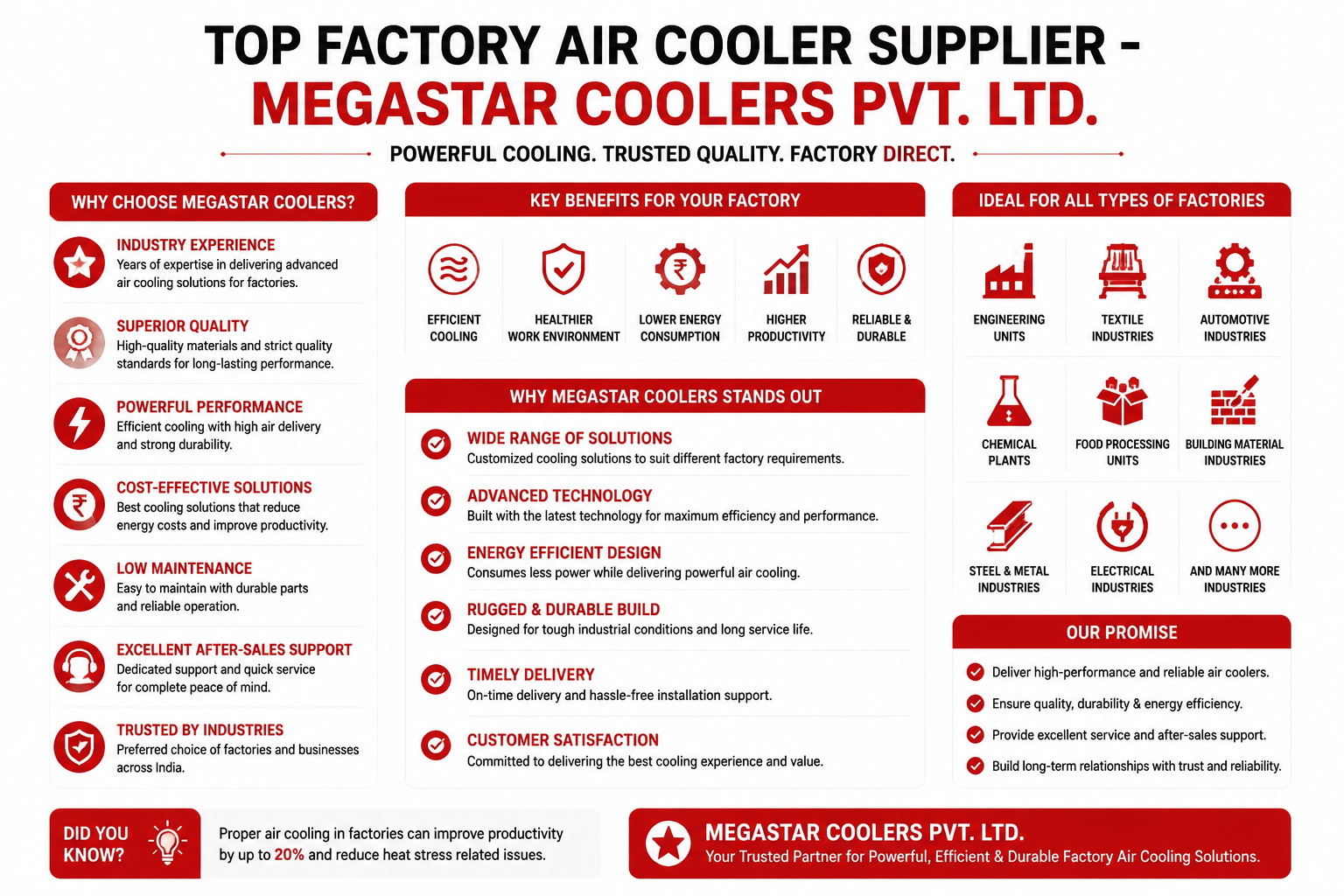
Top Factory Air Cooler Supplier - Megastar Coolers Pvt. Ltd.
No.1 Factory Air Cooler Supplier - Megastar Coolers Pvt. Ltd.
Your factory shed turns into a furnace by 11 AM. Workers lose focus, machines overheat, and production slows down every single summer. A reliable and top Factory Air Cooler Supplier fixes this problem at the root, not just for a season, but for years.
Megastar Coolers Pvt. Ltd. is a Delhi-based manufacturer that has installed cooling systems for over 1,000 factories, warehouses, and industrial units across India. As a direct Factory Cooler Supplier, Megastar removes the dealer markup that most buyers unknowingly pay, and delivers heavy-duty coolers straight from the factory floor to your facility.
This page explains how factory cooling works, what causes heat build-up on the shop floor, which cooler type fits your industry, and why Megastar is the supplier factory owners keep coming back to.
Understanding Factory Air Coolers - What Is a Factory Cooling System and How Does It Work?
A factory cooling system pulls hot, stale air out of an industrial shed and replaces it with cooled, fresh air through evaporative or forced-draft technology. Unlike a home cooler, an industrial unit is built to move thousands of cubic meters of air per hour across large open floor areas with high ceilings, tin roofs, and heavy machinery load.
The system works on a simple principle: hot air rises and stale air gets trapped near the roof. A well-designed Factory Cooling Solutions setup combines air coolers with exhaust fans, so hot air is pushed out from the top while cool air enters from the sides at floor level. This constant air exchange keeps the ambient temperature 8-12°C lower than outside, even in peak summer.
Importance of Ventilation in Factory Cooling Systems
Cooling without ventilation only recirculates hot, humid air. Every effective Warehouse & Factory Cooling Solutions plan pairs air coolers with proper exhaust points. Ventilation removes:
- Trapped heat from machines, furnaces, and lighting
- Humidity generated by evaporative cooling
- Dust, fumes, and odor from production processes
Without ventilation, humidity levels rise indoors and workers feel more uncomfortable than before installation, even though the temperature has dropped.
What Causes Excess Heat in Industrial Factories?
Most factory heat problems come from a mix of these five sources:
- Roof heat gain - metal or asbestos roofing absorbs and radiates heat for hours after sunset
- Machine and motor heat - production equipment runs continuously and adds direct heat load
- Poor air circulation - low ceiling fans and blocked vents trap hot air near work stations
- High occupant density - more workers per square foot means more body heat and CO2
- Process heat - furnaces, boilers, and curing chambers push localized temperatures far above ambient
Identifying which of these applies to your unit decides which Heavy Duty Air Cooler For Factory setup will actually solve the problem, instead of adding cost without result.
Different Types of Industrial Factory Cooling Systems for Different Industries
No two factories cool the same way. Textile units need humidity control near machines. Poultry farms need uniform, low-noise airflow. Warehouses need spot cooling near loading bays. That's why Megastar designs Factory Shed Cooling Solution packages by industry:
| Industry | Recommended System |
|---|---|
| Warehouses & Godowns | Wall-mounted heavy-duty coolers + exhaust fans |
| Manufacturing plants | Ducted centralized cooling with zone control |
| Poultry farms | Tunnel ventilation with cellulose pad coolers |
| Greenhouses | High-humidity evaporative cooling systems |
| Assembly & packaging units | HVLS fans with spot air coolers |
Ways to Reduce Cooling Costs in Manufacturing and Factory Units
A factory cooling system is a long-term investment, and keeping its operating cost low requires smart choices at the point of purchase and throughout its service life.
- Right-size your system from day one. Oversized systems cycle inefficiently and waste energy. Undersized systems run continuously without reaching target temperatures. A proper heat load calculation before purchase eliminates both problems.
- Choose evaporative over refrigerant where climate permits. In Delhi NCR's dry summer months, evaporative coolers consume 70–80% less electricity per hour than equivalent-capacity air conditioning. For a 20,000 sq. ft. factory, this can mean annual savings of ₹3–8 lakhs in electricity costs.
- Invest in roof insulation and heat-reflective paint. Reducing solar heat gain through the roof directly reduces the cooling load your system must handle. White or silver heat-reflective coatings on metal roofs can reduce roof surface temperature by 15–20°C.
- Schedule cooling during off-peak tariff hours where your operations permit. Industrial electricity tariffs in Delhi vary by time of use; pre-cooling the space before peak production hours can reduce peak-period load.
- Maintain regularly. A clogged cooling pad or dirty fan reduces efficiency by 20–30% and increases energy consumption. A ₹500 maintenance visit can prevent ₹50,000 in wasted electricity over a season.
- Use zoned cooling. Not all areas of your factory need the same temperature. Directing full cooling capacity to production zones while allowing storage areas to run warmer reduces your total system load.
Common Heat Problems in Manufacturing Plants and Their Solutions
| Factor | Industrial Air Cooler | Traditional AC System |
|---|---|---|
| Running Cost | Low (fan + pump only) | High (compressor-driven) |
| Installation | Fast, minimal civil work | Complex, needs compressor room |
| Air Source | Fresh outdoor air | Recirculated indoor air |
| Coverage | Large open areas efficiently | Best for sealed, smaller rooms |
| Maintenance | Simple, low-cost parts | Requires refrigerant, technician visits |
| Best Suited For | Warehouses, factories, poultry farms, greenhouses | Offices, server rooms, sealed spaces |
How to Maintain Ideal Temperature in Large Factory Sheds
- Use zone-based cooling – place multiple coolers at regular intervals along the shed length instead of one large unit in a corner
- Pair every cooling zone with exhaust fans – roof-mounted exhaust fans pull hot air out, keeping the cooling loop continuous
- Calculate CFM based on shed size – air delivery must match the shed's length, height, and heat load, not a standard fixed capacity
- Position coolers for cross-ventilation – air should enter from one side and exit from the opposite or roof side, not recirculate in the same zone
- Account for machine density per zone – areas with more equipment need higher cooling capacity than open floor space
- Maintain consistent airflow direction – directional ducting or HVLS fans help distribute cool air evenly across large spans
- Get a professional load calculation – Megastar's technical team assesses shed dimensions and heat sources before recommending unit count and placement
Key Features to Look for in an Factory Air Cooler
Before you buy, check for:
- Air delivery (CFM) - higher CFM means faster cooling for large areas
- Pad material - cellulose pads cool better and last longer than aspen pads
- Body material - FRP or galvanized steel bodies resist rust and last 10+ years
- Motor quality - copper-wound motors run cooler and last longer than aluminium-wound ones
- Water tank capacity - larger tanks mean fewer refills during long shifts
- Noise level - important for factories with close working proximity
Types of Factory Air Coolers
- Wall-mounted industrial coolers - fixed installation for consistent airflow direction
- Portable heavy-duty coolers - movable units for changing floor layouts
- Ducted centralized cooling systems - one system cools multiple zones through ducting
- Tower and cabinet coolers - vertical airflow for tight floor spaces
Benefits of Using Factory Air Coolers
- Lower installation and running cost compared to central AC
- Continuous fresh air supply, unlike sealed AC systems
- Improved worker productivity and reduced heat-related fatigue
- Lower fire risk compared to compressor-based systems in dusty environments
- Minimal maintenance compared to refrigerant-based cooling
Factors Influencing Air Cooler Performance
- Shed height – taller sheds need higher static pressure and CFM to push air all the way to floor level
- Roof material – tin and asbestos roofs absorb more heat, increasing the cooling load on the system
- Outdoor humidity – evaporative cooling works best in dry climates; high humidity reduces temperature drop
- Air changes per hour (ACH) – the number of times air is fully replaced per hour must match the shed's heat load
- Pad-to-airflow ratio – airflow must pass through the cooling pad at the correct speed, or cooling efficiency drops
- Exhaust capacity – cooling only works if hot air has an exit point; mismatched exhaust and cooler capacity cause poor results
- Unit placement – coolers placed too close together or too far apart create uneven cooling zones
- Water quality – hard water causes scale build-up on pads, reducing cooling efficiency over time
- Machine heat load – factories with more running machinery need higher-capacity coolers to offset localized heat
Energy Efficiency and Cost Considerations
Evaporative coolers consume roughly 0.5 to 1.5 units of electricity per hour compared to 3-5 units for an equivalent compressor AC. For a factory running 10-12 hours daily, this difference adds up to significant monthly savings, often recovering the cooler's cost within the first cooling season.
Maintenance Tips for Optimal Performance in Factories
- Clean cooling pads every 30-45 days during peak season
- Check water pump and float valve monthly
- Drain and clean the tank before season start to prevent scale build-up
- Inspect belts and motor bearings every quarter for early wear signs
Comparing Top Brands and Models
Most branded industrial coolers in the market are sold through multiple layers of dealers, which inflates the final price by the time it reaches the factory owner. Megastar Coolers manufactures in-house and sells directly, matching or exceeding the build quality of leading brands at a lower landed cost, with faster replacement part availability since production happens locally in Delhi.
Megastar Coolers Pvt. Ltd. - Leading Factory Air Coolers Suppliers
Megastar Coolers Pvt. Ltd. has spent years manufacturing and installing industrial cooling systems across India. As a trusted Factory Air Cooler Supplier, the company designs, builds, and services:
- Heavy-duty industrial air coolers
- HVLS (High Volume Low Speed) fans
- Centralized duct cooling systems
- Exhaust fan systems for factory sheds
More than 1,000 clients, including warehouse operators, manufacturing plants, greenhouse growers, and poultry farm owners, currently run their facilities on Megastar cooling systems. The company operates without middlemen, which means every unit is priced at direct-from-factory rates.
How to Choose the Right Factory Cooling System Supplier
Look for a supplier who:
- Manufactures in-house rather than reselling imported or third-party units
- Offers site visits and load calculations before quoting a price
- Provides after-sales service and spare parts locally
- Has verifiable installation history with similar industries
- Backs the product with a written warranty
Questions to Ask Before Purchasing Factory Air Coolers
Use these questions when speaking with any supplier — including us. The answers will tell you whether the supplier genuinely understands your requirement or is simply trying to close a sale.
What heat load calculation method will you use for my facility?
A credible answer involves visiting the site, measuring the space, assessing machinery heat output, and calculating air change requirements. An answer that jumps straight to equipment capacity without assessment is a red flag.
What cooling capacity and air delivery rate (CFM) do you recommend, and why?
Ask them to show you the calculation behind the recommendation, not just the conclusion.
Which cooling pad specification are you proposing, and what is the expected pad life?
Cellulose pads (90mm or 100mm thickness) significantly outperform lower-grade alternatives in both efficiency and lifespan.
What are the annual operating costs for electricity and water?
A supplier who cannot answer this is not thinking about your long-term interests.
What is the warranty period, and does it cover labor as well as parts?
Get this in writing before purchase.
What is your service response time during peak summer months?
This is when failures are most likely and most damaging. Confirm specifically for June and July.
Do you have references from factories in my area and industry?
Ask for contact details of two or three existing customers you can speak with directly.
What does the installation include, and what is not included in the price?
Clarify whether structural mounting, electrical connections, water supply lines, and commissioning are included or quoted separately.
Factors to Consider Before Buying Industrial Cooling Systems
- Total floor area and ceiling height of the shed
- Number of heat-generating machines on the floor
- Local humidity levels, since evaporative cooling performs best in dry climates
- Number of working shifts and daily run-time
- Budget for both installation and long-term running cost
Why Choose Megastar Coolers for Factory Cooling Systems
- Direct-from-factory pricing - no dealer margin added to the final cost
- 1,000+ installations across warehouses, factories, greenhouses, and poultry farms
- In-house manufacturing in Delhi, allowing faster customization and delivery
- Complete cooling ecosystem - coolers, HVLS fans, and duct systems from a single supplier
- Site-specific load calculation before every quotation, avoiding under or over-sizing
- Local after-sales support for spares, service, and maintenance
Making the Right Choice for Your Factory
A factory cooling system is a long-term investment, not a seasonal purchase. Choosing a supplier who manufactures the product, understands industrial heat load, and stands behind the installation with local service makes the difference between a cooler that lasts one season and one that runs reliably for a decade. Megastar Coolers Pvt. Ltd. builds every unit to withstand that demand.
Contact Megastar Coolers Pvt. Ltd. For Factory Air Coolers At Best Price in Delhi
Stop paying dealer markups on your factory cooling system. Get a direct-from-factory quote from Megastar Coolers Pvt. Ltd., Delhi's trusted Factory Air Cooler Supplier, and cool your factory, warehouse, greenhouse, or poultry farm at the best price in the market.
Request your free site assessment and quotation today.