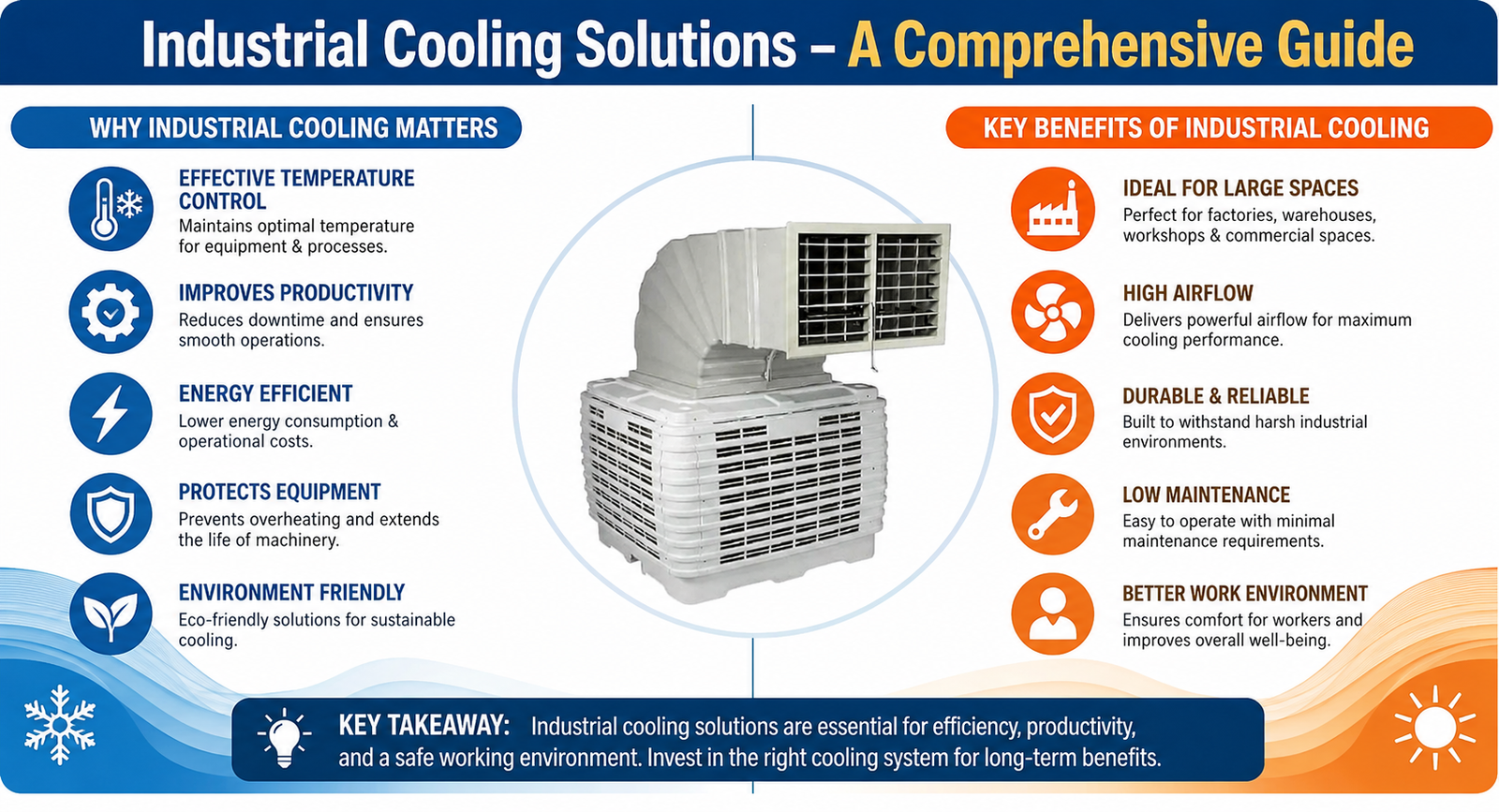
Industrial cooling solutions - A Comprehensive Guide
Managing heat in large factories, warehouses, and manufacturing plants is no longer optional — it is a critical operational need. As India's industrial sector grows rapidly, the demand for reliable, energy-efficient industrial cooling solutions has never been higher. Whether you run a textile mill, a food processing unit, a logistics warehouse, or a chemical plant, the right cooling system directly impacts your worker productivity, machinery performance, and overall operational costs.This guide covers everything you need to know about industrial cooling — from choosing the right system to understanding costs, maintenance, and the latest trends in 2026.
Industrial Air Coolers vs Cooling Towers: Which is Better for Your Factory?
Two of the most widely used industrial cooling systems in India are industrial air coolers and cooling towers. Both serve the purpose of heat reduction but operate differently and suit different environments.
Industrial Air Coolers work on the evaporative cooling principle. They draw warm air through water-saturated cooling pads, which reduces the air temperature through evaporation and circulates cool, fresh air across the space. They are ideal for open or semi-open factory floors, warehouses, and large work areas with natural ventilation.
Cooling Towers are used primarily for process cooling — removing heat from industrial machinery, HVAC systems, or manufacturing processes by cycling water through the tower where heat dissipates. They are best suited for closed-loop systems such as injection moulding machines, compressors, or chemical reactors.
Which is better for your factory?
| Factor | Industrial Air Coolers | Cooling Towers |
|---|---|---|
| Best For | Worker comfort, open spaces | Process/machinery cooling |
| Energy Consumption | Low | Moderate to High |
| Installation Cost | Low | High |
| Maintenance | Simple | Complex |
| Water Usage | Moderate | High |
| Ideal Environment | Semi-open, ventilated spaces | Enclosed process systems |
For most Indian factories, warehouses, and agricultural facilities, industrial air coolers combined with HVLS fans deliver the best cost-to-performance ratio for cooling large open spaces.
Top 10 Industrial Cooling Systems for Large Manufacturing Units
Large manufacturing units have unique cooling requirements. Below are the top industrial cooling systems widely used across Indian industries:
1. Industrial Evaporative Air Coolers — Use water evaporation to cool large open areas cost-effectively. Best for factories, warehouses, and assembly lines.
2. HVLS (High Volume Low Speed) Fans — Move massive volumes of air at low rotational speeds. Excellent for uniform air circulation in large spaces without increasing heat load.
3. Industrial Ducted Cooling Systems — Channel cooled air through ductwork to specific zones within a large facility.
4. Roof Ventilators — Passive or powered systems that exhaust hot air from the roof, improving overall temperature management.
5. Industrial Chillers — Cool process water that is then circulated to machinery or air handling units.
6. Cooling Towers — Large-scale water-based heat exchangers used in power plants, refineries, and chemical industries.
7. Air Handling Units (AHUs) — Process and circulate air in large industrial buildings in combination with chillers or cooling coils.
8. Spot Coolers — Portable cooling units targeted at specific hot zones or individual workstations.
9. Misting Systems — High-pressure water mist dispersed into the air to lower ambient temperature in open outdoor or semi-outdoor industrial areas.
10. Heat Exchangers — Transfer heat between two fluids to maintain process temperatures in manufacturing equipment.
For most Indian manufacturing units, combining industrial air coolers with HVLS fans delivers maximum air coverage, energy efficiency, and worker comfort without high capital investment.
How Industrial Cooling Solutions Improve Worker Productivity
Heat stress is one of the leading causes of reduced productivity in Indian factories and warehouses. Studies show that workers in high-temperature environments experience up to 30–40% decline in productivity, increased error rates, and higher absenteeism.
Effective industrial cooling solutions directly address this problem in the following ways:
Reduced Heat Stress — Maintaining factory temperatures between 24°C–30°C significantly lowers heat fatigue among workers on long shifts.
Improved Concentration and Accuracy — Cooler working environments lead to better focus, fewer mistakes, and higher quality output — especially critical in precision manufacturing, electronics assembly, and textile production.
Lower Absenteeism — Heat-related illness is a common reason for worker absences. Proper ventilation and cooling reduce sick days and improve workforce reliability.
Extended Working Hours — In industries like agriculture and logistics where summer heat peaks beyond 40°C, cooling systems extend productive working hours into the afternoon.
Better Machine Performance — When ambient temperatures drop, machinery operates within safe thermal limits, reducing breakdowns and unplanned downtime.
Enhanced Worker Morale — A comfortable work environment shows employees that the company values their health, improving retention and morale across the workforce.
Investing in industrial cooling is not just an infrastructure expense — it is a direct investment in your workforce's output and your company's bottom line.
Industrial Cooling Systems: Benefits, Working & Applications
How Industrial Cooling Systems Work
Most industrial cooling systems operate on one of three principles:
- Evaporative Cooling — Water evaporates from cooling pads, absorbing heat from the air and reducing temperature. Used in industrial air coolers.
- Refrigerant-Based Cooling — Refrigerant cycles through compressor-condenser-evaporator loops to absorb and remove heat. Used in chillers and precision air conditioners.
- Air Circulation — Large fans move high volumes of air to displace heat and create a wind-chill effect. Used in HVLS fans and industrial ceiling fans.
Key Benefits
- Energy-efficient temperature management across large areas
- Reduced risk of heat-related worker illness and injury
- Extended machinery lifespan by preventing overheating
- Compliance with occupational health and safety standards
- Lower electricity costs compared to conventional air conditioning
- Scalable to any facility size — from small workshops to large industrial campuses
Applications
Industrial cooling solutions are used across a wide range of sectors in India:
- Textile Mills — Cool spindle rooms, weaving sections, and finishing floors
- Food Processing Plants — Maintain hygienic temperatures for safe food handling
- Warehouses and Logistics Hubs — Protect goods and maintain worker comfort
- Automotive Manufacturing — Cool painting, welding, and assembly areas
- Pharmaceutical Units — Maintain temperature-sensitive production environments
- Steel and Foundry Plants — Manage extreme radiant heat near furnaces
- Agricultural Storage — Preserve grains, produce, and seeds from heat damage
- Data Centres — Maintain optimal temperature for server rooms
Best Industrial Cooling Solutions for Warehouses in India
Warehouses present a unique cooling challenge — they are massive, often poorly ventilated, and house heat-sensitive goods alongside workers who spend entire shifts indoors.
Top Recommended Solutions for Warehouses:
Industrial Evaporative Coolers are the most effective and cost-efficient solution for large warehouses. They provide high air throw distances, fresh air circulation, and operate at a fraction of the cost of air conditioning.
HVLS Fans work exceptionally well in warehouses with high ceilings (15 feet and above). A single HVLS fan can effectively cool and ventilate up to 2,000 square metres of floor space, creating consistent airflow without uncomfortable drafts.
Roof Exhaust Ventilators installed at the peak of warehouse roofs extract trapped hot air, creating a natural thermal draft that improves the effectiveness of ground-level coolers and fans.
Key Factors to Consider for Warehouse Cooling:
- Total square footage and ceiling height
- Number of loading dock openings and doors
- Type of goods stored (heat-sensitive or standard)
- Number of workers and shift timing
- Power availability and budget
Megastar Coolers Pvt. Ltd. offers customised industrial cooling packages specifically designed for Indian warehouses — combining industrial coolers and HVLS fans for maximum efficiency.
How to Choose the Right Industrial Cooling System for Your Business
Choosing the wrong cooling system is a costly mistake. Here is a practical, step-by-step framework to help you select the right industrial cooling solution:
Step 1 — Assess Your Space Measure your facility's total area, ceiling height, and layout. Open spaces with natural airflow are ideal for evaporative coolers. Enclosed spaces may need supplementary ventilation or refrigerant-based systems.
Step 2 — Identify the Heat Sources Determine whether heat comes from ambient climate, machinery, solar radiation through roofing, or human activity. Each heat source requires a different cooling approach.
Step 3 — Define Your Cooling Goal Are you cooling for worker comfort, process temperature control, or goods preservation? Each goal has a different optimal solution.
Step 4 — Consider Your Climate Zone Evaporative coolers work best in dry, hot climates (Rajasthan, Gujarat, Delhi, UP, MP). In high-humidity coastal regions, mechanical ventilation or hybrid systems may perform better.
Step 5 — Evaluate Energy Costs Industrial evaporative coolers consume 70–80% less electricity than air conditioning systems. Calculate your operational cost over 5 years, not just the upfront price.
Step 6 — Check Maintenance Requirements Choose systems that your in-house team can maintain easily. Simpler systems mean lower downtime and lower long-term costs.
Step 7 — Request a Site Assessment Always work with an experienced industrial cooling supplier who offers a proper site assessment before recommending equipment. Megastar Coolers provides free site consultations across India.
Cost Breakdown of Industrial Cooling Systems in India (2026)
Understanding the true cost of industrial cooling helps you make a financially sound decision. Here is a realistic cost breakdown for 2026:
Industrial Evaporative Air Coolers
- Unit Cost: ₹15,000 – ₹1,50,000 (depending on capacity — 1,000 to 25,000 CMH)
- Installation Cost: ₹5,000 – ₹25,000 per unit
- Monthly Operating Cost: ₹800 – ₹3,500 per unit (electricity + water)
- Maintenance Cost: ₹2,000 – ₹6,000 per year
HVLS Industrial Fans
- Unit Cost: ₹1,00,000 – ₹4,00,000 (depending on diameter — 6 ft to 24 ft)
- Installation Cost: ₹10,000 – ₹40,000
- Monthly Operating Cost: ₹500 – ₹2,000 per unit
- Maintenance Cost: Very low (annually serviced)
Cooling Towers
- Unit Cost: ₹2,00,000 – ₹15,00,000+
- Installation: High — requires civil and plumbing work
- Operating Cost: Higher water and power consumption
Industrial Chillers
- Unit Cost: ₹5,00,000 – ₹50,00,000+ (based on tonnage)
- Suitable for: Process cooling in closed systems
ROI Perspective: A medium-sized factory investing ₹5–8 lakh in industrial evaporative coolers and HVLS fans typically recovers the investment within 12–18 months through improved productivity, reduced absenteeism, and lower energy bills compared to air conditioning alternatives.
Industrial Cooling Solutions for Textile Industry: Complete Guide
The textile industry is one of the largest consumers of industrial cooling in India. Here is why cooling is critical across every stage of textile production:
Spinning Section — High spindle speeds generate significant heat. Maintaining temperatures between 26°C–30°C and relative humidity between 50–60% is essential to prevent yarn breakage and improve fibre quality.
Weaving Section — Looms and weaving machines operate continuously and release both heat and fine dust particles. Evaporative coolers provide cooling while their pads also help trap airborne fibres.
Dyeing and Processing — These sections often generate steam and high ambient heat. Roof ventilators and exhaust fans combined with fresh air coolers maintain breathable working conditions.
Finishing and Packing — Workers in finishing sections require comfortable temperatures to maintain accuracy in quality checking and folding.
Recommended Textile Mill Cooling Setup:
- Industrial evaporative coolers for spinning and weaving sections
- HVLS fans for large shed areas
- Roof-mounted exhaust ventilators for heat extraction
- Ducted fresh air systems for enclosed finishing rooms
Megastar Coolers has served multiple textile mills across Gujarat, Rajasthan, and Maharashtra with customised cooling solutions designed for the unique requirements of textile production.
Common Problems in Industrial Cooling Systems & How to Fix Them
Even the best industrial cooling equipment faces issues without proper care. Here are the most common problems and their solutions:
Problem 1 — Reduced Cooling Efficiency Cause: Clogged cooling pads, dirty filters, or mineral deposits from hard water. Fix: Clean or replace cooling pads every 3–6 months. Use a water treatment system if your local water is hard.
Problem 2 — Motor Overheating or Failure Cause: Dust accumulation on motor, running the unit without adequate ventilation, or voltage fluctuations. Fix: Clean motor housing regularly. Install voltage stabilisers. Check motor bearings annually.
Problem 3 — Uneven Air Distribution Cause: Incorrect placement of units, blocked air outlets, or undersized coolers for the space. Fix: Reposition units for maximum throw distance. Combine with HVLS fans for uniform distribution.
Problem 4 — Water Leakage Cause: Damaged water distribution pipes inside the cooler, cracked water tray, or blocked drain. Fix: Inspect and replace internal water pipes and trays during annual maintenance.
Problem 5 — Foul or Musty Odour Cause: Algae or bacteria growth in the water tank or cooling pads. Fix: Drain and clean the water tank monthly. Use anti-algae tablets. Replace cooling pads if heavily contaminated.
Problem 6 — High Electricity Bills Cause: Oversized units running at full capacity unnecessarily, or old inefficient motors. Fix: Right-size equipment to your actual space. Upgrade to energy-efficient inverter-based motors.
Latest Trends in Industrial Cooling Technology
The industrial cooling industry is evolving rapidly. Here are the most significant trends shaping the sector in 2026:
1. IoT-Enabled Smart Cooling Systems — Sensors and controllers that automatically adjust cooling based on real-time temperature, humidity, and occupancy data. This reduces energy waste and extends equipment life.
2. Energy-Efficient EC (Electronically Commutated) Motors — Modern industrial coolers now use EC motors that are 30–50% more energy efficient than conventional AC motors.
3. Variable Speed HVLS Fans — HVLS fans with variable frequency drives (VFDs) allow precise airflow control, reducing energy consumption by up to 40% compared to fixed-speed models.
4. Hybrid Evaporative Cooling Systems — Combining evaporative cooling with mechanical ventilation for improved performance in moderate-humidity regions like coastal Maharashtra and Andhra Pradesh.
5. Eco-Friendly Refrigerants — Chillers and precision cooling systems are transitioning to low-GWP refrigerants such as R-32 and R-454B in compliance with India's updated environmental standards.
6. Solar-Powered Industrial Coolers — Solar PV systems integrated with industrial coolers to reduce daytime electricity costs — especially valuable for agricultural cold storage and outdoor warehouses.
7. Predictive Maintenance Systems — AI-powered monitoring tools that detect early signs of equipment failure, reducing unplanned downtime in critical industrial environments.
Megastar Coolers continuously updates its product range to incorporate these emerging technologies, ensuring customers always have access to the most efficient and future-ready cooling solutions.
Top Features to Look for in Industrial Air Coolers
When buying an industrial air cooler, these are the features that matter most:
1. High Air Delivery (CMH Rating) — CMH (Cubic Metres per Hour) determines how much air the cooler moves. Larger spaces require higher CMH ratings. Match the CMH to your facility size.
2. Energy-Efficient Motor — Look for ISI-marked, BEE-rated, or EC motor variants that consume less power for the same output.
3. Durable Body Material — Industrial coolers should use galvanised steel, powder-coated frames, or high-grade plastic that resists rust, corrosion, and UV degradation.
4. High-Efficiency Cooling Pads — Cellulose or Aspen wood wool pads with 90mm or 150mm thickness deliver superior evaporative efficiency compared to basic synthetic pads.
5. Large Water Tank Capacity — A larger water tank reduces refilling frequency. For continuous industrial use, look for automatic water float valve connection for uninterrupted operation.
6. Adjustable Louvres — Multi-directional louvres allow you to direct airflow precisely where needed across large factory floors.
7. Easy Maintenance Access — Removable pads, accessible filters, and front-access panels make routine maintenance faster and less disruptive to operations.
8. Noise Level — Industrial coolers should operate at acceptable noise levels that do not disrupt communication or increase workplace stress.
9. 12-Month Warranty and After-Sales Service — Always choose a manufacturer that backs their product with a proper warranty and has a pan-India service network.
Industrial Cooling Maintenance Checklist: Increase Lifespan
Regular maintenance is the single most important factor in extending the life of your industrial cooling equipment. Follow this monthly and annual checklist:
Monthly Maintenance:
- Clean or inspect cooling pads for mineral deposits or algae growth
- Drain and flush the water tank completely
- Check and clean the water distribution system (pipes and nozzles)
- Inspect fan blades for dust accumulation or damage
- Check all electrical connections and control panel settings
- Verify water float valve is functioning correctly
- Lubricate motor bearings if applicable
Quarterly Maintenance:
- Replace cooling pads if efficiency has dropped significantly
- Clean motor housing and check for overheating signs
- Inspect belt tension (if belt-driven) and replace if worn
- Check and tighten all mounting bolts and brackets
- Test all louvres and air direction controls
Annual Maintenance:
- Full inspection of motor windings and bearings
- Replace all cooling pads as a preventive measure
- Check and repaint or treat any rust on the body
- Verify ampere draw against rated specifications
- Test all safety cutoffs and thermal protection systems
- Calibrate thermostat and controls
Proper maintenance can extend the working life of your industrial air cooler from 5 years to 10–15 years, delivering significantly better return on your investment.
Why Industrial Cooling is Essential for Large-Scale Manufacturing
Large-scale manufacturing facilities face thermal challenges that smaller businesses rarely encounter. Here is why industrial cooling is not a luxury — it is a necessity:
Regulatory Compliance — The Factories Act, 1948, and its amendments mandate that employers maintain safe working temperatures in all factories and manufacturing units. Non-compliance results in penalties and shutdowns.
Product Quality — In industries like food processing, pharmaceuticals, textiles, and electronics, temperature directly affects product quality. Excess heat leads to defects, spoilage, and customer complaints.
Machinery Longevity — CNC machines, motors, compressors, and precision equipment all have specified operating temperature ranges. Consistently high ambient temperatures accelerate wear, reduce accuracy, and increase failure rates.
Fire and Safety Risk — Heat combined with flammable materials, chemicals, or dust creates fire hazards. Proper ventilation and cooling significantly reduce this risk.
Labour Law Compliance — Modern occupational health standards require employers to maintain workplaces at humane temperatures. Failure to do so creates legal liability and reputational damage.
Insurance Requirements — Many industrial insurance policies include clauses requiring adequate ventilation and temperature management systems in place.
For large-scale manufacturers, industrial cooling is a foundational infrastructure investment — as essential as power supply, water, and raw materials.
Best Industrial Air Coolers in India with Price & Features
Here is a reference guide to industrial air cooler capacity categories and their typical applications in India:
Small Industrial Coolers (1,000 – 3,000 CMH)
- Ideal For: Small workshops, cabins, counters, server rooms
- Coverage: Up to 300–500 sq. ft.
- Approximate Price Range: ₹15,000 – ₹35,000
Medium Industrial Coolers (3,000 – 8,000 CMH)
- Ideal For: Mid-sized factory floors, packing sections, showrooms
- Coverage: Up to 1,000–2,000 sq. ft.
- Approximate Price Range: ₹35,000 – ₹70,000
Large Industrial Coolers (8,000 – 18,000 CMH)
- Ideal For: Large manufacturing plants, warehouses, loading docks
- Coverage: Up to 3,000–6,000 sq. ft.
- Approximate Price Range: ₹70,000 – ₹1,20,000
Heavy-Duty Industrial Coolers (18,000 – 25,000+ CMH)
- Ideal For: Steel plants, large textile mills, logistics hubs
- Coverage: 6,000–12,000+ sq. ft.
- Approximate Price Range: ₹1,20,000 – ₹1,80,000+
Note: Prices vary based on brand, motor type, pad quality, and features. Megastar Coolers offers competitive factory-direct pricing with 12 months warranty on all products.
How to Reduce Factory Temperature Naturally with Industrial Cooling
Before investing in powered cooling equipment, implementing natural temperature reduction strategies alongside your cooling systems dramatically improves results and reduces operating costs.
Roof Insulation — Install reflective roof insulation panels or false ceilings to block solar radiation from entering the factory floor. This alone can reduce ambient temperature by 4–8°C.
Natural Cross-Ventilation — Position entry points for fresh air and exhaust points for hot air on opposite sides of the building. Industrial coolers placed at fresh air inlets and roof ventilators at the exhaust side create a powerful thermal draft.
Tree and Shade Canopy — Planting trees along the south and west-facing walls of a factory reduces direct solar heat gain significantly.
Cool Roofing Paint — High-reflectivity exterior roof coatings reflect solar radiation instead of absorbing it, reducing roof surface temperature by up to 20°C.
Night Purging — Running HVLS fans or exhaust ventilators during cooler night hours flushes hot air stored in the building fabric, starting the next shift at a lower baseline temperature.
Machinery Layout Optimisation — Position heat-generating machinery near exhaust points so that hot air rises and exits without spreading across the working area.
Combining these passive strategies with Megastar's industrial evaporative coolers and HVLS fans creates the most energy-efficient and cost-effective cooling system for any Indian factory.
Top Mistakes to Avoid When Buying Industrial Cooling Equipment
Many businesses waste significant money by making avoidable mistakes when purchasing industrial cooling systems. Here are the most common ones:
Mistake 1 — Buying Based on Price Alone Cheap industrial coolers often use low-quality motors, thin cooling pads, and substandard frames that fail within 1–2 seasons. Always evaluate total cost of ownership — not just the sticker price.
Mistake 2 — Incorrect Capacity Sizing Undersized coolers work continuously at 100% load, wear out faster, and never achieve the desired temperature. Oversized coolers waste energy. Always calculate the required CMH based on your actual space volume and heat load.
Mistake 3 — Ignoring After-Sales Service A cooler that breaks down in peak summer with no service support available is a serious operational problem. Always check the manufacturer's dealer network and service response time before purchasing.
Mistake 4 — Skipping a Site Assessment Every factory has unique airflow patterns, heat sources, and structural features. A generic cooling solution without a proper site assessment often delivers disappointing results.
Mistake 5 — Not Considering Water Quality Hard water with high TDS levels chokes cooling pads and internal pipes within weeks. If your facility has hard water, plan for water treatment or regular pad replacement from the start.
Mistake 6 — Purchasing Without Warranty Clarity Always confirm what the warranty covers — motor, body, pads, or complete unit — and ensure the warranty is backed by the manufacturer directly, not only through a dealer.
Mistake 7 — Choosing Aesthetics Over Performance For industrial use, airflow performance, motor efficiency, and durability matter far more than external appearance. Focus on technical specifications.
Why Choose Megastar Coolers Private Limited
Megastar Coolers Pvt. Ltd. is a leading industrial cooler manufacturer and supplier in India, with over 20 years of experience delivering high-performance cooling and ventilation solutions to industrial, commercial, and agricultural clients.
Here is why thousands of businesses across India trust Megastar:
20+ Years of Manufacturing Experience — Two decades of product development, field testing, and real-world application across India's most demanding industrial environments.
Complete Product Range — From industrial evaporative air coolers and HVLS fans to roof ventilators and ducted cooling systems, Megastar offers every cooling solution a facility needs under one roof.
100+ Dealers Pan-India — A strong, nationwide dealer and service network ensures prompt installation support and after-sales service wherever your facility is located.
12 Months Warranty — Every product carries a 12-month manufacturer's warranty backed directly by Megastar — not just the dealer.
1,000+ Satisfied Clients — Serving clients across textiles, automotive, food processing, warehousing, agriculture, and manufacturing sectors with consistently high satisfaction.
Custom Cooling Solutions — Megastar does not believe in one-size-fits-all. Every client gets a space assessment and a customised product recommendation matched to their exact requirements.
Factory-Direct Pricing — As a manufacturer and direct supplier, Megastar eliminates middlemen to deliver competitive pricing without compromising on quality.
Trusted by Multiple Industries — From small workshops to large industrial campuses, Megastar's industrial cooling solutions have been deployed successfully across India's most demanding environments.
Innovation-Driven Products — Megastar continuously upgrades its product range with energy-efficient motors, smart controls, and superior cooling pad technology aligned with 2026 industry standards.
Conclusion — Contact Megastar Coolers Private Limited For Industrial cooling solutions AT Best Price in India
Finding the right industrial cooling solution requires expertise, experience, and a deep understanding of your facility's unique requirements. Cutting corners on cooling leads to reduced productivity, machinery failures, worker health issues, and significantly higher long-term costs.
Megastar Coolers Pvt. Ltd. brings together 20+ years of manufacturing expertise, a pan-India dealer network of 100+ partners, and a product range built specifically for India's industrial environment — to deliver cooling solutions that work reliably, efficiently, and cost-effectively for years.
Whether you need industrial air coolers for a large warehouse, HVLS fans for a textile mill, or a complete ventilation solution for a manufacturing plant, Megastar has the right product, the right experience, and the right team to get it done.
Get in touch with Megastar Coolers today for:
- Free site assessment and cooling requirement analysis
- Customised product recommendations for your facility
- Best factory-direct pricing with no hidden costs
- 12-month warranty and pan-India after-sales support
Contact Megastar Coolers Pvt. Ltd. now — and take the first step toward a cooler, more productive, and more profitable factory.
Megastar Coolers Pvt. Ltd. — Trusted Industrial Cooling Solutions Manufacturer & Supplier in India | 20+ Years Experience | 100+ Dealers Pan-India | 12 Months Warranty