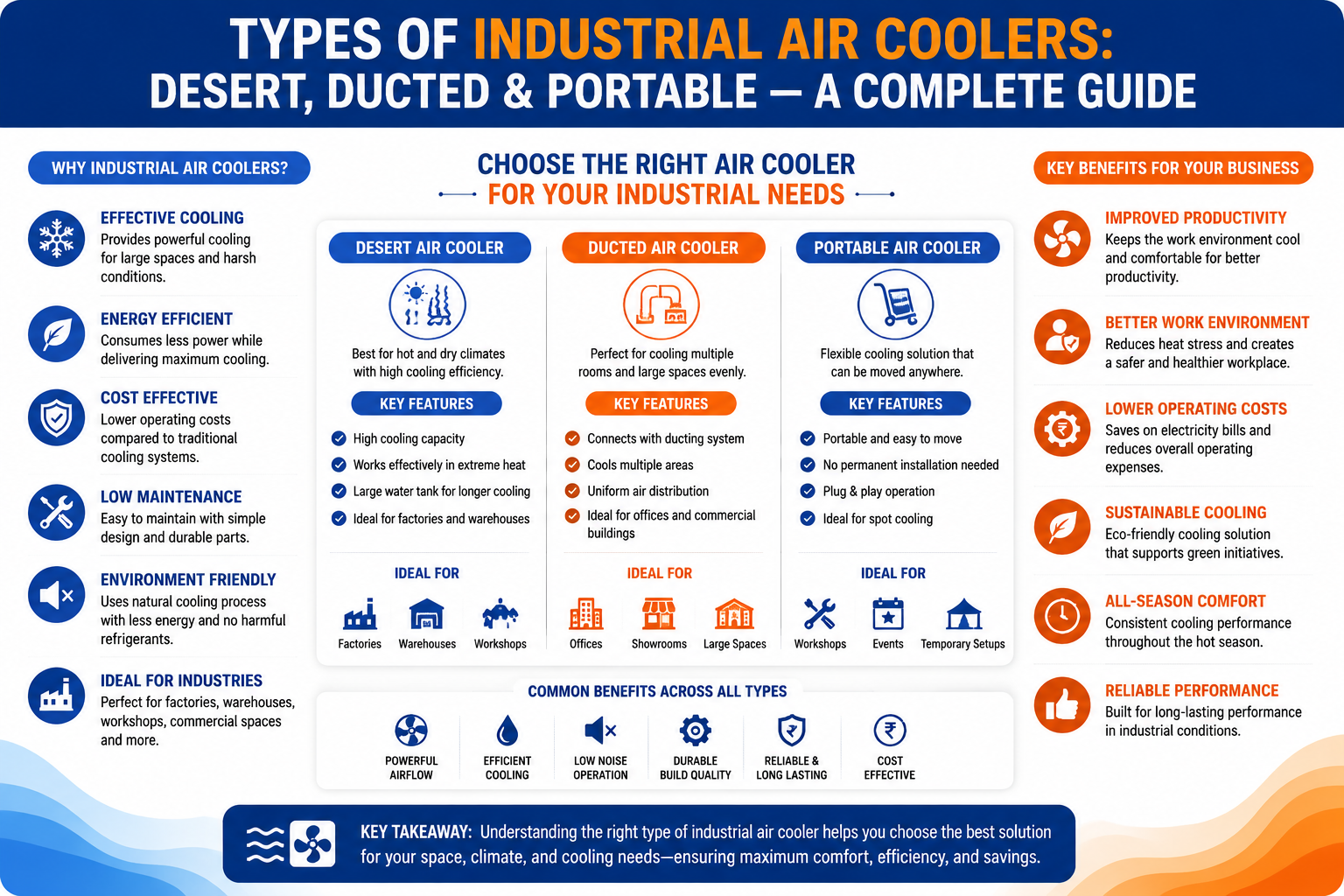
Types of Industrial Air Coolers: Desert, Ducted & Portable — A Complete Guide
Best Industrial Air Cooler Manufacturer in India
When a plant manager walks into a 10,000 square foot production floor in the middle of May, the first question is not should we cool this space — it is which cooling system actually works here.
Industrial air coolers are not one-size-fits-all machines. The wrong type costs money, underperforms, and frustrates your workforce. The right type transforms your facility's environment, cuts energy bills, and keeps operations running at full efficiency.
Megastar Coolers Pvt. Ltd., with 20+ years of manufacturing experience and 1000+ industries served across India, breaks down the three primary types of industrial air coolers — Desert, Ducted, and Portable — so you can make an informed decision before you invest.
How Industrial Evaporative Cooling Works — The Foundation
Before comparing types, understand the core principle. All three cooler types operate on evaporative cooling technology. Hot ambient air passes through water-saturated cooling pads. As water evaporates, it absorbs heat from the air and drops the temperature by 10°C to 15°C. The cooled, fresh air then circulates across the workspace.
No refrigerants. No compressors. Up to 80% lower electricity consumption compared to conventional air conditioning.
Now, the three types differ in how they deliver this cooled air.
Desert Air Coolers (Direct Evaporative Coolers)
What They Are
Desert air coolers are large-capacity, high-airflow units designed for open or semi-open industrial spaces. They draw in hot outside air, pass it through thick cooling pads, and discharge cooled air directly into the space — without any duct network.
How They Work
The unit mounts on a wall, rooftop, or floor stand. A high-powered blower pulls outdoor air through water-soaked cellulose or aspen pads. The cooled air discharges at high velocity into the facility. Fresh air continuously replaces hot, stale air.
Where They Work Best
- Large open manufacturing floors
- Warehouses and logistics facilities
- Automobile workshops and service centres
- Steel fabrication units
- Textile weaving and processing halls
- Any space with natural or designed air outlets
Key Advantages
High Air Volume Output — Desert coolers deliver anywhere from 5,000 CMH to 30,000 CMH of cooled airflow per unit, making them ideal for large open spaces.
No Duct Infrastructure Required — Simple installation. Mount the unit, connect the water supply, power it on. No civil work needed.
Extremely Low Operating Cost — A desert cooler running continuously costs a fraction of what a central AC system costs for the same space.
Works With Open Doors and Windows — Unlike AC, desert coolers perform better when the space has air outlets. Industrial facilities with loading docks, open shutters, and natural ventilation are perfect candidates.
Limitations to Know
Desert coolers lose efficiency in very high-humidity conditions. They are designed for dry-to-moderate humidity environments, which covers most of India's industrial regions during the critical summer months.
Type 2: Ducted Air Coolers (Indirect/Central Evaporative Systems)
What They Are
Ducted air coolers are centrally installed systems that distribute cooled air across multiple zones or rooms through an engineered duct network. They function like central cooling infrastructure — one powerful unit, multiple delivery points.
How They Work
A large central evaporative cooler unit is installed outside or on the rooftop of the facility. A network of insulated ducts carries the cooled air from the central unit to multiple discharge points spread across the production floor, offices, rest areas, or multiple floors of the building.
Where They Work Best
- Multi-floor industrial buildings
- Pharmaceutical manufacturing facilities
- Food processing plants where hygiene and controlled airflow are critical
- Large factories requiring zone-wise cooling control
- Buildings where aesthetics or cleanliness standards restrict wall-mounted units
Key Advantages
Uniform Cooling Across Large Areas — Ducted systems eliminate hot spots. Every corner of the facility receives consistent cooled airflow.
Centralized Control — One control panel manages cooling for the entire facility. Easy to operate, easy to maintain.
Cleaner Facility Appearance — No multiple units mounted across walls. The duct network is integrated into the building structure for a clean, professional look.
Zone-Wise Air Management — Different areas can receive different volumes of airflow based on heat load and occupancy.
Limitations to Know
Ducted systems require upfront civil and duct installation work. Project planning and lead time are longer compared to direct coolers. However, for facilities above 20,000 square feet, the long-term performance and energy savings make ducted systems the superior investment.
Portable Industrial Air Coolers
What They Are
Portable industrial air coolers are freestanding, mobile units that cool specific zones or spot locations within a facility. They sit on heavy-duty castors, require no permanent installation, and move wherever cooling is needed.
How They Work
The portable unit contains a built-in water tank, cooling pads, and a blower. You fill the tank, plug in the power, and direct the cooled airflow to the target area. Some models connect to a continuous water supply for uninterrupted operation.
Where They Work Best
- Spot cooling for specific workstations or machinery
- Temporary cooling for events, construction sites, or project setups
- Warehouses where cooling requirements shift by season or by product
- Facilities undergoing renovation or expansion
- Small workshops and fabrication units
- Outdoor work areas and loading docks
Key Advantages
Zero Installation Required — No mounting, no ducting, no civil work. Unbox, fill with water, and operate.
Complete Mobility — Move the unit from one zone to another in minutes. One cooler can serve multiple locations across different shifts.
Low Capital Investment — Portable coolers offer the lowest entry cost among all industrial cooling types, making them ideal for budget-conscious operations or temporary requirements.
Flexible for Growing Facilities — As your facility expands, simply add more portable units without infrastructure changes.
Limitations to Know
Portable coolers cover smaller areas per unit compared to desert or ducted systems. For large-scale cooling requirements, multiple units are needed, which eventually makes a fixed installation more cost-effective.
Side-by-Side Comparison: Desert vs Ducted vs Portable
| Feature | Desert Cooler | Ducted Cooler | Portable Cooler |
|---|---|---|---|
| Coverage Area | Large (open spaces) | Very Large (multi-zone) | Small to Medium (spot) |
| Installation | Simple wall/roof mount | Civil + duct work required | No installation |
| Mobility | Fixed | Fixed | Fully mobile |
| Airflow Capacity | 5,000–30,000 CMH | 10,000–1,00,000+ CMH | 500–5,000 CMH |
| Best For | Warehouses, factories | Multi-floor plants, pharma | Workstations, events |
| Energy Efficiency | Very High | High | High |
| Capital Cost | Medium | High (infrastructure) | Low |
| Maintenance | Easy | Moderate | Very Easy |
Which Industrial Air Cooler Type Is Right for Your Facility?
Ask yourself these four questions:
1. How large is the space you need to cool? Above 10,000 sq ft → Desert or Ducted. Below 2,000 sq ft or spot-specific → Portable.
2. Is the facility open or enclosed? Open with outlets → Desert cooler performs best. Enclosed multi-room → Ducted system is more effective.
3. Do you need cooling in multiple zones simultaneously? Yes → Ducted system. Single large zone → Desert cooler.
4. Is the requirement permanent or temporary? Permanent → Desert or Ducted. Temporary or flexible → Portable.
Let Megastar Coolers Help You Choose
Megastar Coolers Pvt. Ltd. manufactures all three types — Desert, Ducted, and Portable — with models engineered specifically for Indian industrial conditions. Our application engineers conduct a free site assessment of your facility and recommend the exact cooling configuration that fits your space, budget, and operational needs.
With 20+ years of manufacturing experience, 1000+ industries served, and a 12-month product warranty on every unit, Megastar Coolers is the industrial air cooler manufacturer India's top industries trust.
📞 Contact us today for a free cooling consultation and site assessment.