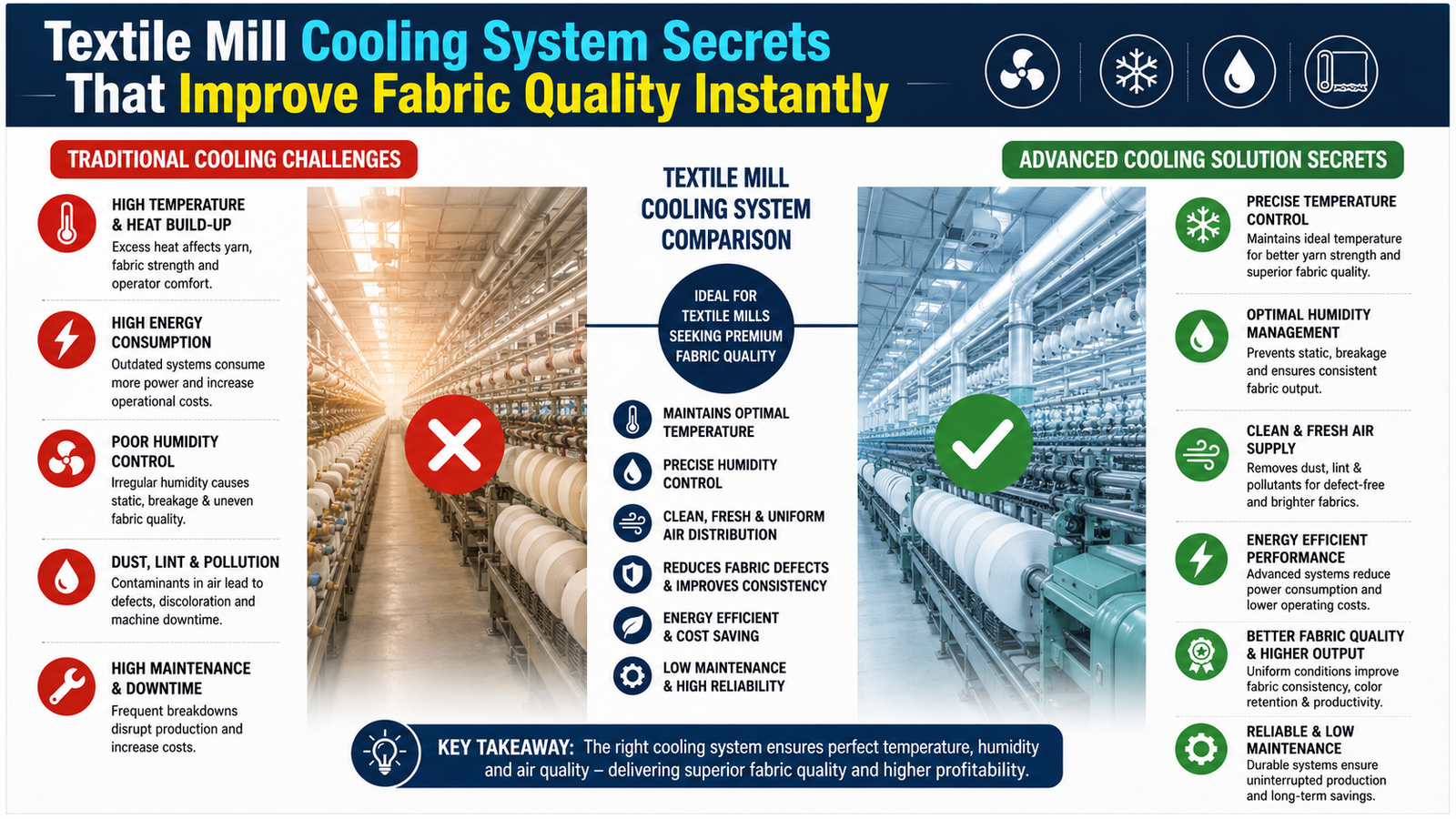
Textile Mill Cooling System Secrets That Improve Fabric Quality Instantly
Smart Cooling Systems for Modern Textile Industries - Megastar Coolers Pvt. Ltd.
Heat is the silent enemy of textile production.
When temperatures inside a spinning room, weaving shed, or knitting floor cross 35°C, yarn breakage rates spike, fabric defects multiply, and worker productivity drops — all at the same time. Every minute of uncontrolled heat costs you in rejected output, machine downtime, and labour inefficiency.
A purpose-built textile mill cooling system solves all three problems at once.
Megastar Coolers Pvt. Ltd. designs and manufactures industrial cooling and ventilation systems specifically engineered for the thermal and humidity demands of textile manufacturing environments. From compact evaporative air coolers for single-shed units to complete duct air cooling systems for large spinning complexes, our solutions keep your production floor at the right temperature — consistently, efficiently, and affordably.
With over 1,000 industrial clients across India relying on our cooling systems, we know what textile mills need. Not just cold air — but precise, humidity-balanced airflow that protects your fibre, your machines, and your people.
Key Benefits of a Textile Mill Cooling System
Installing the right industrial cooling solution in your textile mill delivers measurable results from day one.
Immediate Benefits:
- Lower yarn breakage rates — Stable temperature and humidity reduce fibre brittleness and thread snapping on spinning frames and looms.
- Consistent fabric quality — Controlled airflow prevents uneven moisture absorption, shrinkage irregularities, and weave distortions.
- Higher worker productivity — Cooler working conditions reduce fatigue, heat stress, and absenteeism on the production floor.
- Reduced machine downtime — Industrial coolers remove heat generated by motors, spindles, and looms, extending equipment life.
- Lower energy costs — Megastar's evaporative cooling systems consume up to 80% less electricity than conventional air conditioning units.
- Compliance with factory safety standards — Proper ventilation meets the Factories Act thermal comfort requirements for industrial workplaces.
- Faster return on investment — Most textile mills recover the full cost of installation within 12–18 months through productivity gains and energy savings.
Types of Cooling Systems for Textile Mills
Not every textile unit has the same cooling requirement. Megastar offers the right system for every plant layout, production scale, and budget.
1. Industrial Evaporative Air Coolers
The most cost-effective cooling solution for large open textile sheds. Evaporative coolers draw in hot outside air, pass it through water-saturated cooling media pads, and deliver cool, fresh air directly onto the production floor. They work best in hot and dry climates across North and Central India.
- Ideal for: Spinning mills, weaving sheds, fabric processing units
- Temperature drop: Up to 10–15°C below ambient
- Energy consumption: Fraction of the cost of refrigerated AC
2. Duct Air Cooling Systems
For enclosed or multi-floor textile facilities, ducted cooling systems distribute cooled air uniformly through overhead duct networks. This ensures every corner of your plant receives consistent airflow — no hot spots, no dead zones.
- Ideal for: Large spinning complexes, garment manufacturing units, yarn dyeing plants
- Advantage: Centralised control with zone-wise temperature management
3. HVLS (High-Volume Low-Speed) Fans
HVLS fans move enormous volumes of air at low rotational speeds, creating a destratification effect that eliminates temperature layering inside tall industrial buildings. They complement evaporative coolers to achieve full-floor comfort.
- Ideal for: Warehouses, weaving halls, ginning plants
- Advantage: Silent operation, minimal maintenance, massive airflow coverage per unit
4. Exhaust Fan Systems
Exhaust fans actively push hot, humid, and chemical-laden air out of the production space, creating negative pressure that draws in fresh cooler air. They are essential in dyeing, bleaching, and finishing sections where steam and fumes accumulate.
- Ideal for: Wet processing units, chemical treatment sections
- Advantage: Direct heat and contaminant removal at the source
5. Complete Ventilation Solutions
For mills that need a full-facility approach, Megastar designs integrated ventilation and cooling systems that combine multiple unit types into one coordinated airflow plan — built around your plant's exact floor layout, machine placement, and production schedule.
Why Textile Mills Need Advanced Cooling Systems in 2026
The textile industry in India is changing fast. And so are the cooling demands inside production facilities.
Here is why investing in an advanced textile mill cooling system in 2026 is no longer optional:
1. Machinery runs hotter than ever. Modern high-speed looms, rapier machines, and ring frames generate significantly more heat per square foot than older equipment. Legacy ventilation systems — ceiling fans and open windows — simply cannot handle this thermal load.
2. Energy costs are rising. Mills that rely on split ACs or outdated cooling equipment are paying four to six times more per unit of cooling compared to evaporative systems. In 2026, energy efficiency is a direct competitive advantage.
3. Skilled workers demand better conditions. Labour retention in textile manufacturing is directly linked to the comfort of the work environment. A cooler floor reduces turnover, reduces sick leave, and attracts better operators.
4. Fabric quality standards are tighter. Export buyers in Europe, the US, and East Asia now demand process documentation that includes environmental controls during production. Temperature and humidity logs are becoming part of quality audits.
5. Government incentives favour energy-efficient cooling. Schemes under BEE (Bureau of Energy Efficiency) and several state industrial promotion bodies now offer capital subsidies and accelerated depreciation for energy-efficient cooling installations in manufacturing units.
Humidity Control in Textile Mills: Why It Matters More Than Temperature
Most mill owners focus on temperature. The real damage happens in humidity.
Textile fibres — cotton, polyester, viscose, wool, and blends — are highly sensitive to the moisture content of the surrounding air. When relative humidity (RH) inside a spinning or weaving shed falls below or rises above the optimum range, the consequences are immediate and expensive.
What happens when humidity is too low (below 45% RH):
- Cotton fibres become brittle and lose tensile strength
- Electrostatic charge builds up on synthetic yarns, causing machine jams and uneven feeding
- Thread breakage rates increase sharply on winding and warping machines
- Fabric weight and width can fall outside tolerance limits
What happens when humidity is too high (above 65% RH):
- Yarns absorb excess moisture and become heavy and sticky
- Mould and mildew risk increases in stored raw material and finished goods
- Loom sheds become slippery, increasing worker accident risk
- Dyeing and finishing results become unpredictable
The ideal relative humidity range for most textile operations is between 50% and 65% RH, depending on the fibre type and specific process stage.
Megastar's evaporative cooling systems naturally add controlled moisture to dry air during the cooling process, making them an ideal solution for maintaining the right humidity balance on the production floor — especially in arid regions of Rajasthan, Gujarat, and Madhya Pradesh.
Top Cooling Challenges in Textile Manufacturing Plants
Every textile mill manager knows these problems. Here is how each one connects directly to inadequate or outdated cooling:
Challenge 1: Uneven temperature distribution Large sheds with high roofs trap heat at certain heights and allow cool air to settle near the floor. HVLS fans and ducted systems solve this by continuously circulating and stratifying air evenly across the entire height of the building.
Challenge 2: High heat load from machinery Modern knitting, weaving, and spinning machines generate continuous heat. Industrial coolers with high airflow capacity must be positioned near heat-generating machines to provide spot cooling at the source.
Challenge 3: Seasonal variability North Indian textile mills face extreme summers above 45°C and dry winters. Cooling systems must be designed for peak summer conditions without becoming energy liabilities during cooler months. Megastar's systems are built for India's actual climate conditions — not European or American assumptions.
Challenge 4: Dust and fibre contamination in cooling units Textile environments are fibre-rich. Standard cooling equipment clogs quickly. Megastar industrial coolers are built with heavy-duty filtration and easy-clean maintenance panels designed specifically for fibre-heavy manufacturing environments.
Challenge 5: Water consumption concerns Evaporative coolers use water. Mills in water-scarce regions need systems that optimise water use without compromising cooling performance. Megastar's latest cooling media technology delivers maximum cooling efficiency at minimum water consumption.
Challenge 6: High capital cost of traditional AC systems Central air conditioning for a 50,000 sq ft weaving shed can cost upwards of ₹1–2 crore in installation alone, with massive ongoing electricity bills. Evaporative and hybrid cooling solutions from Megastar deliver comparable comfort at a fraction of the capital and operating cost.
How Proper Cooling Improves Yarn Quality in Textile Mills
The connection between floor temperature, relative humidity, and yarn quality is not theoretical — it is measurable at every stage of production.
In the Blowroom and Carding Section: Consistent temperature prevents moisture variation in raw cotton, enabling more uniform fibre opening and cleaner card web formation. Mills with controlled environments report 8–12% fewer neps in card slivers.
In the Drawing and Combing Section: Controlled humidity reduces fibre cohesion irregularities. Combed slivers maintain better linear density (CV%) when produced in a 55–60% RH environment compared to uncontrolled conditions.
In the Ring Spinning Section: This is where cooling pays the highest dividend. Ring frames are the hottest machines on any spinning floor, and they are also the most sensitive to ambient conditions. Proper cooling reduces end breakages by 15–25%, directly improving machine efficiency and reducing waste.
In Weaving Preparation (Warping and Sizing): Controlled humidity prevents warp thread brittleness, reduces beam breaks, and improves sizing adhesion — all of which translate into higher loom efficiency on the weaving floor.
In the Weaving Shed: Temperature and humidity stability reduce warp tension irregularities, filling breaks, and fabric width variation. Weavers working in a cooler environment make fewer pattern errors and service their machines more attentively.
The bottom line: A properly cooled textile mill produces better fabric. It is not an opinion — it is physics.
How to Choose the Best Cooling System for Your Textile Mill
Buying a cooling system for a textile mill is not like buying an air conditioner for an office. The stakes are higher, the environment is harsher, and the wrong choice costs more than money.
Here are the top features and factors to evaluate:
1. Cooling Capacity (CFM or CMH Rating)
Match the airflow output of the system to the volume of your production space. As a general guideline, a textile spinning shed requires a complete air change every 1–2 minutes. Undersized systems deliver inadequate cooling regardless of brand or price.
2. Humidity Management Capability
Choose systems that allow you to control the moisture content of the delivered air, not just the temperature. This is especially critical for spinning and weaving operations.
3. Fibre-Ready Build Quality
Standard industrial coolers were not designed for textile environments. Look for units with high-density filtration, sealed motor compartments, and accessible cleaning panels. Megastar coolers are specifically designed for fibre-rich, dusty production environments.
4. Energy Efficiency Rating
Compare power consumption (watts) against airflow output (CFM). A high-efficiency evaporative cooler delivers 3,000–4,000 CFM per kilowatt. Refrigerated systems typically deliver 300–500 CFM per kilowatt. The difference in your monthly electricity bill is significant.
5. Noise Level
Weaving sheds are already loud. Cooling systems that add excessive noise affect operator concentration and machine monitoring. Megastar HVLS fans and ducted systems operate at low decibel levels suitable for continuous production environments.
6. Maintenance Requirements
In a working textile mill, cooling system downtime directly means production floor downtime. Choose systems with local service support, readily available spare parts, and simple maintenance procedures. Megastar has a pan-India service network.
7. Scalability
Your mill will grow. Your cooling system should scale with it. Choose a manufacturer who can design both your current installation and future expansions within a unified system architecture.
8. After-Sales Support and Warranty
A cooling system is a capital investment. Validate the manufacturer's warranty terms, response time for service calls, and availability of technical support. Megastar provides comprehensive post-installation support with dedicated service engineers.
Why Choose Megastar Coolers Pvt. Ltd. for Your Textile Cooling Solution
There are dozens of industrial cooler suppliers in India. Here is what makes Megastar Coolers Pvt. Ltd. the trusted choice for textile mills specifically:
Textile-Specific Engineering Experience We have designed and installed cooling systems for spinning mills, weaving units, knitting plants, dyeing houses, and garment factories across India. We understand the unique airflow dynamics, humidity requirements, and maintenance constraints of textile production environments. We do not sell generic industrial coolers — we build textile cooling systems.
Complete Product Range Under One Roof From individual evaporative air coolers to full-facility duct cooling networks, HVLS fans, exhaust ventilation systems, and integrated climate control solutions — Megastar provides everything your textile mill needs from a single, accountable supplier.
1,000+ Industrial Installations Our cooling systems are running today in warehouses, poultry farms, greenhouses, hospitals, schools, and most importantly, textile mills across every major industrial cluster in India — including Surat, Tiruppur, Ludhiana, Bhilwara, Coimbatore, and Ahmedabad.
Energy-Efficient Technology Megastar evaporative coolers consume up to 80% less electricity than conventional refrigerated systems. For a textile mill running 16–20 hours a day, 300+ days a year, this difference translates into lakhs of rupees in annual savings.
Made-in-India Manufacturing Quality Our products are manufactured in India to international quality standards. This means faster delivery, lower cost, easier local spare part availability, and full technical support in your language.
Custom System Design — Free of Charge Our technical team visits your facility, assesses your production layout, machine placement, and thermal load, and designs a cooling system blueprint tailored to your specific plant. No standard solutions. No guesswork.
Transparent Pricing and Fast Delivery We provide detailed, itemised quotations with clear installation timelines. No hidden costs. No inflated lead times.
Frequently Asked Questions
Q1. What is the ideal temperature for a textile spinning mill?
The recommended ambient temperature for a spinning mill is between 26°C and 32°C, depending on the fibre type. Cotton spinning performs best at 28–30°C with 55–60% relative humidity. Temperatures above 35°C cause a measurable increase in yarn breakage and machine stoppages.
Q2. How is an evaporative cooling system different from air conditioning in a textile mill?
Air conditioning refrigerates air using a compressor and refrigerant, which is expensive to run and requires a sealed environment. Evaporative cooling cools air through water evaporation, which is far more energy-efficient and works well in open or semi-open textile production spaces. For most Indian textile mills, evaporative systems provide the best balance of cost, performance, and practicality.
Q3. Can a cooling system also control humidity in a textile mill?
Yes. Megastar evaporative cooling systems naturally introduce controlled moisture into dry air during the cooling process, making them effective at raising relative humidity in dry production environments. For facilities that need precise RH control, we design systems with integrated humidity management capability.
Q4. How many coolers does a 10,000 sq ft textile shed require?
The exact number depends on ceiling height, machine heat load, and local climate. As a general estimate, a 10,000 sq ft shed with a 4.5-metre ceiling in a hot climate typically requires 3–5 high-capacity industrial coolers with appropriate exhaust fan support. Our technical team calculates this precisely for every client at no charge.
Q5. What is the typical installation time for a textile mill cooling system?
For a standard mid-size textile mill, installation typically takes between 3 and 7 working days depending on system complexity and plant accessibility. We plan all installations to minimise production disruption.
Q6. Does Megastar provide after-sales service for cooling systems?
Yes. Megastar provides comprehensive after-sales service including annual maintenance contracts (AMC), on-call breakdown support, and genuine spare parts supply across India. Our service engineers are trained specifically on Megastar products.
Q7. What is the lifespan of a Megastar industrial cooling system?
With regular maintenance, Megastar industrial air coolers and HVLS fans are designed for a service life of 10–15 years. Our cooling media pads typically last 3–5 years before requiring replacement, depending on water quality and usage hours.
Q8. Do you offer site visits before quoting?
Yes. For medium and large textile facilities, our technical team conducts a free on-site assessment to understand your plant layout, cooling requirements, and installation constraints before preparing a system design and quotation.
Contact Megastar Coolers for Textile Cooling Solutions
Your textile mill deserves a cooling system that is engineered for the job — not adapted from a generic industrial product.
Megastar Coolers Pvt. Ltd. is ready to help you solve your heat, humidity, and ventilation challenges with solutions designed specifically for textile manufacturing.
Here is how to get started:
Step 1: Contact our textile cooling specialists through the form below or call us directly.
Step 2: Our technical team schedules a free facility assessment at your plant.
Step 3: We prepare a custom cooling system design and transparent quotation.
Step 4: Upon approval, we handle full installation with minimal disruption to your production.
Step 5: You get a cooler, more productive, more efficient textile mill — backed by Megastar's full after-sales support.
Megastar Coolers Pvt. Ltd. India's Leading Manufacturer & Supplier of Industrial Air Coolers, HVLS Fans, and Ventilation Solutions Trusted by 1,000+ Industries Across India
Call Us: +91 86077 00 370 , +91 86077 00 373
Email Us: megastarcoolers@gmail.com , mtex@ymail.com
Website: www.megastarcoolers.com
Address: 7, Shri Ram Marg, Sector-25, HUDA, Panipat – 132103
Megastar Coolers Pvt. Ltd. — Cooling Solutions for Spinning Mills, Weaving Units, Knitting Plants, Dyeing Houses, and Garment Manufacturing Facilities across India.