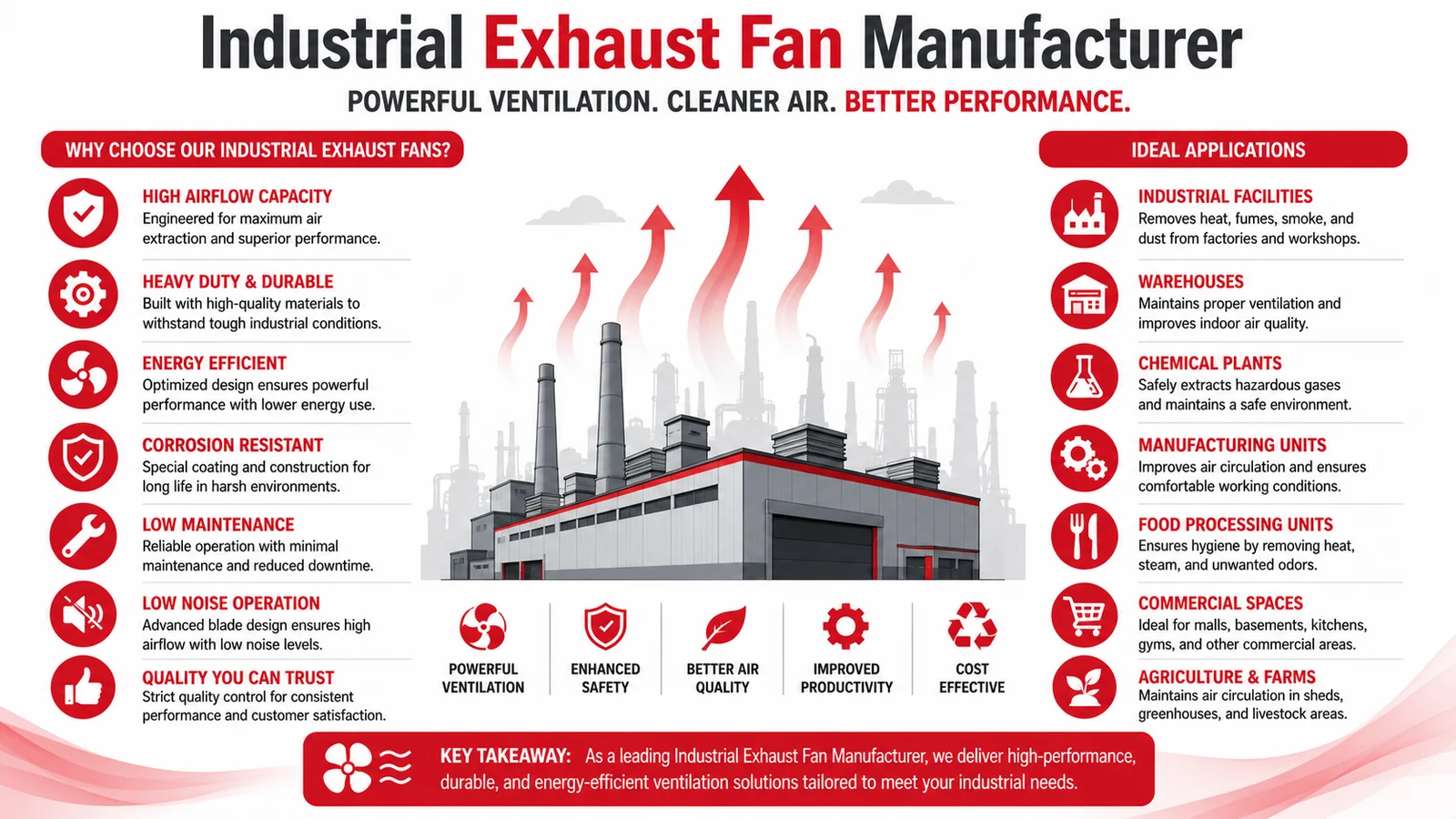
Industrial Exhaust Fan Manufacturer for Factories , Warehouse & Sheds
Industrial Exhaust Fan Manufacturer: A Complete Technical Guide for Factory and Shed Ventilation Buyers
When a factory floor runs at 46°C in June, when fumes accumulate near a welding station, when workers slow down because the air in the shed has nowhere to go — the problem is almost always the same. The ventilation system is not moving enough air. And in the majority of cases, the solution starts with selecting the right industrial exhaust fan from a manufacturer who understands the specific demands of your facility.
This guide is written for plant engineers, facility managers, procurement heads, and project consultants evaluating industrial exhaust fan manufacturers, shed exhaust fan suppliers, and heavy duty exhaust fan options for factories, warehouses, processing plants, and large-format industrial sheds. It covers how industrial exhaust fans work, what separates a manufacturer from a distributor, how to read technical specifications, what heavy duty exhaust fan price structures look like across different capacity ranges, and what to verify before placing any significant order with a factory exhaust fan supplier.
What Is an Industrial Exhaust Fan and How Does It Work?
An industrial exhaust fan is a mechanical ventilation device designed to extract hot, stale, humid, or contaminated air from an enclosed industrial space and expel it outside. Unlike domestic exhaust fans, which move small volumes of air for bathroom or kitchen ventilation, industrial exhaust fans are engineered to move tens of thousands of cubic feet of air per minute continuously, under adverse operating conditions, and often against static pressure from ductwork or restricted outlet openings.
The operating principle is straightforward. The fan creates a negative pressure zone inside the facility by exhausting air at a higher rate than natural infiltration can replace it. Fresh outside air is then drawn in through designated intake openings — windows, louvres, evaporative coolers, or air inlets — replacing the hot or contaminated air that has been expelled. When this exhaust-intake balance is properly designed, the result is a controlled airflow pattern that removes heat at the source, dilutes contaminants, and maintains a bearable working environment even in extreme summer conditions.
The effectiveness of an industrial exhaust fan installation is determined by three variables working together: the fan's airflow capacity (measured in CFM or CMH), the static pressure it can work against, and the cross-sectional area and positioning of the intake openings. An exhaust fan operating without adequate intake area simply starves for air and delivers a fraction of its rated performance — a mistake that is common in poorly designed installations and one that a credible industrial exhaust fan manufacturer will help you avoid during the design phase.
Types of Industrial Exhaust Fans: What Manufacturers Produce and What Each Is Used For
Industrial exhaust fan manufacturers produce several distinct fan types, each suited to specific applications, mounting configurations, and performance requirements. Understanding which type fits your facility is the starting point for any procurement decision.
Axial Flow Exhaust Fans
Axial fans move air parallel to the fan shaft. They are the most widely used type in industrial facilities because they can move very large volumes of air at relatively low static pressures — which is the typical requirement for open factory sheds, warehouses, and large production halls where air needs to be moved across a wide area without significant ductwork resistance.
Axial exhaust fans for industrial applications are available in blade diameters from 300mm to 1,800mm, with airflow capacities ranging from approximately 3,000 CFM for smaller units to over 200,000 CFM for large-diameter direct-drive models. They are typically mounted in wall openings, roof exhaust panels, or purpose-built frames at the high points of shed walls — where accumulated hot air is concentrated.
For shed exhaust fan installations specifically, axial fans are the dominant choice because shed ventilation typically involves large open volumes, low static pressure, and a requirement for high air change rates. A well-specified axial shed exhaust fan from a reputable manufacturer will achieve the 20–40 air changes per hour that an industrial shed requires to maintain tolerable working temperatures.
Centrifugal Exhaust Fans
Centrifugal fans move air at right angles to the fan inlet, generating significantly higher static pressure than axial fans of equivalent size. They are used when air must be moved through ductwork, filters, or restricted outlet paths — common in process ventilation, fume extraction, dust collection systems, and multi-floor facilities where exhaust air must travel through long duct runs before being expelled outside.
Industrial centrifugal exhaust fans from established manufacturers are rated by airflow (CFM or CMH), static pressure (Pascals or mm WG), and motor power (kW). For applications involving corrosive, humid, or high-temperature exhaust streams — such as chemical processing, electroplating, or heat treatment — manufacturers supply centrifugal fans in corrosion-resistant materials including FRP (Fibre Reinforced Plastic), stainless steel, and special alloy construction.
Roof Exhaust Fans (Turbo Ventilators and Power Roof Ventilators)
Roof-mounted exhaust fans are designed specifically for factory shed and warehouse applications where wall space is limited or where hot air stratification near the roof must be addressed directly at the highest point of the building. They are available in natural-draft (wind-driven turbine) and powered configurations.
Powered roof exhaust fans from industrial manufacturers deliver consistent, controllable airflow regardless of wind conditions — a significant advantage over passive turbine ventilators, which are entirely dependent on wind speed and direction. For facilities operating in low-wind environments or requiring precise air change rates, powered roof exhaust fans are the technically appropriate choice.
Heavy Duty Exhaust Fans for High-Temperature and Aggressive Environments
Standard industrial exhaust fans are rated for continuous operation in ambient temperatures up to approximately 50°C. Heavy duty exhaust fans — designed for foundries, forge shops, kiln rooms, chemical plants, and high-heat process areas — are built to operate in higher ambient temperatures, handle particulate-laden airstreams, and withstand chemically aggressive environments that would degrade standard fan components within months.
Key features that distinguish heavy duty exhaust fans from standard industrial models include cast iron or heavy gauge fabricated steel housings, dynamically balanced impellers designed for high-particulate airstreams, high-temperature motor windings (Class F or Class H insulation), and sealed or externally-mounted bearings that remain accessible for maintenance without dismantling the fan assembly.
When evaluating heavy duty exhaust fan price, buyers should account for the significantly longer service life of properly specified heavy duty units versus repeated replacement of undersized standard fans in demanding applications. A heavy duty unit with a 10-year design life in a forge shop application is a better economic decision than a standard fan replaced every two to three years.
Key Technical Specifications Every Buyer Must Understand
Whether you are purchasing from an industrial exhaust fan manufacturer directly or through a factory exhaust fan supplier, you need to read and verify these specifications before approving any purchase.
Airflow Capacity: CFM and CMH
Airflow is the fundamental specification. It is expressed in Cubic Feet per Minute (CFM) or Cubic Meters per Hour (CMH). To determine the airflow you need, calculate your facility volume (length × width × height in the appropriate units) and multiply by the target number of air changes per hour for your application.
General guidance for air change rates by facility type:
| Facility Type | Recommended Air Changes per Hour |
|---|---|
| General manufacturing / assembly | 20–30 |
| Textile mill / garment factory | 25–40 |
| Foundry / forge shop | 40–60 |
| Warehouse / logistics | 15–25 |
| Chemical processing | 30–60 (process-dependent) |
| Food processing | 20–40 |
| Pharmaceutical manufacturing | 20–30 (plus process requirements) |
Always add a 15–20% capacity margin to your calculated requirement to account for static pressure losses, future load increases, and fan aging.
Static Pressure Rating
Every fan has a performance curve that shows how airflow capacity decreases as static pressure increases. A fan rated at 50,000 CFM in free air (zero static pressure) may only deliver 35,000 CFM against 50 Pascals of static pressure. Always specify and verify fan performance at the actual static pressure your installation will generate — not the free-air rating.
For open shed applications with wall-mounted exhaust and unobstructed intake, static pressure is typically low (20–50 Pa). For ducted applications, calculate your duct resistance carefully before selecting a fan model.
Motor Power and Efficiency
Industrial exhaust fans are driven by IE2 or IE3 efficiency-class motors in properly manufactured units. IE3 motors — the current standard for industrial applications in India under BEE regulations — consume 3–5% less electricity than equivalent IE2 motors, which translates to measurable savings in facilities running fans for 4,000–8,000 hours per year.
Verify the motor power rating (kW), supply voltage (typically 415V 3-phase for industrial units above 1 kW), and efficiency class with your supplier or manufacturer before purchase. Fan manufacturers who cannot provide motor efficiency class documentation are likely supplying non-compliant or underspecified motors.
Blade Material and Pitch
Fan blade material and geometry directly affect performance, durability, and maintenance requirements. Common blade materials in industrial exhaust fans include:
Aluminium alloy blades are lightweight, corrosion-resistant, and suitable for general industrial applications. They are standard in most commercial and light industrial axial fans.
FRP (Fibre Reinforced Plastic) blades resist corrosion and moisture better than aluminium and are preferred in humid, chemical, or marine environments. They are lighter than steel alternatives and allow more complex aerofoil profiles.
MS (Mild Steel) fabricated blades are used in heavy duty exhaust fans for high-temperature or abrasive environments. They are more robust than aluminium under impact loads but require protective coating in corrosive conditions.
Adjustable pitch blades — available in larger industrial fans — allow airflow to be optimized for the installation conditions without changing the fan unit, which is particularly useful in variable-load applications.
Frame and Housing Construction
The fan frame and housing must match the environmental demands of the installation. Powder-coated MS construction is standard for general industrial applications. Hot-dip galvanized or stainless steel construction is specified for outdoor, high-humidity, or corrosive environments. FRP housings are used in chemical processing applications where metal would be attacked by process fumes.
Verify the housing specification matches your environment. A standard powder-coated fan in a chemical plant exhaust application will show corrosion failure within 12–18 months regardless of blade or motor quality.
Industrial Exhaust Fan Price: What Determines Cost Across Capacity Ranges
Heavy duty exhaust fan price varies significantly based on fan size, construction specification, motor grade, and whether the unit is purchased from a manufacturer directly or through a shed exhaust fan supplier or distributor. The following ranges reflect typical market pricing in India for industrial-grade units.
| Fan Type | Blade Diameter / Capacity | Typical Price Range (INR) |
|---|---|---|
| Axial wall exhaust fan (standard) | 300mm–600mm | ₹3,500–₹18,000 |
| Axial wall exhaust fan (industrial) | 600mm–900mm | ₹15,000–₹55,000 |
| Heavy duty axial exhaust fan | 900mm–1,200mm | ₹45,000–₹1,20,000 |
| Heavy duty exhaust fan (large diameter) | 1,200mm–1,800mm | ₹90,000–₹2,50,000+ |
| Centrifugal exhaust fan (industrial) | 500–10,000 CMH | ₹12,000–₹80,000 |
| FRP centrifugal fan (corrosion-resistant) | 1,000–20,000 CMH | ₹35,000–₹2,00,000+ |
| Powered roof exhaust fan | 5,000–50,000 CMH | ₹20,000–₹1,50,000 |
These are equipment-only prices and exclude installation, electrical work, structural framing for wall openings, and commissioning. Total installed cost typically runs 30–50% above equipment cost for wall-mounted industrial units and higher for roof-mounted configurations requiring structural modifications.
When evaluating price from any factory exhaust fan supplier or manufacturer, always compare on a specification-matched basis. A ₹15,000 fan and a ₹45,000 fan in the same diameter category may be entirely different products — different motor grades, different blade materials, different housing construction, and different design service lives. Price comparison without specification comparison is not procurement; it is guessing.
Industrial Exhaust Fan Manufacturer vs. Factory Exhaust Fan Supplier: Understanding the Difference
This distinction matters more than most buyers realize, particularly for large-volume orders, custom specifications, or applications that require performance guarantees.
An industrial exhaust fan manufacturer designs and produces fans in their own facility. They control the raw material inputs, manufacturing processes, quality inspection, and performance testing. They can produce custom specifications — non-standard sizes, special materials, modified motor ratings — because they have the engineering capability to modify their own designs. They can provide factory test certificates, performance curve data from actual testing, and type-approval documentation. For technically demanding applications or large-volume procurement, buying direct from a manufacturer eliminates the intermediary markup and gives you direct accountability for product performance.
A factory exhaust fan supplier or shed exhaust fan supplier typically sources fans from one or more manufacturers and sells them under their own brand or as branded resellers. This is a legitimate supply chain model — many reliable suppliers add value through local stock availability, technical advisory, project management, and after-sales service that manufacturers operating at national or multi-state scale may not provide directly. However, a supplier who cannot provide the manufacturer's technical documentation, cannot arrange factory visits, and cannot trace quality issues back to the production source is a risk for industrial buyers with performance-critical requirements.
The practical question to ask any potential supplier is: who manufactures this product, where, and can you provide manufacturer test certificates and performance curves for the specific model I am purchasing?
What to Look for in an Industrial Exhaust Fan Manufacturer
Evaluating a manufacturer — whether directly or through their authorized supplier — requires going beyond catalog specifications and price lists.
Manufacturing Capability and Quality Systems
A credible industrial exhaust fan manufacturer will have in-house manufacturing for the core components — impeller fabrication or casting, motor mounting structures, and housing fabrication — and will perform dynamic balancing of fan assemblies before dispatch. Dynamic imbalance in a large industrial fan causes vibration, bearing failure, and structural fatigue in the mounting frame. Ask any manufacturer whether they perform dynamic balancing and to what standard (ISO 1940 Grade G6.3 is the typical industrial requirement for exhaust fan impellers).
Quality system certification — ISO 9001 or equivalent — is a baseline expectation for any manufacturer supplying industrial-grade equipment. It does not guarantee product quality by itself, but the absence of any quality system documentation is a meaningful warning signal for industrial buyers.
Product Range Depth
A manufacturer with a genuine product range — covering multiple fan types, blade diameters from 300mm to 1,800mm or beyond, and variants for different environmental conditions — has the engineering infrastructure to support custom orders and handle your requirements as they evolve. A manufacturer with a narrow range of a few standard models has limited flexibility for non-standard requirements.
Application Engineering Support
The best industrial exhaust fan manufacturers employ application engineers who can review your facility drawings, assess your heat load and ventilation requirements, and recommend a system design — not just sell you a model from a catalog. This capability is especially important for complex installations involving multiple fans, duct systems, or process ventilation where fan selection interacts with system performance in non-obvious ways.
After-Sales Service and Spare Parts Availability
An industrial exhaust fan running 6,000–8,000 hours per year will require bearing replacement, belt replacement (for belt-drive models), and periodic motor servicing. Confirm that the manufacturer or their authorized shed exhaust fan supplier network can supply spare parts — particularly bearings, belts, and impeller assemblies — within your region and within an acceptable lead time. A fan with an 18-month spare parts lead time is a liability in a continuous-operation facility.
Reference Installations and Industry Experience
Any manufacturer worth considering for industrial supply will have a documented installation base in facilities similar to yours. Ask for references by industry and facility size. Visiting an operating installation of the specific fan model you are considering is the most reliable form of product evaluation available.
How to Calculate the Number of Exhaust Fans Required for Your Factory or Shed
Getting the number and placement of fans right requires a systematic calculation, not an estimate. Here is the method.
Step 1: Calculate facility volume. Measure the internal length, width, and average height of the space. For pitched or arched roofs, use the average height between eave and ridge.
Example: 80 metres × 30 metres × 8 metres average height = 19,200 cubic metres.
Step 2: Convert to CMH at your target air change rate. Multiply volume by target air changes per hour.
Example: 19,200 m³ × 30 air changes/hour = 576,000 CMH required.
Step 3: Determine fan airflow at operating static pressure. Look up the fan performance curve at the estimated installation static pressure (typically 20–50 Pa for open shed applications). Do not use free-air (zero static pressure) ratings.
Example: Selected fan delivers 18,000 CMH at 30 Pa static pressure.
Step 4: Calculate number of fans required. Divide total required airflow by per-fan airflow at operating static pressure.
Example: 576,000 CMH ÷ 18,000 CMH = 32 fans.
Step 5: Apply a 15–20% safety margin and round up. Example: 32 × 1.18 = 38 fans. Specify 38 units minimum.
Step 6: Verify intake area is sufficient. Total intake free area must be at least equal to the total fan exhaust area, and preferably 20–30% greater, to prevent intake restriction from starving the fans. Insufficient intake area is the most common cause of underperformance in completed industrial exhaust fan installations.
Common Problems with Industrial Exhaust Fan Installations and How to Prevent Them
Problem: Fans are running but the factory is still hot. The most common cause is insufficient intake area. If the exhaust fans cannot draw enough fresh air in through intake openings, they recirculate internal air rather than replacing it. Verify intake free area equals or exceeds exhaust fan total outlet area. Secondary causes include fans operating against higher-than-assumed static pressure, or fans placed too close to the exhaust face — reducing effective airflow before it covers the working zone.
Problem: Excessive noise from the fan installation. Noise above the manufacturer's rated dBA level typically indicates one of three problems: impeller imbalance from accumulated dust or physical damage, worn bearings, or fan operating significantly above its rated airflow (which occurs when actual static pressure is lower than designed, causing the fan to run further out on its performance curve). Address each in sequence before assuming the fan is defective.
Problem: Bearing failures occurring too frequently. Premature bearing failure in industrial exhaust fans is almost always a maintenance or installation error, not a manufacturing defect. Common causes include under-lubrication, over-lubrication, misalignment between motor and fan shaft (in belt-drive configurations), or installation in an environment significantly more humid or corrosive than the bearing specification allows. Sealed, grease-filled bearings for life-lubricated applications require replacement — not regreasing — at manufacturer-specified intervals.
Problem: Motor overheating and tripping thermal protection. If an industrial exhaust fan motor trips repeatedly on thermal overload, the motor is being asked to do more work than it is rated for. This occurs when actual static pressure is lower than designed (the fan runs at higher flow, drawing more power), when supply voltage is outside the motor's rated range, or when ambient temperature around the motor exceeds its design limit. Do not simply reset the thermal protector and continue — investigate and resolve the root cause.
Problem: Corrosion damage within the first operating season. Material specification mismatch with the environment. A powder-coated mild steel fan in a humid, chemical, or marine-adjacent environment will corrode rapidly. Review the environment specification with the manufacturer and upgrade to appropriate corrosion-resistant construction.
Factors to Evaluate Before Placing an Order with a Shed Exhaust Fan Supplier or Manufacturer
Use this checklist before committing to any purchase:
Confirm that the fan's airflow capacity at your operating static pressure — not free-air rating — meets your calculated requirement.
Verify motor power and efficiency class (IE3 for new installations above 0.75 kW is best practice and increasingly mandatory under BEE guidelines).
Confirm blade material and housing construction match your operating environment — temperature, humidity, chemical exposure, and particulate load.
Request dynamic balancing certification (ISO 1940 Grade G6.3 or better) for fans above 600mm diameter.
Verify that spare parts — bearings, belts, impeller assemblies — are available within your region and confirm lead times.
For orders above 10 units, request a factory test report for the batch, not just a type-approval certificate.
Confirm warranty terms — including whether labor for warranty claims is covered and what the process is for defective units.
For custom specifications, get the manufacturing drawing and dimensional confirmation before production release.
Ask the factory exhaust fan supplier or manufacturer for two to three reference contacts at similar installations you can speak with directly.
Industries Where Industrial Exhaust Fan Manufacturers Supply Regularly
Understanding the industries that drive demand for industrial exhaust fans helps buyers assess whether a manufacturer has relevant experience with their application's specific requirements.
Textile and garment manufacturing requires high-volume exhaust in weaving sheds, dyeing units, and finishing halls where heat, humidity, and fiber-laden air combine to create a demanding environment. Shed exhaust fan suppliers serving the textile industry typically offer corrosion-resistant models suited to humid conditions.
Automotive component manufacturing uses exhaust fans in press shops, paint booths, and assembly halls. Paint booth exhaust fans are explosion-proof rated and require manufacturers with specific certifications for hazardous area equipment.
Steel and metal fabrication operations require heavy duty exhaust fans capable of handling high ambient temperatures and airstreams carrying weld fume, metal oxide particles, and grinding dust. FRP or stainless impellers are often specified for aggressive fume environments.
Chemical and pharmaceutical manufacturing demands exhaust fans in corrosion-resistant materials, with motors and electrical components rated for potentially explosive atmospheres (ATEX or PESO certification) where solvent vapors may be present.
Food processing and cold storage facilities use exhaust fans in production halls and loading bays. Hygienic design requirements in food processing facilities — smooth surfaces, no horizontal ledges, no corrodible materials — influence fan specification significantly.
Logistics and warehousing — particularly large distribution centers and e-commerce fulfillment facilities operating in North Indian summers — have high demand for shed exhaust fan systems that can maintain tolerable working temperatures in 50,000 to 200,000 sq. ft. of open space.
Conclusion: Choosing the Right Industrial Exhaust Fan Manufacturer or Supplier
The difference between a factory that runs productively through a North Indian summer and one that loses output, suffers equipment failures, and struggles with workforce heat stress often comes down to a single decision: the selection of the right industrial exhaust fan system from a manufacturer or supplier who genuinely understands the engineering requirements of the application.
When evaluating any industrial exhaust fan manufacturer or factory exhaust fan supplier, the criteria that matter are technical depth, manufacturing transparency, specification integrity, and service reliability — not catalog price alone. A correctly specified, properly installed heavy duty exhaust fan system will pay for itself in productivity, energy efficiency, and equipment longevity within two to four operating seasons in most industrial applications.
Get the specification right. Get the supplier qualified. And make the decision based on performance data at your operating conditions — not on brochure numbers or the lowest heavy duty exhaust fan price on the first quote you receive.