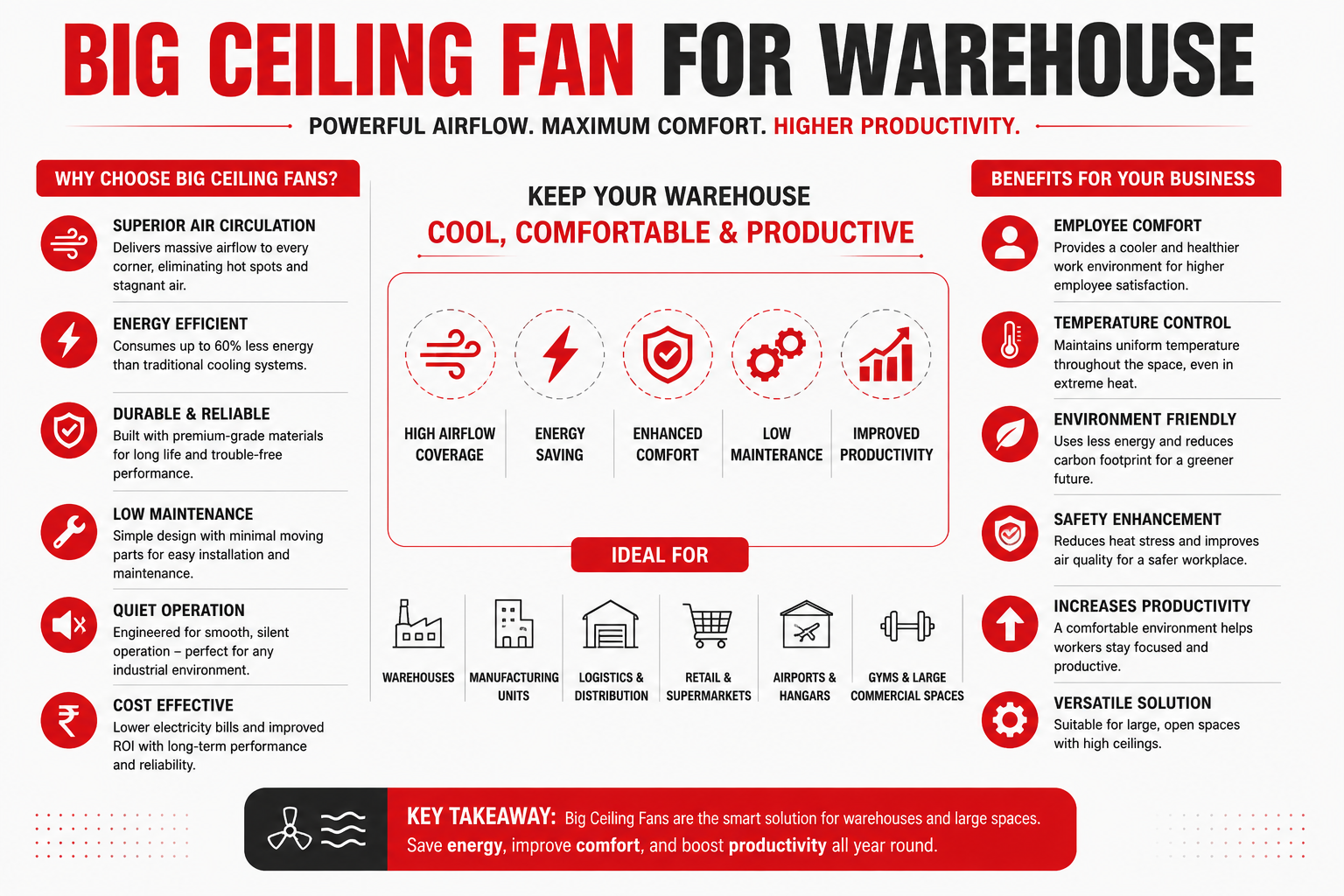
Big Ceiling Fan for Warehouse | Best Large Industrial Celling Fans in India
Big Ceiling Fan for Warehouse: Buyer's Guide to Large Industrial Ceiling Fans in India - Megastar Cooler Pvt. Ltd.
A warehouse that stays cool in May and June is not a luxury — it is an operational necessity. When floor temperatures climb past 40°C, picking accuracy drops, staff fatigue sets in faster, equipment runs hotter, and perishable goods face spoilage risk. The most cost-effective solution for large-format warehouse cooling in India is also one of the most overlooked: a properly specified big ceiling fan for warehouse use, installed at the right height, in the right quantity, and from the right supplier.
This buyer's guide covers everything a warehouse owner, facility manager, or procurement decision-maker needs to know before investing in large industrial ceiling fans in India — from how these fans work and what differentiates a warehouse-grade product from a standard commercial fan, to warehouse cooling fan price ranges across different capacity tiers, and the key questions to ask before signing a purchase order.
Why Warehouses Need Big Ceiling Fans — Not Standard Commercial Fans
Most warehouse managers initially underestimate the airmovement requirement of their space. A warehouse of 30,000 square feet with 10-metre ceilings has roughly 27,900 cubic metres of air volume — significantly more than a commercial office or retail store of equivalent floor area. Standard ceiling fans, even large domestic models, are designed for ceiling heights of 3 to 4.5 metres and air volumes a fraction of what a warehouse involves.
A big ceiling fan for warehouse applications is a fundamentally different product. Blade diameters for industrial warehouse fans typically range from 1,800mm (6 feet) at the entry level to 7,600mm (25 feet) for High Volume Low Speed (HVLS) fans used in the largest distribution centres. The physics are straightforward: a larger blade diameter moves a greater volume of air per rotation, which means a single large ceiling fan can cover a floor area that would require dozens of standard fans to address. Fewer motors running at lower speeds also means lower energy consumption and significantly lower noise levels — both important in warehouses with large workforces and continuous operations.
For large industrial ceiling fan installations in India, where ambient temperatures in warehouses across Delhi NCR, Rajasthan, Maharashtra, Gujarat, and Telangana regularly exceed 44°C in summer, the air movement provided by correctly sized ceiling fans reduces the apparent temperature felt by workers by 5°C to 8°C. This is not air conditioning — the air temperature itself does not change — but the increase in air velocity across the skin accelerates evaporative cooling of perspiration, which is the mechanism by which moving air reduces heat stress in industrial environments.
Types of Big Ceiling Fans Suitable for Warehouse Applications
Not all large ceiling fans are built for warehouse conditions. Understanding the available product categories helps buyers narrow the field before evaluating specific suppliers and warehouse cooling fan prices.
HVLS Fans (High Volume Low Speed)
HVLS fans are the premium category of big ceiling fan for warehouse use. Blade diameters range from 3,000mm (10 feet) to 7,600mm (25 feet). They rotate at very low RPM — typically 40 to 100 RPM — which is why a single fan can produce a column of air that reaches the floor and spreads outward across a diameter of 30 to 55 metres of floor space.
A single 7.3-metre HVLS fan can effectively cover 1,500 to 2,500 square metres of warehouse floor — coverage that would require 15 to 20 standard 1,200mm ceiling fans to approximate. In large warehouses, fulfillment centres, aircraft hangars, and cold chain loading docks, HVLS fans are the specification choice of global logistics operators and large-format retailers.
HVLS fans in India are available from both imported brands and domestic manufacturers. Large industrial ceiling fan pricing in India for HVLS units of 4.2 metres (14 feet) and above typically ranges from ₹1,20,000 to ₹5,00,000 per unit depending on blade diameter, motor type (direct drive vs. gearbox), and control system sophistication.
Industrial High-Speed Ceiling Fans (1,800mm–2,400mm)
For smaller warehouses, smaller budget requirements, or facilities with lower ceiling heights (6 to 9 metres), industrial ceiling fans in the 1,800mm to 2,400mm (6 to 8 feet) blade diameter range offer a practical middle ground between standard commercial fans and full HVLS systems.
These fans rotate at higher RPM than HVLS units — typically 200 to 400 RPM — and cover smaller floor areas per unit (approximately 90 to 180 square metres per fan, depending on ceiling height and blade diameter). They are mounted on drop rods that position the fan at the optimal height above the working zone, typically 4.5 to 6 metres above floor level for warehouse applications.
Warehouse cooling fan price for industrial ceiling fans in the 1,800mm to 2,400mm range in India starts at approximately ₹18,000 for entry-level models and runs to ₹75,000 or more for industrial-grade units with sealed motors, IP-rated enclosures, and extended warranty coverage.
Directional Industrial Pedestal and Column Fans (Supplemental Use)
For spot cooling in specific warehouse zones — loading bays, packing stations, quality control areas — directional pedestal or column fans supplement the primary ceiling fan system. These are not a substitute for overhead coverage but address localised high-traffic zones where additional airflow is needed beyond what the ceiling fans deliver to the general floor area.
Large Industrial Ceiling Fan India: Key Technical Specifications to Compare
When evaluating large industrial ceiling fans in India from any supplier, the following specifications determine whether the product will actually perform in your warehouse environment.
Blade Diameter and Coverage Area
This is the primary sizing specification. Larger diameter means greater floor coverage per fan. However, blade diameter alone does not determine performance — blade pitch, aerofoil profile, and rotational speed collectively determine actual airflow volume.
As a practical reference:
| Blade Diameter | Typical Coverage per Fan | Suitable Ceiling Height |
|---|---|---|
| 1,800mm (6 ft) | 70–100 sq. metres | 5–8 metres |
| 2,400mm (8 ft) | 100–160 sq. metres | 6–10 metres |
| 3,000mm (10 ft) | 200–350 sq. metres | 7–12 metres |
| 4,200mm (14 ft) | 500–900 sq. metres | 8–15 metres |
| 6,100mm (20 ft) | 1,000–1,800 sq. metres | 10–18 metres |
| 7,300mm (24 ft) | 1,500–2,500 sq. metres | 12–20 metres |
These are indicative ranges. Actual coverage depends on ceiling height, airflow obstacles, and the specific fan's aerodynamic performance. Always verify with the supplier using your actual ceiling height and warehouse dimensions.
Motor Type: Direct Drive vs. Gearbox Drive
HVLS fans use either direct drive motors — where the motor output shaft connects directly to the fan hub — or gearbox drive systems where a smaller, higher-speed motor is connected to the fan hub through a reduction gearbox.
Direct drive motors have fewer moving parts, lower maintenance requirements, and typically quieter operation. They are the preferred specification for warehouses where noise levels matter and maintenance access is limited. Gearbox drive systems can be more robust in very large diameter fans but require periodic gearbox oil changes and are more complex to service.
For large industrial ceiling fan installations in India, direct drive HVLS fans with permanent magnet motors or high-efficiency induction motors are increasingly the specification standard for new installations.
Motor Power and Energy Consumption
A 7.3-metre HVLS fan typically consumes 1.0 to 1.5 kW of power while delivering airflow equivalent to what 20 to 30 standard 75W ceiling fans would attempt to produce — consuming 1,500 to 2,250 watts for the same floor coverage. The energy efficiency advantage of HVLS fans over multiple smaller fans is typically 70 to 85% in equivalent applications.
For 1,800mm to 2,400mm industrial ceiling fans, motor power ranges from 0.18 kW for small industrial models to 0.75 kW for larger high-speed units. At 8 hours per day for 250 operating days per year, even a 0.37 kW motor consumes only 740 kWh annually — well under ₹7,000 in electricity cost at typical industrial tariffs.
IP Rating and Motor Enclosure
Warehouses accumulate dust, and many also handle moisture from loading dock operations, sprinkler systems, or product storage conditions. The motor enclosure IP (Ingress Protection) rating tells you how well the fan motor is protected against dust and water.
For standard dry warehouses, IP44 (protected against solid objects above 1mm and water splashes) is the minimum acceptable rating. For warehouses with frequent hosing down, outdoor covered areas, or cold chain facilities with high condensation, IP55 or IP65 rated motors are the appropriate specification.
Fans sold without a stated IP rating, or with only a basic "dust-protected" claim, should be treated with caution for industrial warehouse applications.
Blade Material
Warehouse ceiling fan blades in large industrial models are manufactured from aluminium alloy, FRP (Fibre Reinforced Plastic), or fabricated steel.
Aluminium aerofoil blades are the standard for HVLS fans — lightweight, dimensionally stable, corrosion resistant, and amenable to precision aerofoil profiling that optimizes airflow efficiency. FRP blades are used in moisture-heavy or chemically aggressive environments. Steel blades are found in older designs and heavy duty applications but add significant rotational mass that increases motor load.
For cold storage and refrigerated warehouse applications, blade material thermal expansion characteristics matter — confirm with the supplier that the blade specification is rated for the operating temperature range of your facility.
Control Systems
Modern large industrial ceiling fan systems for warehouses offer variable speed control, allowing facilities to adjust airflow based on occupancy, time of day, outdoor temperature, or integration with building management systems.
Entry-level control is a simple variable speed wall controller or remote. Mid-range systems offer programmable schedules and speed presets. Premium HVLS systems from established suppliers offer BMS integration, temperature-triggered automatic speed adjustment, and multi-fan synchronisation across large installations.
For a warehouse running two or three shifts with variable occupancy, variable speed control pays for itself through reduced energy consumption during lower-occupancy periods.
Warehouse Cooling Fan Price: What to Expect Across Product Tiers in India
Understanding warehouse cooling fan price ranges before approaching suppliers protects you from both overpaying for the wrong product and accepting underspecified products at prices that appear attractive.
Entry-Level Industrial Ceiling Fans (1,800mm–2,100mm)
These are suitable for smaller warehouses under 5,000 sq. ft., spaces with ceiling heights of 5 to 7 metres, and budget-constrained installations where coverage per fan is a secondary concern.
Warehouse cooling fan price in this tier: ₹12,000 to ₹35,000 per unit (equipment only, excluding installation).
Mid-Range Industrial Ceiling Fans (2,400mm–3,000mm)
These are the workhorses of warehouse ceiling fan installations across medium-sized Indian logistics, manufacturing, and distribution facilities. They deliver meaningful floor coverage, are available from multiple domestic manufacturers, and represent the best value-to-performance position in the large industrial ceiling fan India market for facilities under 15,000 sq. ft.
Warehouse cooling fan price in this tier: ₹30,000 to ₹85,000 per unit.
HVLS Fans — Entry Level (3,600mm–4,800mm)
Entry-level HVLS fans begin delivering the high-volume airflow column that characterises the technology. Suitable for warehouses of 10,000 to 25,000 sq. ft. with ceiling heights of 7 metres or above.
Warehouse cooling fan price in this tier: ₹80,000 to ₹1,80,000 per unit.
HVLS Fans — Industrial Grade (5,500mm–7,600mm)
Full-scale HVLS systems for large distribution centres, e-commerce fulfillment facilities, aircraft hangars, and manufacturing halls. Coverage per fan justifies the price in facilities where multiple smaller fans would create noise, consume more energy, and require significantly more maintenance touchpoints.
Warehouse cooling fan price in this tier: ₹1,80,000 to ₹5,00,000+ per unit.
Installation Cost
Installation for large ceiling fans involves structural mounting (drop rod and ceiling attachment rated for the dynamic loads of the fan), electrical supply cabling, control wiring, and commissioning. For HVLS fans, a structural engineer's sign-off on the mounting point is standard practice and should not be skipped. Installation cost typically adds ₹8,000 to ₹35,000 per fan depending on ceiling height, mounting complexity, and site access.
How to Calculate How Many Big Ceiling Fans Your Warehouse Needs
The correct number of fans depends on your warehouse dimensions, ceiling height, and the coverage specification of the fan model you select. Use this method.
Step one: Measure your usable warehouse floor area in square metres, excluding racking bases and structural columns.
Step two: Identify your ceiling height at the mid-point of the space (not at the ridge for pitched roofs — use average working height).
Step three: Select a fan model appropriate for your ceiling height from the coverage table above. Use the fan's stated coverage per unit at your ceiling height — confirm this with the supplier rather than using generic estimates.
Step four: Divide your usable floor area by the per-fan coverage figure. Round up to the nearest whole number.
Step five: Add one additional fan for every major thermal obstruction — large mezzanine structures, dense racking that interrupts airflow, or high-heat areas near loading dock doors.
As a worked example: A warehouse of 4,000 sq. metres with 10-metre ceiling height using 4.2-metre HVLS fans with a stated coverage of 700 sq. metres per fan requires 4,000 ÷ 700 = 5.7 — round up to 6 fans, plus one additional for the loading bay area = 7 fans total.
For large installations, request a fan layout plan from the supplier. Credible suppliers of big ceiling fans for warehouse applications will provide a coverage map showing projected airflow zones for your specific floor plan before you commit to the order.
Key Factors to Compare When Evaluating Suppliers of Large Industrial Ceiling Fans in India
The large industrial ceiling fan market in India has both established domestic manufacturers and importers of international brands. What separates suppliers worth doing business with from those who will create problems post-installation comes down to a few consistent criteria.
Product Certification and Testing
Any credible supplier of industrial ceiling fans should be able to provide BIS (Bureau of Indian Standards) certification or equivalent test reports for their products. For HVLS fans specifically, structural load ratings for the mounting system should be documented — this is not optional in a safety context. Fans lacking traceable certification represent both a product quality risk and a liability risk if a mounting failure occurs.
Warranty Coverage
Industrial ceiling fans for warehouse applications involve significant investment. A one-year warranty on a product with a 10-year design life is inadequate. Look for suppliers offering minimum three-year warranty on motors and mechanical components, with clear documentation of what the warranty covers and what the claim process involves. Confirm whether labour for warranty work is included — parts-only warranty coverage is common with lower-tier suppliers and significantly increases the real cost of a warranty claim.
After-Sales Service Reach
A warehouse in Pune, Hyderabad, or Ludhiana has no value from a supplier whose service network is concentrated in one city. Before placing any significant order for large industrial ceiling fans in India, confirm the supplier has authorised service technicians or service partners within your region and ask for their typical response time for a service call during peak summer months — when fan failures have the highest operational impact.
References from Comparable Installations
Ask any supplier for two to three reference contacts at warehouse installations of similar size and ceiling height to yours. Speaking directly with an existing customer about installation quality, product performance over time, and supplier responsiveness to service needs is more informative than any product brochure.
Supply Consistency for Multi-Phase Projects
Large warehouse projects are often installed in phases — initial fitout followed by expansion. Confirm the supplier can guarantee consistent product specifications and supply continuity across phases so that your maintenance inventory and spare parts can be standardised. A supplier who cannot guarantee product availability beyond the immediate order is a risk for phased installations.
Applications: Which Types of Warehouses Benefit Most from Big Ceiling Fans
E-commerce fulfillment centres with large multi-level picking areas, high worker density, and operations running across multiple shifts benefit significantly from HVLS fan coverage. Worker productivity in fulfilment operations is directly correlated with thermal comfort — major e-commerce operators have documented measurable improvements in picking rates following large industrial ceiling fan installations.
Cold chain and temperature-controlled warehouses use ceiling fans in their ambient and loading dock areas. Controlled air movement in loading bays reduces the thermal intrusion into refrigerated zones when dock doors are open — a meaningful operating efficiency gain in continuous-throughput facilities.
Automotive parts warehouses with tall racking systems and high ambient heat from adjacent manufacturing operations require fan coverage that penetrates below racking height. HVLS fan column airflow — which descends vertically from the fan and spreads outward at floor level — is particularly effective in this configuration.
Textile and apparel storage warehouses where humidity and dust management are product-quality concerns benefit from the constant gentle air circulation that HVLS fans provide, reducing static dust accumulation and preventing localised humidity build-up in deep racking zones.
Agricultural and food grain storage facilities use large ceiling fans to maintain air circulation that reduces grain temperature stratification and slows moisture migration — both of which contribute to storage quality and reduce spoilage losses.
Logistics and distribution hubs in India's Tier 1 and Tier 2 cities, where rapid expansion of warehousing infrastructure has created high demand for cost-effective warehouse cooling solutions, represent the largest growth segment for big ceiling fan installation activity in India currently.
Common Mistakes Buyers Make When Purchasing Warehouse Ceiling Fans
Buying on price per unit without comparing specification. A ₹15,000 fan and a ₹55,000 fan in the same nominal diameter category are not competing products. Motor grade, blade material, IP rating, and design service life differ significantly. Evaluate price against specification, not price alone.
Underestimating the number of fans required. Buyers frequently install fewer fans than the coverage calculation requires, expecting each fan to cover more area than its specification supports. The result is a system that makes the space feel marginally better rather than genuinely comfortable. Follow the calculation methodology and do not reduce the number to save cost — fewer, larger-diameter fans are often more cost-effective than more, smaller-diameter fans for equivalent coverage.
Ignoring ceiling height in the selection process. A fan specified for 6-metre ceiling height installed at 12 metres delivers a fraction of its rated floor coverage because the air column disperses before reaching the working zone. Always specify fans rated for your actual ceiling height.
Skipping the structural assessment for HVLS fan mounting. Large HVLS fans exert dynamic loads on their mounting points that standard ceiling purlin structures are not always designed to handle. A structural assessment before installation is not an unnecessary expense — it is a safety requirement.
Choosing a supplier without local service capability. The best-specified fan installed by a supplier with no service presence in your region will eventually require maintenance that takes months to arrange. Service capability within your region is a non-negotiable supplier qualification criterion.
Questions to Ask Before Buying a Big Ceiling Fan for Your Warehouse
What is the airflow volume this fan delivers at my ceiling height, not in free-air conditions?
What is the motor IP rating, efficiency class, and power consumption at full speed?
What blade material and surface treatment is used, and is it appropriate for my warehouse environment?
What is the static structural load on the mounting point, and can you provide a certificate confirming the mounting hardware is rated for this load plus a safety factor?
What is the warranty period and what exactly does it cover — parts only, or parts and labour?
Do you have authorised service technicians in my city or state, and what is your response time commitment for a service call?
Can you provide a fan layout plan for my specific floor dimensions and ceiling height before I finalise the order?
What is the lead time for delivery, and what does the installation price include?
Do you have reference customers in the warehousing or logistics sector in India I can speak with?
Conclusion: Getting the Warehouse Cooling Fan Purchase Right
Investing in big ceiling fans for your warehouse is one of the highest-return cooling decisions you can make for a large industrial space in India. The energy efficiency of HVLS and large industrial ceiling fans relative to equivalent air conditioning is well-documented — a single HVLS fan consuming 1.2 kW delivers comfort across 700 to 2,500 sq. metres, a performance ratio that no refrigerant-based system can approach at equivalent cost.
The key to getting value from this investment is specification discipline. Match blade diameter to ceiling height. Calculate the number of fans from your floor area and the fan's stated coverage, not from a rough estimate. Verify IP ratings, motor grades, and certifications before purchase. And choose a supplier who has demonstrated service capability in your region and installation references in comparable facilities.
Warehouse cooling fan prices in India have become increasingly accessible across all tiers — from mid-range industrial ceiling fans at ₹30,000 to ₹85,000 per unit to full-scale HVLS systems. The market has matured enough that buyers have genuine choice. Make that choice based on total performance and total cost of ownership over a ten-year horizon, and the right large industrial ceiling fan installation will serve your warehouse reliably through every summer for years to come.