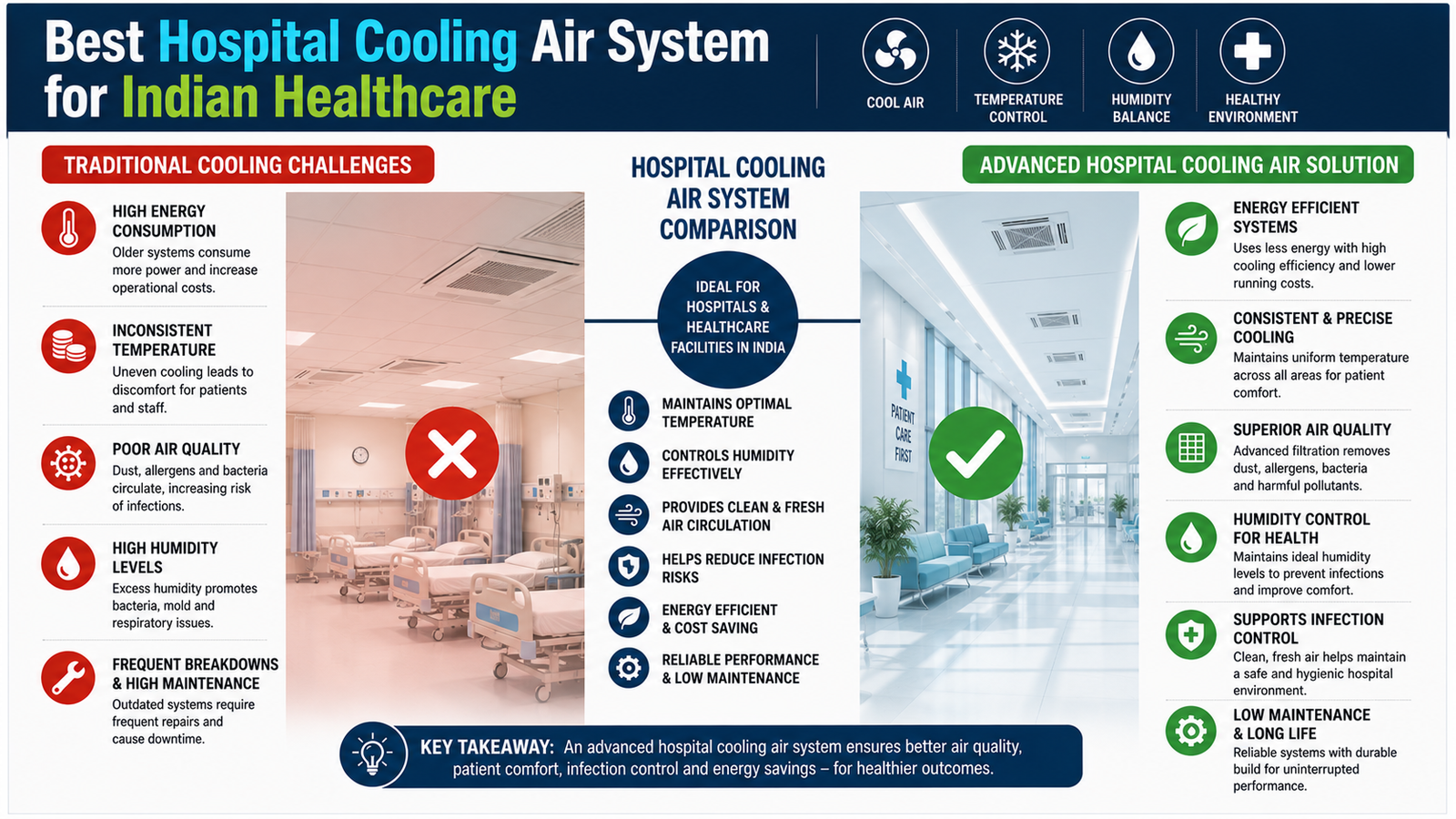
Best Hospital Cooling Air System for Indian Healthcare
Hospital Cooling Air System Secrets That Protect Patients and Staff Every Single Day
A hospital cannot afford unpredictable temperatures. From patient wards and ICUs to OPD halls and pharmacy storage, every zone in a healthcare facility demands precise, reliable cooling — 24 hours a day, 365 days a year. Megastar Coolers Pvt. Ltd. manufactures and supplies advanced hospital cooling air systems designed specifically for healthcare environments across India. Our solutions — including industrial evaporative air coolers, duct cooling systems, HVLS fans, and exhaust ventilation units — maintain the right temperature, humidity, and air quality in every department. Poor cooling increases infection risk, damages medical equipment, slows patient recovery, and burns through your energy budget. The right system fixes all four. Trusted by 1,000+ industries across India, Megastar brings proven engineering, energy-efficient technology, and full after-sales support to hospitals of every size — from single-floor clinics to large multi-specialty campuses. Get a free facility assessment today.
Smart Cooling Systems for Modern Hospitals and Healthcare Facilities
In a hospital, temperature is not a comfort issue. It is a clinical one.
When indoor temperatures in patient wards, operation theatres, ICUs, or pharmacy storage areas go uncontrolled, the consequences range from patient discomfort to life-threatening infection risk. Heat stress accelerates bacterial growth, compromises sterile environments, degrades temperature-sensitive medications, and pushes already stretched clinical staff toward dangerous levels of fatigue.
A purpose-built hospital cooling air system addresses every one of these risks — simultaneously, reliably, and efficiently.
Megastar Coolers Pvt. Ltd. designs and manufactures advanced industrial cooling and ventilation solutions for healthcare environments across India. From high-performance evaporative air coolers for hospital utility zones and support areas to complete duct air cooling systems for OPD halls, wards, and administrative blocks — our systems deliver clean, controlled, consistent airflow where patient safety depends on it.
Trusted by 1,000+ industries across India — including hospitals, clinics, diagnostic centres, and healthcare campuses — Megastar brings manufacturing expertise and field-proven performance to every healthcare cooling project.
Protect your patients and staff with the right cooling system. [Get a Free Hospital Cooling Assessment →]
Key Benefits of a Hospital Cooling Air System
The right hospital cooling solution delivers measurable improvements across every department from day one.
Clinical and Operational Benefits:
- Reduced infection and contamination risk — Proper airflow management reduces the concentration of airborne pathogens, allergens, and particulates in patient care areas, lowering hospital-acquired infection (HAI) rates.
- Improved patient recovery outcomes — Thermally comfortable patients sleep better, experience lower physiological stress, and recover faster — a clinically documented effect across multiple studies on hospital environmental design.
- Extended medical equipment life — Sensitive diagnostic and monitoring equipment — MRI machines, ventilators, infusion pumps, laboratory instruments — operates within safe thermal ranges when cooling is properly maintained.
- Pharmacy and blood bank temperature compliance — Controlled cooling ensures medications, vaccines, blood products, and biological samples remain within safe storage temperature bands as required by CDSCO and hospital accreditation standards.
- Higher staff productivity and retention — Healthcare workers in thermally comfortable environments make fewer errors, experience lower burnout, and perform at a higher level during long shifts.
- Lower energy operating costs — Megastar's energy-efficient evaporative and ventilation systems reduce the electricity burden of hospital climate control by up to 70–80% compared to conventional central AC systems in applicable zones.
- NABH and JCI compliance support — Proper ventilation and cooling documentation supports accreditation audits from NABH, JCI, and other quality certification bodies that assess environmental controls as part of hospital quality standards.
Types of Cooling Systems for Hospitals
Hospitals are not uniform buildings. A single healthcare facility contains zones with radically different cooling requirements — from sterile surgical suites to open waiting halls to outdoor canopy areas. Megastar offers the right cooling system for every hospital zone.
1. Industrial Evaporative Air Coolers
The most cost-effective solution for large non-sterile hospital zones — waiting areas, OPD halls, canteen blocks, laundry units, maintenance areas, and administrative wings. Evaporative coolers draw in fresh outdoor air, cool it through water-saturated media pads, and supply clean, fresh air continuously.
- Ideal for: OPD waiting areas, hospital corridors, staff rest rooms, administrative offices, canteen and kitchen support zones
- Key advantage: Continuous fresh air supply — unlike recirculating AC systems that can trap airborne contaminants
- Temperature drop: 10–15°C below ambient in hot, dry conditions
2. Duct Air Cooling Systems
For multi-floor hospital buildings and enclosed ward blocks, ducted systems distribute cooled air uniformly through overhead duct networks to every room and corridor. Zone-wise control allows individual temperature management for different departments.
- Ideal for: General wards, post-operative recovery rooms, nursing stations, hospital lobbies, administration blocks
- Key advantage: Uniform temperature distribution with department-level control
3. HVLS (High-Volume Low-Speed) Fans
HVLS fans circulate enormous volumes of air at low speeds, eliminating temperature stratification in tall hospital buildings, covered walkways, and large utility halls. They operate silently — a critical requirement in a patient care environment.
- Ideal for: Hospital atria, covered parking areas, large utility halls, physiotherapy gyms, hospital warehousing
- Key advantage: Ultra-quiet operation, large coverage area, minimal maintenance
4. Exhaust Fan and Ventilation Systems
Controlled exhaust ventilation is critical in hospital zones where infectious agents, chemical fumes, and biological contaminants must be continuously extracted. Negative pressure ventilation — created by exhaust fan systems — is an essential infection control tool.
- Ideal for: Isolation wards, pathology laboratories, biomedical waste handling areas, hospital kitchens, generator rooms, mortuary units
- Key advantage: Active removal of contaminated air at the source; supports infection control protocols
5. Complete Hospital Ventilation Solutions
For large hospital campuses, Megastar designs integrated ventilation and cooling systems that combine multiple unit types into one coordinated airflow plan — built around your hospital's floor layout, patient zone classifications, infection control requirements, and energy management targets.
Why Hospitals Need Advanced Cooling Systems in 2026
Healthcare infrastructure in India is expanding at a pace that is outpacing the cooling systems inside it. Here is why upgrading to an advanced hospital cooling air system in 2026 is a clinical and operational necessity:
1. India's summers are getting more extreme. Peak summer temperatures in large parts of North, Central, and Western India now routinely exceed 45°C. Hospitals built 10–15 years ago were not designed for this thermal load. Existing cooling systems are overwhelmed — and vulnerable patients bear the consequences.
2. Hospital-acquired infections (HAIs) are under regulatory scrutiny. The National Centre for Disease Control (NCDC) and accreditation bodies including NABH are placing increasing emphasis on environmental controls — including ventilation and air quality — as core components of hospital infection prevention programs. Poor cooling and ventilation is a direct HAI risk factor.
3. Medical equipment heat sensitivity is increasing. Next-generation diagnostic, monitoring, and therapeutic equipment carries tighter operating temperature tolerances. Hospitals that cannot maintain stable thermal environments risk equipment malfunctions, calibration drift, and warranty voidance.
4. Energy costs are a major hospital operating burden. Electricity bills represent 5–10% of total hospital operating costs in India. A significant portion of this is driven by inefficient cooling. Modernising to energy-efficient evaporative and hybrid cooling systems in applicable zones delivers direct bottom-line savings.
5. Patient experience is now a healthcare quality metric. Patient satisfaction surveys — which directly influence hospital ratings, referrals, and insurance empanelment — consistently identify thermal comfort as a top-ranked concern. A hospital that is too hot loses patients to competitors.
6. Accreditation standards are tightening. NABH's latest standards include specific requirements for ventilation rates, air change frequency, and temperature control in different hospital zones. Meeting these standards requires purpose-designed ventilation and cooling infrastructure — not adapted residential or commercial AC systems.
Air Quality Control in Hospitals: Why It Matters More Than Just Temperature
Temperature is visible. Air quality is not. And in a hospital, invisible air quality failures cause the most serious harm.
Most hospital administrators focus on how cool the building feels. The clinically critical question is what is in the air — and how fast it is being replaced.
The three air quality parameters that define patient safety in a hospital:
1. Air Change Rate (ACH — Air Changes per Hour) The number of times per hour that the total air volume in a room is completely replaced with fresh air. Higher ACH = faster dilution of airborne pathogens and contaminants.
Standard requirements by hospital zone:
- General ward: 6–10 ACH
- Operation theatre: 20–25 ACH (typically managed by specialised OT HVAC systems)
- ICU: 12–15 ACH
- Isolation room: 12 ACH minimum with negative pressure
- OPD waiting area: 6–8 ACH
Megastar's industrial ventilation systems are designed and sized to achieve the required ACH for each hospital zone type.
2. Relative Humidity (RH) Hospital environments require RH control for two distinct reasons. First, very low humidity (below 30% RH) causes dryness of mucous membranes in patients, increasing susceptibility to respiratory infection. Second, very high humidity (above 60% RH) promotes bacterial and mould growth on surfaces, in ducts, and in stored medical supplies.
The recommended RH range for most hospital patient areas is 40–60%.
3. Particulate and Pathogen Concentration High airflow and continuous fresh air supply continuously dilute and remove airborne particulates — dust, allergens, droplet nuclei from coughs and sneezes, and volatile organic compounds (VOCs) from disinfectants and medications. Evaporative cooling systems that continuously supply fresh outdoor air perform better in this regard than recirculating AC systems in non-sterile zones.
Top Cooling Challenges in Hospital Buildings and Healthcare Facilities
Every hospital facility manager recognises these problems. Each one traces directly to inadequate cooling and ventilation infrastructure:
Challenge 1: Thermal comfort inequality across departments Patient wards on upper floors of multi-storey hospital buildings frequently overheat while ground-floor areas stay cool. HVLS fans and zone-wise ducted cooling systems solve this by ensuring uniform temperature distribution across every floor and department.
Challenge 2: Infection control in shared air spaces Open OPD areas, corridors, and shared waiting halls create mixed populations of infectious and non-infectious patients. Continuous fresh air supply from evaporative and exhaust ventilation systems reduces pathogen concentration in these high-risk shared spaces.
Challenge 3: Night shift cooling efficiency Hospitals run 24 hours a day. Cooling systems that are efficient during peak daytime loads must also maintain acceptable conditions during lower-occupancy night shifts without over-running and wasting energy. Megastar systems are designed with variable capacity to match real-time demand.
Challenge 4: Generator room and utility zone heat management Hospital generator rooms, boiler rooms, and electrical switch rooms generate intense heat that must be extracted to prevent equipment failure and fire risk. High-capacity exhaust fan systems from Megastar handle these extreme heat extraction requirements reliably.
Challenge 5: Cooling for outdoor patient care areas Hospitals in India increasingly manage patient overflow in covered outdoor areas, canopy zones, and temporary wards during peak admission periods. Portable and semi-permanent evaporative cooling solutions from Megastar extend thermal comfort to these non-standard patient care spaces.
Challenge 6: Budget constraints versus clinical cooling requirements Government hospitals and smaller private facilities face severe capital budget constraints. Central HVAC systems for large hospital buildings can cost ₹2–5 crore or more. Megastar provides high-performance, zone-appropriate cooling solutions at a fraction of this cost — making clinical-grade environmental control accessible to facilities of all sizes.
How Proper Cooling Protects Patients, Staff, and Medical Equipment
The link between hospital cooling performance and clinical outcomes is direct, measurable, and well-documented.
Patient Safety Impact:
Patients with fever, post-operative inflammation, cardiovascular conditions, or respiratory illness have reduced physiological capacity to self-regulate body temperature. In an environment above 30°C, these patients experience compounded thermal stress that slows recovery, increases heart rate, and raises infection susceptibility. Controlled cooling directly reduces these clinical risks.
In paediatric and neonatal wards, thermal management is even more critical. Neonates cannot thermoregulate independently. A ward temperature that is too high or too variable directly threatens neonatal health.
Staff Performance and Safety:
A 2021 study by the Indian Journal of Occupational and Environmental Medicine found that healthcare workers in thermally uncomfortable environments reported 23% higher error rates, 31% higher fatigue scores, and significantly increased intention to leave the workplace. In a sector already facing severe staffing pressure, this is not an abstract statistic — it is a recruitment and patient safety issue.
Megastar cooling systems create working conditions that support sustained clinical performance across 8–12 hour shifts.
Medical Equipment Protection:
- Laboratory analysers and diagnostic equipment require stable operating temperatures of typically 18–25°C. Ambient temperatures above this range cause calibration errors and false results.
- Medication refrigerators and cold chain storage operate more efficiently and maintain more consistent internal temperatures when the ambient room temperature is controlled.
- Ventilators, infusion pumps, and bedside monitors have thermal shutoff protections that activate above their rated ambient temperature. In a hot ward, this is a direct patient safety risk.
- Imaging equipment (CT, MRI, X-ray) generates its own heat load and requires dedicated cooling to maintain operating temperatures within manufacturer specifications. Ambient cooling reduces the thermal burden on these systems' internal cooling mechanisms.
How to Choose the Best Cooling System for Your Hospital
Purchasing a cooling system for a healthcare facility requires a different evaluation framework than choosing cooling for any other building type. Patient safety, infection control, energy efficiency, and regulatory compliance must all be weighed together.
1. Zone Classification and Compliance Requirements
Different hospital zones carry different regulatory cooling and ventilation requirements. Start by classifying your facility into clinical zones (OT, ICU, wards, isolation), support zones (pharmacy, labs, blood bank), and general zones (OPD, admin, canteen). Each zone requires a system designed to meet its specific ACH, temperature, and humidity specifications.
2. Fresh Air vs Recirculated Air
In infection-sensitive hospital zones, systems that supply continuous fresh outdoor air (evaporative coolers, fresh air handling units) are clinically preferable to systems that recirculate room air. In sterile zones like OTs, specialised HEPA-filtered HVAC systems are required. Megastar helps you match the right air supply approach to each zone.
3. Noise Level
Patient recovery and sleep quality are directly affected by ambient noise. Cooling systems in patient-facing zones must operate at low decibel levels. Megastar's HVLS fans and ducted systems are specifically selected for low-noise hospital environments.
4. Infection Control Compatibility
All cooling system components installed in patient-accessible areas must be cleanable, resistant to disinfectant chemicals, and free of internal dead zones where water or organic matter can accumulate and support microbial growth. Megastar designs hospital cooling systems with these requirements built in from the specification stage.
5. Energy Efficiency
Hospitals operate 24 hours a day, 365 days a year. Even a modest improvement in cooling system efficiency translates into significant annual electricity savings at this scale of continuous operation. Evaluate kW per ton of cooling (or kW per CFM) and compare across system options.
6. Scalability and Future Expansion
Healthcare facilities expand. New wings, new floors, and new departments are added over time. Choose cooling infrastructure that can be extended without requiring a complete system redesign. Megastar's modular cooling and ventilation systems are designed for exactly this kind of phased expansion.
7. After-Sales Support and Service Response
In a hospital, a cooling system failure is never just an inconvenience. System uptime is a clinical priority. Evaluate manufacturers on their local service network density, average response time for breakdown calls, and availability of spare parts. Megastar maintains a pan-India service network with dedicated hospital sector support.
8. NABH and Regulatory Alignment
Ensure your cooling system supplier understands the ventilation requirements within NABH accreditation standards. Megastar's technical team includes specialists who design hospital systems with accreditation documentation in mind.
Why Choose Megastar Coolers Pvt. Ltd. for Your Hospital Cooling Solution
India has many cooling equipment suppliers. Very few understand the specific, uncompromising requirements of a hospital environment. Megastar does.
Healthcare-Aware Engineering Approach We do not apply generic industrial cooling logic to hospital environments. Our technical team designs hospital cooling systems with patient safety, infection control, regulatory compliance, and clinical staff requirements at the centre of every specification decision. We understand ACH requirements, humidity bands for patient zones, and the difference between a general ward and an isolation room.
Complete Cooling and Ventilation Range Megastar supplies the full spectrum of cooling and ventilation products required for a healthcare campus — industrial evaporative air coolers, duct air cooling systems, HVLS fans, exhaust ventilation systems, and integrated ventilation solutions. One supplier. One accountable partner. No coordination gaps between multiple vendors.
Proven Trust Across 1,000+ Industries Our cooling systems operate today in hospitals, schools, warehouses, textile mills, poultry farms, and greenhouses across every major state in India. Healthcare facilities benefit from the same manufacturing quality, field-proven reliability, and service infrastructure that serves India's most demanding industrial clients.
Energy-Efficient Technology That Reduces Operating Costs Megastar evaporative and ventilation systems consume significantly less electricity than conventional refrigerated cooling — up to 70–80% less in applicable zones. For a hospital running cooling systems continuously throughout the year, this translates into substantial savings that go directly back into patient care.
Made-in-India Manufacturing Quality All Megastar products are designed and manufactured in India to international quality standards. This means faster delivery, lower procurement cost, easier spare part availability, and full technical support in your local language — advantages that matter when you need service quickly.
Free Custom Cooling Design for Your Facility Our technical specialists visit your hospital, map your zone layout and patient flow, assess your current thermal environment and ventilation shortfalls, and design a complete, zone-wise cooling and ventilation solution tailored to your facility. This assessment and design service is provided free of charge to all hospital clients.
Transparent Pricing. No Hidden Costs. Megastar quotations are detailed, itemised, and clear. We specify every component, installation requirement, and timeline upfront. Our pricing reflects real value — not inflated margins hidden behind vague bundled costs.
Frequently Asked Questions
Q1. What temperature should hospital wards and patient rooms be maintained at? The recommended ambient temperature for general hospital wards in India is between 22°C and 26°C. ICUs and post-operative recovery rooms typically target the lower end of this range (22–24°C) to reduce metabolic stress on critically ill patients. Neonatal units require tighter control, typically maintaining 24–26°C with close humidity management.
Q2. Can evaporative coolers be used in hospitals? Yes — in the right zones. Evaporative air coolers are highly suitable for non-sterile hospital areas including OPD waiting halls, hospital corridors, administrative wings, canteen areas, laundry blocks, and utility zones. They supply continuous fresh air, which is clinically preferable to recirculating AC systems in these shared spaces. They are not suitable for operation theatres, ICUs, or sterile processing zones, which require specialised filtration and pressure-controlled HVAC systems.
Q3. What is the required air change rate (ACH) for hospital patient wards? NABH and ASHRAE standards recommend 6–10 air changes per hour for general patient wards. ICUs require 12–15 ACH. Operation theatres require 20–25 ACH. Isolation rooms require a minimum of 12 ACH with negative pressure relative to adjacent areas. Megastar designs ventilation systems to meet each zone's specific ACH requirement.
Q4. How does poor cooling affect hospital infection rates? Inadequate cooling and ventilation in hospitals directly increases hospital-acquired infection (HAI) risk in three ways: it raises ambient temperatures that accelerate bacterial multiplication on surfaces and in the air; it reduces the air change rate that dilutes and removes airborne pathogens; and it compromises the integrity of sterile environments where humidity and temperature go uncontrolled. Proper cooling and ventilation is one of the most effective environmental infection control measures available.
Q5. Do Megastar cooling systems meet NABH ventilation standards? Megastar designs hospital cooling and ventilation systems with NABH environmental standards as a baseline requirement. Our technical team is familiar with the ventilation, air change, temperature, and humidity requirements specified in NABH accreditation standards and designs each system to support — not contradict — the accreditation process.
Q6. What is the typical cost of installing a hospital cooling system? Cost depends entirely on the size, layout, zone classification, and specific requirements of the facility. Megastar provides detailed, transparent, itemised quotations following a free on-site assessment. As a reference point, Megastar's evaporative and ventilation solutions for hospital support zones are typically 60–75% lower in installation and operating cost compared to equivalent central AC systems.
Q7. How long does installation take for a hospital cooling system? For individual departments or zones, installation typically takes 2–5 working days. Full-campus ventilation and cooling system installations are phased to minimise disruption to patient care activities. Our project team works around your clinical schedule and ensures that no patient care zone is left without cooling during installation.
Q8. Does Megastar provide maintenance contracts for hospital cooling systems? Yes. Megastar offers annual maintenance contracts (AMC) for all hospital cooling and ventilation installations. Our AMC packages include scheduled preventive maintenance visits, priority breakdown response, and genuine spare parts supply. For hospital clients, we offer priority service response given the critical nature of the environment.
Contact Megastar Coolers for Hospital Cooling Solutions
Your hospital patients, staff, and equipment deserve a cooling environment that is designed for healthcare — not adapted from a generic industrial or commercial product.
Megastar Coolers Pvt. Ltd. is ready to design, supply, and install a complete cooling and ventilation solution built around your hospital's exact clinical, regulatory, and operational requirements.
Here is how to get started:
Step 1: Contact our hospital cooling specialists through the form below or call us directly.
Step 2: Our technical team schedules a free on-site facility assessment at your hospital.
Step 3: We prepare a zone-wise cooling system design and a transparent, itemised quotation.
Step 4: Upon approval, we complete installation with full coordination around your patient care schedule.
Step 5: Your hospital benefits from a safer, cooler, more energy-efficient environment — backed by Megastar's full after-sales and AMC support.
Megastar Coolers Pvt. Ltd. India's Leading Manufacturer & Supplier of Industrial Air Coolers, HVLS Fans, and Ventilation Solutions Trusted by 1,000+ Industries Across India — Including Hospitals, Clinics, and Healthcare Facilities