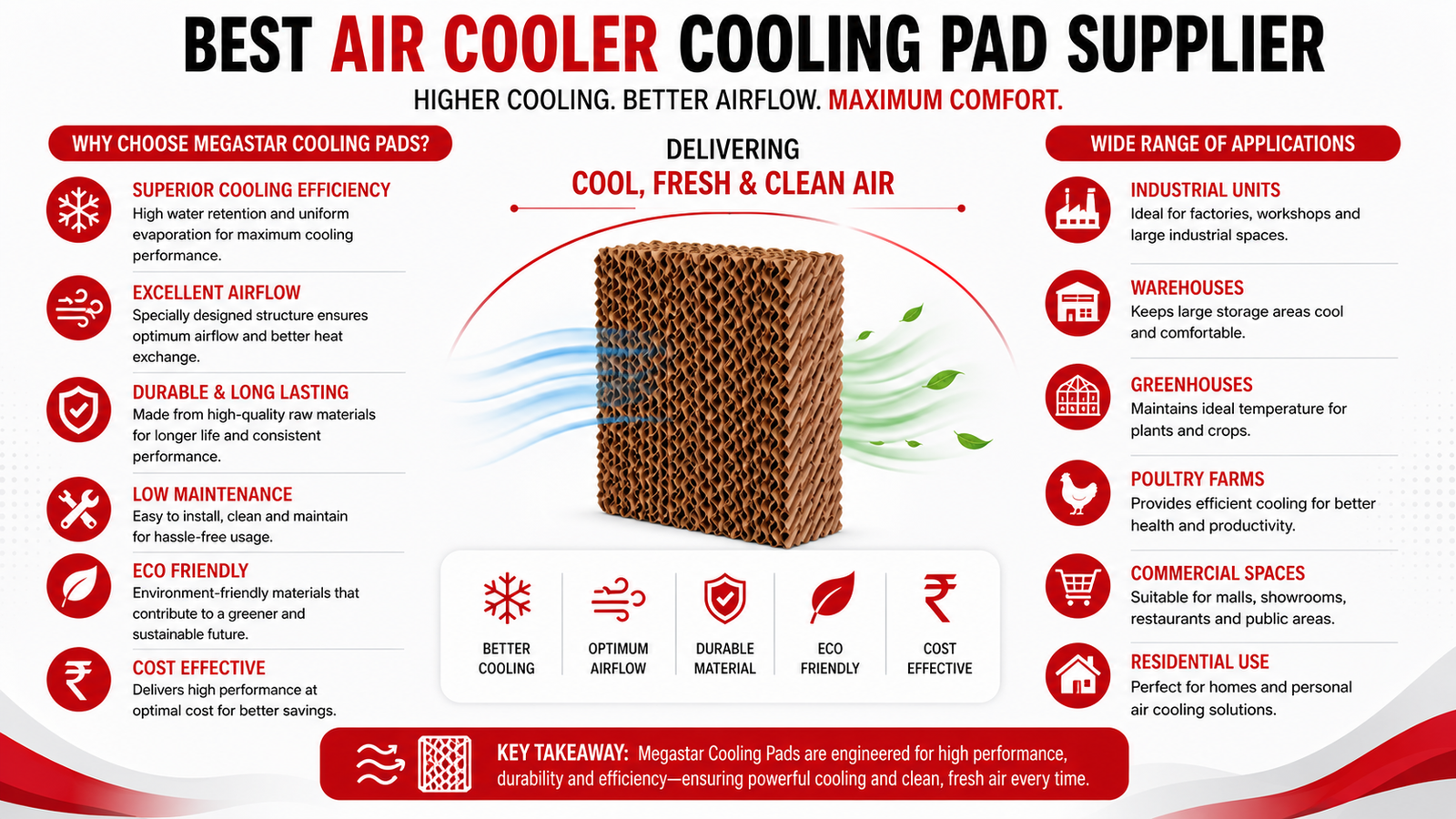
Best Air Cooler Cooling Pad Supplier - Megastar Coolers
Air Cooler Cooling Pad Supplier: Everything Industrial Buyers Need to Know Before Buying
If you manage procurement for a factory, a fleet of industrial coolers, or a cooling system service operation, the quality of your cooling pads is directly tied to the performance of every air cooler in your facility. A low-grade pad loses 25–30% of its cooling efficiency within a single season. A correctly specified, industrial-grade pad from a reliable supplier delivers consistent temperature drops for three to five years — and keeps your energy costs predictable.
This guide is written for industrial buyers, facility managers, and maintenance engineers who are evaluating air cooler cooling pad suppliers and need to understand specifications, material grades, volume pricing, and supplier qualification criteria before committing to a purchase.
What Is an Air Cooler Cooling Pad and What Does It Do?
A cooling pad — also called an evaporative media pad or evaporative cooling pad — is the core heat exchange component inside an evaporative air cooler. Its function is straightforward: warm incoming air passes through the pad while water trickles down through it. The water evaporates on contact with the warm air, absorbing heat in the process and reducing the air temperature before it is delivered into the space.
The efficiency of this heat exchange process depends almost entirely on the quality and specification of the pad. A thicker pad with higher surface area and better water distribution absorbs more heat per cubic foot of air passing through it. A degraded, scaled, or incorrectly specified pad does the opposite — it restricts airflow, distributes water unevenly, and delivers temperatures that are only marginally cooler than the outside air.
For industrial coolers handling large air volumes — typically 5,000 to 60,000 CFM — pad performance directly determines whether the cooler meets its rated capacity. This is why industrial buyers treat pad procurement as a critical maintenance input, not a generic consumable.
Types of Cooling Pads: What Industrial Applications Require
Not all cooling pads are manufactured the same way or suitable for the same applications. Understanding the available types is essential for matching the right pad to your cooler specification.
Cellulose Honeycomb Cooling Pads
Cellulose pads are the industry standard for industrial evaporative coolers. They are manufactured from specially treated cellulose fiber formed into a cross-fluted honeycomb structure. The cross-fluted geometry maximizes the surface area available for water-to-air contact, which directly increases evaporation rate and cooling efficiency.
Cellulose pads used in industrial applications are treated with anti-rot compounds, stiffening agents, and anti-microbial coatings that extend service life and inhibit mold and algae growth — a critical requirement in facilities where air quality standards must be maintained.
The standard thickness options for industrial cellulose pads are 90mm and 100mm. The 100mm pad delivers higher cooling efficiency (typically 85–90% saturation efficiency) compared to thinner alternatives and is the recommended specification for any cooler operating in an ambient temperature above 38°C — which covers most of North and Central India during summer months.
Aspen Wood Fiber Pads
Aspen pads are made from shredded aspen wood fibers packed into a frame. They are lower cost than cellulose pads and have been widely used in domestic and light commercial coolers. However, they are not suited for heavy industrial applications. Aspen pads have shorter service life (typically one to two seasons), lower saturation efficiency, and are more susceptible to breakdown under high continuous water flow rates. Industrial buyers should specify cellulose pads unless the application is specifically low-duty.
Synthetic Rigid Media Pads
Synthetic pads — manufactured from PVC, polypropylene, or fiberglass — are used in specialized industrial applications where chemical resistance is required. If your facility processes chemicals, acids, or solvents that would degrade cellulose, synthetic media is the appropriate specification. Synthetic pads have very long service lives (8–15 years) but higher unit cost and lower thermal efficiency than cellulose at equivalent thickness.
Comparison at a Glance
| Facility Size | Recommended CFM | Megastar Model |
|---|---|---|
| Up to 1,500 sq. ft. | 8,000 – 12,000 CFM | MG-HD 08 / MG-HD 12 |
| 1,500 – 3,000 sq. ft. | 15,000 – 20,000 CFM | MG-HD 15 / MG-HD 20 |
| 3,000 – 6,000 sq. ft. | 25,000 – 35,000 CFM | MG-HD 25 / MG-HD 35 |
| 6,000 – 12,000 sq. ft. | 40,000 – 50,000 CFM | MG-HD 40 / MG-HD 50 |
| 12,000+ sq. ft. | Custom multi-unit solution | Contact our team |
Key Technical Specifications to Evaluate When Sourcing Cooling Pads
Industrial buyers evaluating suppliers need to look beyond price per unit and assess the technical specifications that determine real-world performance and total cost of ownership.
Saturation Efficiency
Saturation efficiency — sometimes called thermal efficiency — expresses what percentage of the theoretical maximum temperature drop the pad actually delivers. A pad with 85% saturation efficiency in 43°C dry-bulb outdoor conditions will deliver air approximately 10–11°C cooler than ambient. The same cooler fitted with a 65% efficiency pad will deliver only 7–8°C of cooling. Over a full summer season in a 20,000 sq. ft. factory, that difference is significant in both comfort and productivity.
Always ask suppliers for saturation efficiency data at your specific ambient dry-bulb and wet-bulb temperature conditions. Reputable suppliers will have this data. Those who cannot provide it are likely sourcing generic, ungraded material.
Face Velocity Rating
The pad must be matched to the air velocity passing through it. Industrial evaporative coolers operate at face velocities typically between 1.0 and 1.8 meters per second. Exceed the pad's rated face velocity and you get water carryover — droplets of water passing through the pad into the airstream and into the facility. Specify pads rated for the actual face velocity of your coolers, not a generic catalog selection.
Flute Angle and Cell Size
The internal geometry of a cellulose pad — the angle of the cross flutes and the cell size — determines the balance between pressure drop and heat transfer. Wider cell angles (45/45 degree) favor lower pressure drop and higher airflow, suitable for high-volume coolers. Narrower angles (15/45 degree) favor higher heat transfer at lower air volumes. Your supplier should be able to match pad geometry to your cooler specifications.
Water Distribution Rate
Industrial pads require a minimum water flow rate — typically 0.5 to 1.5 liters per minute per 0.1 square meter of pad face — to stay fully saturated. Pads that are not kept uniformly wet develop dry spots that reduce efficiency and accelerate degradation. Confirm with your supplier the minimum water flow specification for the pad grade you are purchasing.
Anti-Rot and Anti-Microbial Treatment
In industrial environments, untreated cellulose pads begin to degrade within months due to biological growth and water-borne mineral attack. Properly treated industrial pads incorporate phenolic resin impregnation for stiffness and rot resistance, plus anti-microbial additives compliant with relevant occupational health standards. Ask suppliers for documentation on their treatment specifications — not just a general claim that pads are "treated."
Standard Dimensions and Custom Sizing for Industrial Orders
Industrial coolers vary significantly in pad frame dimensions, and a pad that is even 5mm off in either dimension will leak air around the edges, reducing effective cooling area and creating bypass airflow that reduces overall system efficiency.
Standard cellulose pad dimensions commonly stocked by industrial suppliers in India include:
- 600mm × 600mm × 90mm
- 600mm × 900mm × 90mm
- 600mm × 1200mm × 100mm
- 900mm × 900mm × 100mm
- 900mm × 1200mm × 100mm
- 1200mm × 1200mm × 100mm
However, many industrial coolers — particularly older units or imported equipment — have non-standard frame sizes. A reliable air cooler cooling pad supplier for industrial buyers must have the manufacturing or cutting capability to supply custom dimensions with clean, accurate edges that seal properly in the frame.
When placing a bulk order for custom dimensions, always provide the internal frame dimensions, not the external housing dimensions, and confirm whether the pad should fit flush or with a 2–3mm compression allowance for a sealed fit.
What to Expect from a Reliable Industrial Cooling Pad Supplier
Industrial procurement is different from consumer purchasing. The criteria that matter most are consistency, documentation, volume capability, and service reliability — not just unit price.
Consistent Product Quality Across Batches
The most common complaint from industrial buyers switching suppliers is inconsistent quality between orders. A pad that performs well in the first delivery and poorly in the third is worse than a moderately inferior pad that performs consistently — because inconsistency makes performance prediction impossible. Ask any new supplier for quality documentation from at least three separate production batches before committing to a large volume contract.
Volume Capability and Lead Times
Industrial cooling pad orders can range from 50 units for a mid-sized factory maintenance stock to 5,000 units or more for a cooling equipment manufacturer or large-scale service contractor. Confirm that your supplier has demonstrated production capacity at your required volume and that their stated lead times are based on actual production schedules, not optimistic estimates.
Technical Support and Specification Matching
A supplier who only sells pads — without the ability to advise on specification matching, face velocity calculation, or water flow requirements for your specific cooler models — is a distributor, not a technical supplier. For industrial applications where incorrect pad specification has real cost consequences, access to technical support before and after purchase is a meaningful part of the supplier's value.
Packaging and Delivery for Bulk Orders
Cooling pads are fragile in bulk. Cellulose pads that arrive with compressed or deformed corners will not seal properly in cooler frames, regardless of material quality. Confirm the supplier's bulk packaging specification — proper interleaving, corner protection, and stacking orientation — and ask for photos of how bulk orders are palletized before you place an initial order.
After-Sales and Warranty
For industrial-grade cellulose pads, a credible supplier will stand behind a minimum service life of three years under normal operating conditions. If pads are degrading materially within a single season under normal use, that is a manufacturing quality issue the supplier should address. Get warranty terms in writing.
Factors That Shorten Cooling Pad Life in Industrial Settings
Understanding what degrades pads prematurely helps industrial buyers make better procurement decisions and get maximum value from each replacement cycle.
Hard water scaling is the single most common cause of premature pad failure in India. Municipal and borewell water supplies in Delhi, Haryana, Rajasthan, and large parts of Maharashtra have high TDS (Total Dissolved Solids) levels — often 400–800 mg/L or higher. Mineral deposits accumulate in the pad cells, restricting airflow, reducing evaporation surface, and eventually causing the pad to collapse structurally. In hard water areas, water softening or regular acid treatment of the recirculating water system is necessary to achieve rated pad life.
Biological growth — algae, mold, and bacteria — develops when pads are left wet during non-operating periods without adequate drainage and drying. Pads stored wet between seasons or left with standing water in the sump over extended shutdowns will show biological degradation regardless of initial treatment quality. Establish a dry-down protocol at the end of each operating season.
Mechanical damage from incorrect water distribution occurs when the distribution header delivers water unevenly — flooding some sections of the pad while others run dry. Wet-dry cycling in localized pad zones degrades the structural integrity of the cellulose significantly faster than uniform wetting. Regular inspection and cleaning of distribution headers is as important as pad quality in achieving full service life.
Operating beyond rated face velocity causes water carryover that visibly saturates the pad's downstream face and leads to accelerated biological contamination and structural softening. If your coolers are showing water carryover, address the face velocity issue before attributing the problem to pad quality.
Incorrect installation — pads fitted with gaps, reversed orientation, or uneven compression — creates localized stress points and air bypass channels that degrade the pad unevenly and reduce effective cooling area.
How to Evaluate and Qualify a New Cooling Pad Supplier
Before committing industrial volumes to a new supplier, run a structured qualification process. This protects your operation from supply disruptions and quality failures mid-season.
Step 1: Request samples with full technical documentation. Any credible supplier will provide sample pads with written specifications covering material grade, treatment type, saturation efficiency rating, face velocity range, and expected service life. Samples without documentation indicate a supplier who cannot substantiate their product claims.
Step 2: Conduct an independent performance test. Install sample pads from the new supplier in a controlled set of cooler units operating at known conditions. Measure inlet air temperature, outlet air temperature, and static pressure drop across the pad. Compare against the supplier's stated saturation efficiency. This takes one operating season but gives you real-world data that catalog claims cannot replace.
Step 3: Inspect production facility or request third-party audit. For large-volume contracts, a factory visit or a third-party quality audit verifies that the supplier has the production equipment, quality controls, and raw material sourcing to deliver consistently. A supplier who resists this request is a risk for industrial volumes.
Step 4: Start with a trial order before full commitment. Place a trial order of 10–15% of your intended annual volume. Evaluate delivery accuracy, packaging quality, dimensional consistency, and customer service responsiveness. Only scale to full contract volume after the trial order meets your standards.
Step 5: Confirm supply chain redundancy. Ask the supplier where their raw cellulose material is sourced and whether they have backup suppliers for critical inputs. A supplier dependent on a single raw material source is a supply continuity risk for your operation.
Questions Industrial Buyers Should Ask a Cooling Pad Supplier
Use this question set when evaluating any supplier for a bulk or ongoing contract:
What is the saturation efficiency of your 100mm cellulose pad at 43°C dry-bulb and 24°C wet-bulb conditions?
What face velocity range is your standard industrial pad rated for, and what is the maximum before water carryover occurs?
What anti-rot and anti-microbial treatments are applied, and what are the chemical specifications of those treatments?
Can you supply custom dimensions, and what is the minimum order quantity for a custom size?
What is your current production capacity per month, and what is your lead time for an order of [your volume]?
What quality testing do you conduct on each production batch, and can you share recent test certificates?
What is your warranty policy for industrial-grade pads, and how do you handle warranty claims?
How do you package bulk orders to prevent damage during transit and storage?
Do you have references from industrial buyers in our sector or region who we can contact?
Industries That Rely on High-Volume Cooling Pad Supply
Understanding which industries drive demand for industrial cooling pad supply helps buyers assess whether a supplier has relevant experience with their specific operational requirements.
Textile and garment manufacturing facilities run large evaporative cooling systems continuously through eight to ten months of the year. Annual pad replacement cycles at multi-unit installations create consistent large-volume demand. Pad quality directly affects the humidity balance on the production floor, which in turn affects fabric quality in certain processes.
Automotive component manufacturing plants operate coolers in assembly halls, paint shops, and press areas where consistent temperature is tied to dimensional accuracy and coating quality. Pad failures mid-season cause production interruptions that are disproportionately expensive.
Pharmaceutical and packaging operations require cooling pad suppliers who can provide documentation supporting GMP compliance — specifically anti-microbial treatment records and material safety data to confirm that pad materials and coatings do not introduce contaminants into process airflows.
Cooling equipment manufacturers and OEMs are among the highest-volume cooling pad buyers. They source pads in large batches for assembly into new cooler units and require dimensional consistency and material uniformity that meets their product warranty specifications.
Industrial HVAC and cooling system service contractors maintain pad replacement schedules across multiple client facilities and require reliable supply continuity, consistent quality, and supplier responsiveness to emergency replacement orders during peak summer operating periods.
Warehousing and logistics facilities — particularly temperature-sensitive cold chain adjacent operations — have standardized large-format cooler installations that consume significant pad volumes on annual replacement schedules.
Cooling Pad Pricing Factors for Industrial Buyers
Pricing for industrial cooling pads varies based on several factors that buyers should understand to evaluate quotes accurately.
Material grade and treatment level are the primary cost drivers. A properly treated 100mm industrial cellulose pad costs 30–50% more per unit than an untreated or lightly treated equivalent. The cost difference is recovered many times over in extended service life and consistent performance.
Dimensions affect material consumption and cutting complexity. Standard dimensions are priced lower than custom cuts because they can be manufactured in high-volume runs without retooling. Custom dimensions carry a modest premium, typically 10–20% over equivalent standard sizes, depending on volume.
Order volume drives unit price down significantly in the industrial cooling pad market. Buyers ordering 500 units typically pay 25–35% less per unit than buyers ordering 50 units. Buyers ordering 5,000+ units with regular repeat schedules can negotiate pricing that reflects the supplier's reduced sales and logistics cost.
Packaging and logistics add to total landed cost. For buyers outside major supply centers, freight cost per pad unit can be a meaningful component of total cost, particularly for low-density packaged pads being shipped long distances. Consolidated bulk pallets reduce per-unit freight cost significantly versus individual carton shipping.
When comparing supplier quotes, always evaluate price on a total landed cost basis — unit price plus freight plus packaging — not on unit price alone.
Conclusion: Choosing the Right Air Cooler Cooling Pad Supplier for Industrial Requirements
For industrial buyers, a cooling pad supplier is not simply a vendor for a commodity item. The pad is a performance-critical component that determines whether your cooling systems deliver their rated capacity, consume energy efficiently, and remain in service for their intended operational life.
The right supplier combines verified technical specifications, consistent production quality across batch orders, volume fulfillment capability, and the technical support to help you match pad specifications to your exact cooler models and operating conditions.
Before placing any significant volume order, request documentation, run a structured trial, and verify that the supplier's service capability matches your operational needs — not just during normal conditions, but during peak summer demand when every cooler on your facility must perform reliably.
The difference between a qualified industrial cooling pad supplier and a generic distributor is measured in your facility's temperature, your maintenance budget, and your production continuity every summer.