Best Air Cooler Cooling Pad Supplier in Delhi - Megastar Coolers Pvt. Ltd.
Best Air Cooler Cooling Pad Suppliers in Delhi – Megastar Coolers Pvt. Ltd.
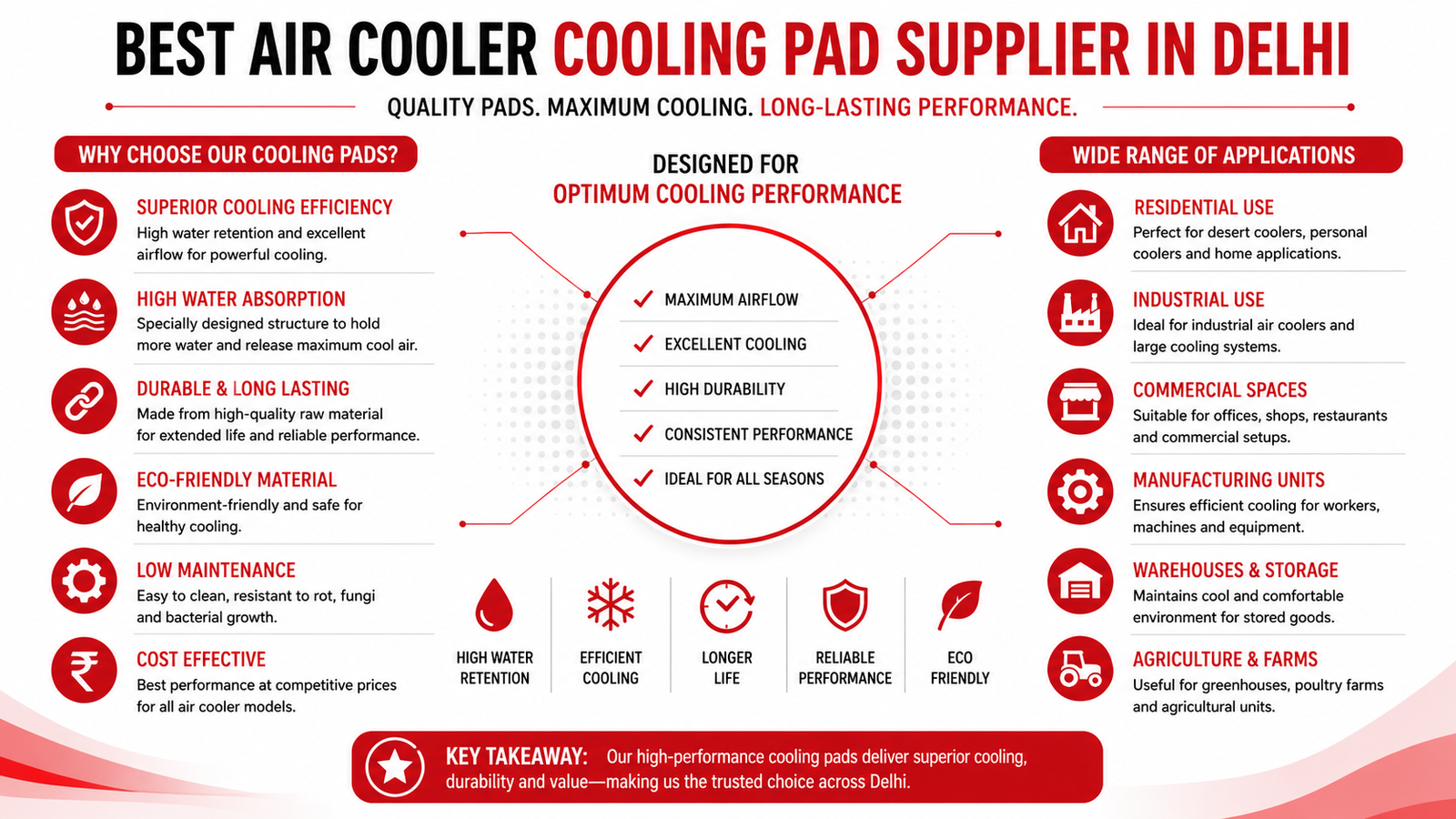
Looking for a reliable air cooler cooling pad supplier in Delhi? Megastar Coolers Pvt. Ltd. supplies industrial-grade evaporative cooling pads to warehouses, poultry farms, greenhouses, textile mills, hospitals, and commercial facilities across India. We manufacture and supply honeycomb cooling pads, cellulose pads, and wood wool pads engineered for maximum water absorption, airflow efficiency, and long service life. Whether you manage a single facility or run large-scale industrial operations, our cooling pads are built to perform in India's most demanding environments. As Delhi's leading air cooler cooling pad supplier, we serve 1,000+ industries with OEM supply, bulk orders, and branded cooling pad solutions. Our pads are fully compatible with all major air cooler brands and custom-fit for industrial, commercial, and agricultural air cooling systems. Every pad we supply goes through strict quality checks for thickness uniformity, water retention capacity, and structural durability — so your air coolers deliver maximum cooling efficiency every season. Get the right cooling pad at the best price. Contact Megastar Coolers today for bulk pricing, technical specifications, and fast dispatch from Delhi.
How Air Cooler Cooling Pads Work
An air cooler cooling pad is the core component of any evaporative cooler. Warm air passes through the water-saturated pad surface. As water evaporates, it absorbs heat from the air — dropping the outlet temperature by 10°C to 15°C in Indian conditions.
The efficiency of this process depends entirely on three factors:
- Pad material and cell structure (determines surface area for evaporation)
- Water distribution across the pad surface (even saturation = uniform cooling)
- Airflow resistance (lower resistance = higher CFM output from the blower)
A high-quality cooling pad maximizes evaporation surface, maintains structural shape under continuous water exposure, and resists algae and mineral scale buildup — keeping your air cooler performing at its rated capacity for longer.
Top Benefits of Honeycomb Cooling Pads for Air Coolers
Honeycomb cooling pads are the most widely used pad type in modern industrial and commercial air coolers — and for good reason.
Higher Cooling Efficiency: The hexagonal cell geometry creates a large surface area within a compact pad thickness. More surface area means more evaporation per cubic foot of airflow, which directly translates to lower outlet air temperature.
Longer Service Life: Honeycomb pads made from cross-fluted cellulose or polymer materials resist deformation even after months of continuous water exposure. They maintain their shape, unlike wood wool pads that sag or break down over time.
Low Pressure Drop: The open-cell structure allows air to pass through with minimal resistance. Your cooler's motor works less, consumes less power, and delivers stronger airflow.
Easy to Clean and Maintain: Honeycomb pads rinse clean with water. Mineral deposits and algae are manageable with standard descaling agents, reducing maintenance cost significantly.
Consistent Water Distribution: The structured cell pattern holds water evenly across the entire pad surface, eliminating dry spots and uneven cooling — a common problem with loose-fill or wood wool alternatives.
Top Features to Look for in Air Cooler Cooling Pads
Not all cooling pads perform equally. When you source cooling pads for industrial or commercial applications, evaluate these critical parameters:
Pad Thickness: Standard industrial pads range from 90mm to 150mm. Thicker pads offer more evaporation depth and better cooling performance, especially in high-temperature zones.
Cell Size: Smaller cells (5mm to 7mm) deliver higher evaporation surface area. Larger cells (9mm to 12mm) offer lower resistance and suit high-airflow industrial coolers.
Material Quality: Cellulose pads should be treated for water absorption and microbial resistance. Polymer-based pads offer superior durability in hard-water areas.
Dimensional Accuracy: Poorly cut pads with uneven edges cause air bypass — hot air leaks around the pad instead of passing through it. Always source pads that are cut to precise dimensions.
Frame Compatibility: Pads must fit snugly within the cooler's pad frame. Loose-fit pads reduce efficiency and increase the risk of pad collapse during operation.
Water Absorption Rate: A good pad saturates evenly within 60 to 90 seconds of pump activation. Slow saturation means delayed cooling at startup.
Hardness and Resistance to Sagging: In commercial coolers running 12 to 18 hours daily, pad structural integrity matters. Pads that sag block airflow and reduce cooling output by up to 30%.
Applications of Cooling Pads in Commercial and Industrial Spaces
Megastar Coolers supplies cooling pads to a wide range of industries across India. Here is where our pads deliver the most impact:
Warehouses and Logistics Hubs: Large floor areas with high heat loads require pads that maintain cooling consistency across multiple cooler units running simultaneously.
Poultry Farms and Livestock Shelters: Animals are highly sensitive to heat stress. Evaporative cooling with properly maintained pads reduces mortality rates and improves productivity.
Greenhouses and Nurseries: Controlled temperature and humidity are critical for plant growth. Our pads support precision evaporative cooling in polytunnel and glass greenhouse installations.
Textile Mills and Garment Factories: Humidity control during spinning and weaving reduces yarn breakage and improves fabric quality. Cooling pads play a direct role in maintaining optimal loom-floor conditions.
Hospitals and Healthcare Facilities: Patient areas and operation-adjacent zones require clean, odour-free cooling. Our antimicrobial-treated pads are suitable for healthcare environments.
Schools, Colleges, and Auditoriums: High-occupancy spaces generate substantial heat loads. Properly sized cooling pads help maintain comfortable indoor temperatures during peak summer months.
Food Processing Units: Evaporative cooling is preferred over refrigerant-based systems in many food processing zones. Our food-safe cooling pads comply with hygiene requirements.
Cooling Pads Explained: Honeycomb vs. Wood Wool vs. Cellulose – A Supplier's Guide
Choosing the right pad type for your application requires understanding how each material performs in real conditions.
Honeycomb Cooling Pads (Cross-Fluted Cellulose) Best suited for industrial and commercial air coolers running continuously. These pads offer the highest cooling efficiency per unit thickness, resist deformation, and are easy to clean. They are the standard choice for modern desert coolers and industrial evaporative coolers. Expected lifespan: 3 to 5 years with regular maintenance.
Wood Wool Cooling Pads (Excelsior Pads) Manufactured from shredded aspen wood fibres held in a mesh frame. These are cost-effective and suitable for light-duty residential and small commercial coolers. However, they degrade faster in continuous-use industrial applications and are susceptible to mould in humid climates. Expected lifespan: 1 to 2 seasons.
Cellulose Paper Cooling Pads Treated cellulose paper pads offer high water absorption and good evaporative efficiency. They work well in medium-duty commercial applications. Water quality matters — hard water causes faster scaling on cellulose pads. Expected lifespan: 2 to 3 years in treated water conditions.
Which pad should you choose?
For industrial and commercial buyers, honeycomb cooling pads offer the best return on investment. For residential or light commercial use, wood wool pads remain a practical and affordable option.
OEM vs. Branded Cooling Pads – What Is Right for Your Business?
Many industrial buyers face a common decision: should you source OEM (unbranded) cooling pads or invest in branded pads?
OEM Cooling Pads are manufactured to custom specifications — your dimensions, your cell size, your thickness. They carry no brand markings and are ideal for businesses that resell coolers under their own brand, run large facilities with non-standard cooler models, or want to reduce per-unit procurement cost at scale.
Megastar Coolers offers full OEM supply with custom cutting, custom dimensions, and bulk packaging. Minimum order quantities apply for OEM runs.
Branded Cooling Pads carry quality certification and guarantee consistent specifications. They are the right choice when you need assured performance standards and traceable quality documentation for facility audits or vendor compliance.
For large facility managers, OEM pads sourced from a reliable manufacturer like Megastar Coolers offer the same quality at significantly lower cost. The key is choosing a manufacturer with verified material sourcing and in-house quality control — not simply the cheapest pad available.
Air Cooler Maintenance Tips: How to Clean and Replace Cooling Pads
Regular cooling pad maintenance directly extends pad life and keeps your air cooler performing at peak efficiency.
Monthly Maintenance (During Active Season)
Remove pads from the cooler frame. Rinse pads with clean water to remove dust, mineral deposits, and algae. Use a soft brush to loosen surface scale. For stubborn mineral buildup, soak pads in a mild citric acid solution (1 tablespoon per litre) for 30 minutes, then rinse thoroughly.
Inspect pads for structural damage — tears, collapsed cells, or permanent sag. A damaged pad that remains in service reduces cooling output and increases energy consumption.
End-of-Season Cleaning
Before shutting down coolers for winter, dry pads completely before storage. Storing wet pads promotes mould growth that permanently damages the pad structure.
When to Replace
Replace pads if they show visible cell collapse, persistent foul odour after cleaning, discolouration that doesn't clear after descaling, or if your cooler's outlet temperature has risen despite proper water supply.
On average, industrial honeycomb pads require replacement every 3 to 5 years. Facilities with hard water supply should plan for replacement every 2 to 3 years.
Behind the Scenes: How Evaporative Cooling Pads Are Manufactured
Understanding how cooling pads are made helps buyers evaluate quality before they purchase.
Raw Material Sourcing Quality honeycomb cooling pads begin with specially treated cellulose paper or polymer sheets. The material is impregnated with anti-rot, anti-mould, and water-retention chemicals during the paper manufacturing stage — not applied as a surface coating afterward.
Corrugation and Cross-Fluting Sheets are corrugated to specific flute angles (typically 45° and 60°) and bonded in alternating layers. This cross-fluted structure creates the honeycomb cell pattern, which is the key to high evaporation surface area per unit volume.
Cutting and Sizing Bonded blocks are precision-cut using band saws or CNC water jet cutters to exact pad dimensions. Dimensional accuracy at this stage determines how well the pad seats within the cooler frame.
Surface Treatment Cut pads receive a final chemical treatment to enhance water wicking and biocide protection. This step significantly extends service life in high-mineral or contaminated water supply conditions.
Quality Inspection At Megastar Coolers, every batch undergoes dimensional checks, water absorption rate testing, and visual cell-uniformity inspection before dispatch.
Signs Your Air Cooler Cooling Pad Needs Replacement
Many facility managers delay pad replacement, which leads to rising energy costs and declining cooling output. Watch for these signs:
Reduced Cooling Output: If your air cooler is no longer achieving the same temperature drop it did in previous seasons — despite proper water supply and clean filters — the pad is the first component to inspect.
Visible Structural Damage: Collapsed honeycomb cells, torn corners, or pads that have physically compressed and thinned indicate end-of-life.
Persistent Musty or Foul Odour: Algae and mould colonies embedded deep in degraded pad material produce odour that doesn't clear with surface cleaning. Replacement is the only effective solution.
Increased Energy Bills: A degraded pad creates higher airflow resistance. Your cooler's motor draws more current to maintain airflow — visible as increased electricity consumption with no improvement in cooling.
White Crust and Heavy Scaling: Moderate mineral deposits are normal and manageable. When scaling has blocked a significant portion of pad cells, water distribution becomes uneven and cooling efficiency drops sharply.
How Cooling Pad Quality Affects Air Cooler Performance and Lifespan
The cooling pad is the single component that most directly determines your air cooler's efficiency. Here is how pad quality cascades into overall system performance:
Cooling Efficiency: A high-quality pad with uniform cell geometry and good water saturation can reduce inlet air temperature by 12°C to 16°C. A degraded or low-quality pad may deliver only 6°C to 8°C drop — cutting your cooler's effective output in half.
Motor Stress: Blocked or collapsed pad cells increase static pressure in the cooler cabinet. The blower motor compensates by drawing higher current, generating more heat, and shortening motor life.
Pump Wear: Uneven water distribution caused by partially blocked pads forces the water pump to run continuously at higher output. Over time, this accelerates pump seal wear and increases the risk of burnout.
Frame Corrosion: Sagging pads hold water against the cooler's metal frame rather than allowing it to drain cleanly. Prolonged contact accelerates metal corrosion in the pad housing.
Conclusion: Investing in a quality cooling pad is not a maintenance cost — it is a protection for your entire cooling system. The cost difference between a premium pad and a low-quality alternative is a fraction of the cost of a motor or pump replacement.
What to Look for in a Reliable Cooling Pad Supplier
Sourcing cooling pads from the wrong supplier creates problems that show up at the worst possible time — during peak summer operations. Evaluate your supplier on these criteria:
Manufacturing Capability: Does the supplier manufacture in-house or simply trade imported pads? In-house manufacturing allows for quality control at every production stage and custom sizing on demand.
Material Traceability: Can the supplier provide material specifications and chemical treatment certifications for the pads they supply? This matters for facility compliance and warranty claims.
Custom Sizing Capability: Standard-size pads fit standard coolers. Industrial facilities often run non-standard cooler models. A supplier with custom cutting capability saves you from costly workarounds.
Minimum Order Flexibility: Small facility managers need smaller quantities. Large industrial buyers need bulk pricing. The right supplier structures pricing and minimums to serve both segments.
After-Sale Support: Pad installation guidance, maintenance advice, and replacement scheduling support are signs of a supplier invested in your long-term operations — not just a one-time transaction.
Delivery Reliability: In peak summer, cooling pad availability is critical. A supplier with adequate stock and reliable dispatch timelines prevents operational disruptions.
Megastar Coolers Pvt. Ltd. meets every one of these criteria. We manufacture in Delhi, supply across India, offer custom cutting for non-standard dimensions, and support both single-facility buyers and large industrial procurement teams.
Common Mistakes When Installing Cooling Pads (And How to Avoid Them)
Incorrect installation reduces pad performance and causes premature pad failure. Avoid these common errors:
Installing a Wet Pad in a Dry Frame: Always check that the pad frame is clean and dry before installation. Debris or scale on the frame surface prevents the pad from seating flush, creating air bypass gaps.
Forcing an Oversized Pad: Never compress or force-fit a pad that is larger than the frame opening. Compression collapses cells along the pad edges, reducing the effective evaporation area.
Installing Without Water Distribution Check: After installation, run the water pump and visually confirm even water distribution across the entire pad surface before closing the cooler cabinet. Dry patches indicate blocked distribution channels.
Ignoring Pad Orientation: Cross-fluted honeycomb pads have a specific correct orientation. Installing a pad in the wrong direction reduces evaporation efficiency and can cause uneven water runoff.
Skipping the Break-In Period: New pads take 15 to 20 minutes to reach full saturation during the first use. Do not evaluate cooling performance immediately at startup — allow the pad to fully saturate first.
Mixing Old and New Pads: When replacing pads in a multi-pad cooler, replace all pads together. Mixing old and new pads creates uneven airflow resistance, reducing overall cooler output.
How to Reduce Cooling Pad Replacement Costs for Large Facilities
For industrial and commercial facilities running 50 to 500+ air coolers, cooling pad procurement is a significant operating expense. These strategies reduce total replacement cost without compromising cooling performance:
Establish a Preventive Replacement Schedule: Replace pads at the start of every second or third season rather than waiting for visible failure. Planned replacement eliminates emergency procurement at peak-season premium prices.
Negotiate Annual Supply Contracts: Suppliers like Megastar Coolers offer preferential pricing on committed annual volumes. A supply contract locks in price, guarantees stock availability, and simplifies procurement.
Use Hard Water Treatment at Source: Installing a basic water softener or TDS reducer at the cooler pump inlet significantly extends pad life in areas with hard water supply. The cost of water treatment equipment is typically recovered within one replacement cycle.
Centralise Procurement: Facilities that allow individual departments to source pads independently often pay inconsistent prices and receive inconsistent quality. Centralised procurement through a single supplier improves price negotiation leverage and quality consistency.
Standardise Cooler Models: Facilities that run multiple cooler brands and models require multiple pad sizes and specifications. Where possible, standardise on one or two cooler models to reduce pad SKU complexity and improve bulk pricing leverage.
Train Maintenance Teams on Correct Cleaning Procedures: Pad life is directly linked to maintenance quality. Training facility maintenance staff on correct pad cleaning, descaling, and storage procedures can extend average pad life by 30% to 50%.
Contact Megastar Coolers Pvt. Ltd. for Air Cooler Cooling Pads at the Best Price in Delhi
Megastar Coolers Pvt. Ltd. is Delhi's leading manufacturer and supplier of industrial air cooler cooling pads. We supply honeycomb cooling pads, cellulose pads, and wood wool pads to 1,000+ industries across India — from individual facility managers to large industrial procurement teams.
Why Buyers Choose Megastar Coolers:
- In-house manufacturing with strict quality control
- Custom pad cutting for non-standard cooler dimensions
- Bulk and OEM supply with competitive pricing
- Pan-India delivery with reliable dispatch timelines
- Technical support for pad selection, installation, and maintenance
- Trusted by warehouses, poultry farms, greenhouses, textile mills, hospitals, and schools across India
Get a Quote Today
Tell us your cooler model, pad dimensions, and required quantity. Our technical team responds within 24 hours with pricing, availability, and delivery timelines.
📞 Call us now for bulk pricing and same-day quotes. 📧 Send your requirement to our sales team. 📍 Visit our facility in Delhi for in-person consultation and product samples.
Megastar Coolers Pvt. Ltd. — India's Trusted Air Cooler Cooling Pad Supplier